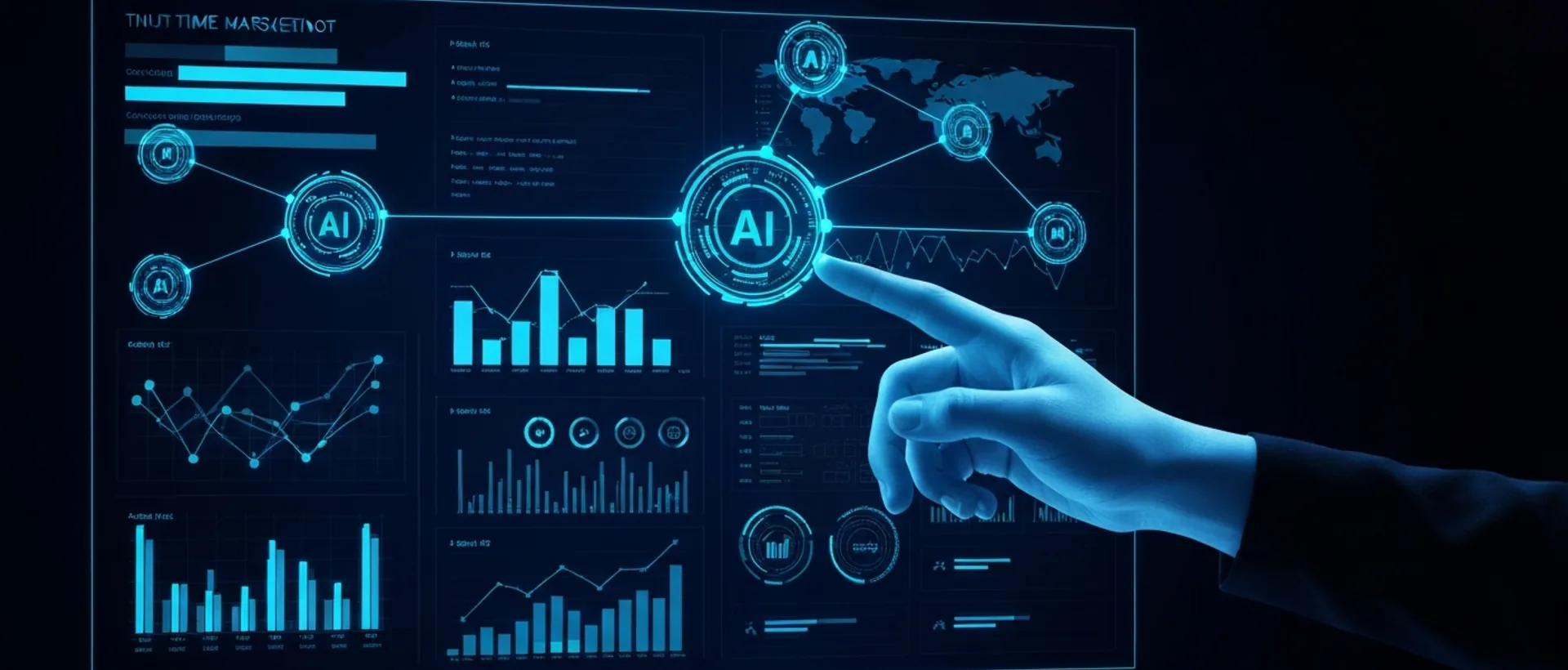
A AI Marketing Automation 2026 isn’t just a passing fad. It truly represents the evolution of the automation platforms we already knew, but now with cutting-edge artificial intelligence that optimizes processes, personalizes interactions, and even predicts what consumers will want, all at scale. Forget the idea of just programming basic tasks. Here, AI delves into complex data, makes decisions almost on its own, and learns non-stop, delivering marketing strategies that are more effective and, let’s face it, much smarter. Unlike traditional automation, which relies on fixed rules, AI in marketing adapts instantly, creating super personalized experiences and adjusting campaigns in real-time. This complete guide to marketing automation and artificial intelligence will show you how AI is revolutionizing marketing operations, from content creation to AI-powered campaign optimization. Understanding this partnership is essential for any company looking to gain a competitive edge, both now and in the future.
Crucial Benefits of Artificial Intelligence in Modern Marketing
Implementing AI today brings benefits of artificial intelligence in marketing that go far beyond just making things more efficient. The thing is, it directly impacts your revenue and customer satisfaction. Who wouldn’t want that, right? For me, the biggest trump card is AI-powered personalization at scale in marketing. We can send the right message, with the right offer, to each person, and that makes engagement and conversion rates skyrocket in ways we never imagined. In the past, I used to waste a lot of time manually segmenting audiences, and I never reached this level of precision.
AI-driven personalization is the most powerful competitive differentiator in 2026, transforming the customer experience at every touchpoint.
AI campaign optimization is another key point. It allows us to adjust everything in real-time, seeing what’s working and what’s not, and that way we allocate money much more intelligently, maximizing return on investment. And it doesn’t stop there. With AI marketing content automation, you can generate drafts, adapt texts for different audiences, and even create ad variations in record time. This frees up the team to think about real strategy, instead of getting stuck in repetitive operational tasks. To top it off, AI’s ability to analyze an absurd volume of data, quickly and accurately, gives us predictive insights that are pure gold. We can anticipate market trends and behaviors, like a crystal ball, but with data.
Best AI Marketing Automation Tools 2026 and How to Choose
The market for the best AI marketing automation tools 2026 is growing like weeds after rain, with solutions for every corner, from CRM to programmatic advertising platforms. But hey, don’t just go buying the first one you see. When choosing a tool, you need to think about its scalability – if it can handle the load when your company grows –, its ease of integration with your existing systems, and, of course, the depth of AI features it offers, such as natural language processing (NLP) and machine learning. It’s like buying a car: it’s no good if it’s pretty but doesn’t fit in your garage or take you where you need to go.
[!CALLOUT tipo=“dica”] Before falling in love with a top-of-the-line tool, make a clear list of what you really need AI to solve in your marketing. Start with the problem, not the solution.
Do you need AI for email marketing? Chatbots? Predictive analytics? Or is it more for AI marketing content automation? Each case is unique. Look for platforms that excel in AI campaign optimization and AI-powered personalization at scale in marketing. That way, the tool grows with your strategies, and you don’t have to change horses in the middle of the stream. There are options like Adobe Marketo Engage, Salesforce Marketing Cloud, and HubSpot, which already come with advanced AI features for optimization and personalization.
Speaking of tools that make a difference, Narratron (which we use here, I confess!) is an example of how AI can supercharge content creation. It helps generate drafts and adapt texts in a super natural way, saving precious time that used to go into repetitive tasks. It’s like having a super fast and efficient junior copywriter.
To enhance your personalization at scale strategy, platforms like HubSpot, for example, offer advanced AI modules for segmentation and customer journey automation. It’s worth taking a look and seeing which one best fits your budget and ambitions, but always with an eye on what it truly delivers in terms of AI, and not just the promise.
Implementing AI in Digital Marketing: A Step-by-Step Guide
Learning how to implement AI in digital marketing might seem like a daunting task, but with a clear strategic plan, it’s all good. The first step is always to define your objectives and identify which areas can benefit the most. There’s no point trying to bite off more than you can chew, right? Here, for example, we started by focusing on ad optimization and only later expanded. I almost fell flat on my face trying to do everything at once in the beginning.
Step 1: Assess your needs and existing data. Think: where can AI solve a real pain point? Do you have quality data to “train” these algorithms? Because without good data, AI turns into artificial “stupidity,” you know?
Step 2: Choose the right tools. Prioritize solutions that match your objectives and integrate well with your existing infrastructure. Integration is key to avoiding headaches later.
Step 3: Start small, test, and iterate. Implement AI in pilot projects. This serves to validate if it really works and to make the necessary adjustments before scaling it everywhere. It’s like making feijoada: you don’t throw everything in at once; you add the seasonings and taste as you go.
Step 4: Train your team. The success of AI heavily depends on the partnership between technology and human knowledge. Invest in training so your team knows how to operate and optimize the new tools. AI is a tool, not a substitute. If people don’t know how to use it, what’s the point?
AI Automation Strategies for Businesses: Practical Examples
AI automation strategies for businesses offer a huge range of possibilities, covering everything from attracting customers to making them loyal. A classic example, and one I think is really cool, is advanced audience segmentation. AI not only looks at demographic data but also behavior, purchase history, and creates such fine segments that AI-powered personalization at scale in marketing becomes ridiculously good. It’s like knowing exactly what your friend wants for a present even before they ask you.
Another example of AI marketing automation is predictive bid optimization in paid advertising campaigns. Here, AI doesn’t mess around. It adjusts bids in real-time for each ad, maximizing return on investment. I, who have spent hours and hours manually adjusting bids, think this is like magic.
AI-powered chatbots and virtual assistants offer 24/7 customer service. They answer frequently asked questions, qualify leads, and only call a human if things get tough. This is a huge help, both for the company and the customer. And the cherry on top, for me, is AI marketing content automation. It can generate variations of titles, descriptions, and even short articles. Imagine the time this saves and the guarantee that the content will be relevant for each platform. It’s fantastic!
Unveiling the Future of AI Marketing Automation in 2026 and Beyond
What’s the future of AI marketing automation? If I had a crystal ball, I’d say the projection for AI Marketing Automation 2026 and the years to come points to an even deeper and more autonomous integration of artificial intelligence into every corner of marketing. We’ll see hyper-personalized predictive marketing, where AI will not only suggest the next best action but will go ahead and execute it on its own. It’s like having an assistant who not only gives you the idea but also does the heavy lifting.
AI marketing automation trends for 2026 include the emergence of AI “marketing agents.” Think of a robot that manages entire campaigns, from the initial idea to results analysis, with minimal human intervention. I confess that gives me a bit of a chill, because we still need the human touch, creativity, but the potential is undeniable. AI will also be fundamental for us to navigate this increasingly complex sea of data, ensuring everything is within legal and ethical bounds, while also extracting valuable insights. It’s quite a challenge, but AI can be our compass.
Ultimately, the collaboration between AI and human creativity will intensify. AI will handle repetitive and analytical tasks, freeing us, marketing professionals, to focus on what really matters: strategy, innovation, and genuinely connecting the audience with the brand. My guess is that whoever doesn’t adapt to this partnership will be left behind, watching the “train” go by.
Automation vs. AI in Marketing: Understanding the Difference
Many people use “automation” and “AI” as if they were the same thing, but the difference between automation and AI in marketing is crucial for anyone who wants to create a truly effective strategy. And look, it’s a difference that makes all the difference.
Marketing automation, in itself, is about programming predefined tasks and workflows. Like, sending an email sequence after someone subscribes to your list, or scheduling social media posts. It’s a straightforward “if this, then that.” Simple, efficient, but limited.
Artificial Intelligence, on the other hand, is a whole other level. It gives machines the ability to learn, reason, “understand,” and act based on data, without us needing to program every scenario. It’s like an intern who learns on their own and starts making intelligent decisions, instead of just following a script.
AI, in fact, enhances automation, making it much smarter and more adaptable. For example, automation can send an email, but it’s AI that decides which email to send, to whom, and when is the best time, all based on predictive analytics. It’s like having a GPS that not only gives you the route but tells you which is the best route now, considering real-time traffic and even your mood (almost).
In 2026, the combination of automation and AI is the gold standard. Automation executes tasks, and AI optimizes and personalizes those executions. Whoever is still only using traditional automation is missing out on a huge opportunity.
| Characteristic | Traditional Automation | AI Automation |
|---|---|---|
| Decision Making | Based on predefined rules | Based on data, learning, and prediction |
| Adaptability | Low (fixed rules) | High (adapts in real-time) |
| Personalization | Basic segmentation | Hyper-personalization at scale |
| Analysis Scope | Limited to programmed data | Complex analysis of large volumes of data |
| Optimization | Manual or by rules | Continuous and autonomous |
That’s why AI Marketing Automation 2026 isn’t just a fancy term. It’s the smartest way to do marketing today and in the future, combining the efficiency of automation with the intelligence and adaptability of AI.
FAQ
How is AI changing digital marketing in 2026?
In 2026, AI is transforming digital marketing by enabling personalization at scale, predictive campaign optimization, and content automation. It analyzes large volumes of data to generate insights, make autonomous decisions, and create highly relevant customer experiences, surpassing the capabilities of traditional automation.
What are the main AI marketing automation trends for 2026?
The main trends for 2026 include hyper-personalized predictive marketing, the increasing use of AI agents to manage complete campaigns, and the intensification of AI content automation. AI will also be fundamental in navigating complex data ecosystems, ensuring ethics and compliance while maximizing data value.
What are the benefits of using AI in marketing automation?
The benefits include greater operational efficiency, improved campaign ROI, personalization at scale for each customer, and valuable predictive insights. AI allows for optimizing advertising spend, generating more qualified leads, and enhancing customer satisfaction through more relevant and timely interactions.
What is the difference between marketing automation and artificial intelligence in marketing?
Marketing automation involves programming predefined tasks and workflows, while artificial intelligence empowers machines to learn, reason, and make decisions based on data. AI enhances automation, making it smarter, more adaptable, and capable of personalizing actions in real-time, going beyond fixed rules.
How can small and medium-sized businesses implement AI in marketing in 2026?
Small and medium-sized businesses can start by defining clear objectives and identifying areas of greatest impact, such as email personalization or ad optimization. They should choose accessible and scalable AI tools, begin with pilot projects to test effectiveness, and train their teams to operate the new technologies, focusing on incremental gains.