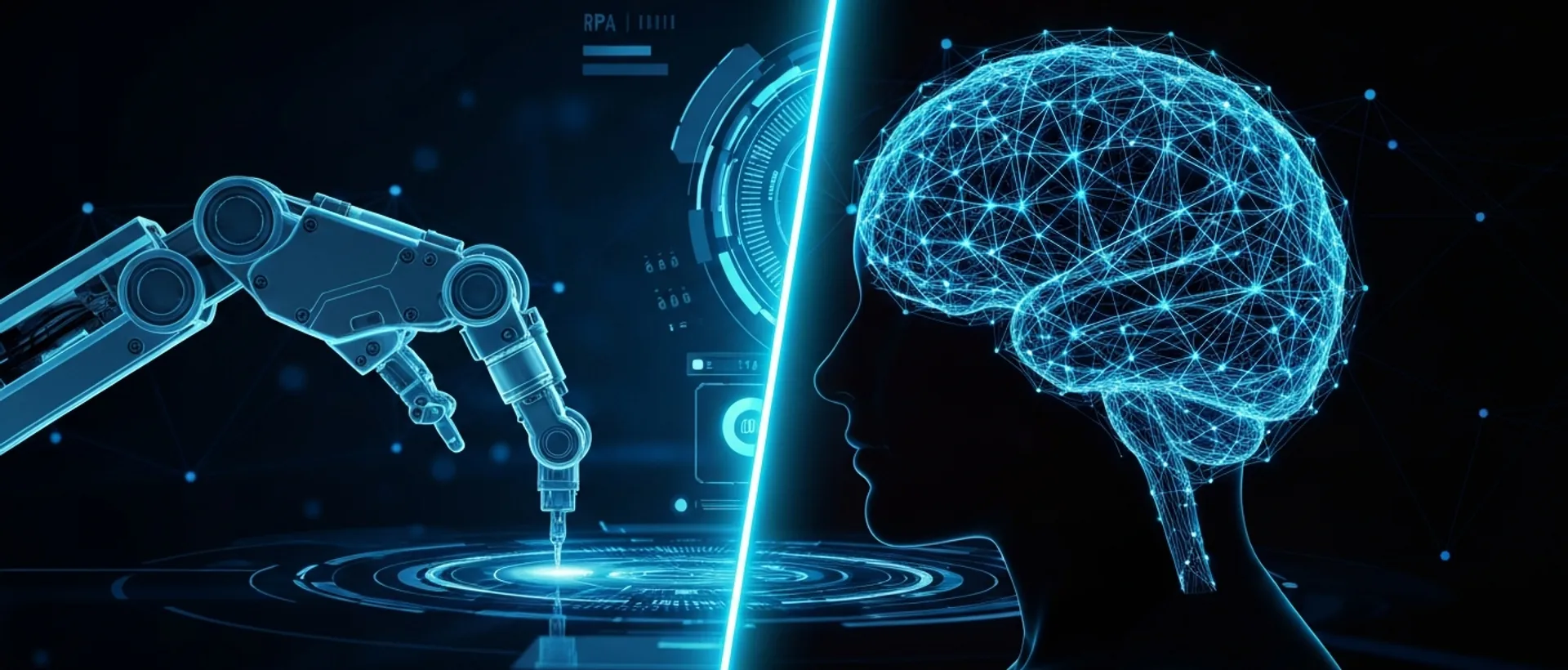
RPA and AI: Definitions and the Fundamental Difference in 2026
When we talk about automation and intelligence in the corporate world, the question always arises: what’s the RPA vs AI difference? To start, Robotic Process Automation, or RPA, is like that super efficient employee who does the same thing every day, without complaining. It mimics the way we interact with digital systems, clicking, typing, copying, and pasting to perform repetitive tasks. There’s no cognitive intelligence involved; it just follows the script you gave it.
Artificial Intelligence (AI), on the other hand, is a whole different ball game. It simulates the human brain. Think of an intern who, after a long time, learns on their own to solve problems, make decisions, and even predict things, even without you having taught them every step. AI learns from data, reasons, and can solve much more complex problems. In 2026, RPA is still the darling for making operations smooth, while AI is the engine of innovation, extracting insights from data for us to make better decisions. I honestly think some people out there confuse the two on purpose, just to sell “magic” solutions, right?
The main distinction is that RPA automates “how to do.” It follows a manual of instructions to the letter. AI, on the other hand, automates “what to think and decide,” transforming a bunch of raw data into useful information. Both aim to optimize but operate at different levels of complexity and autonomy. RPA is more tactical, focused on daily tasks. AI is more strategic, looking to the future. It’s like comparing a good bricklayer who follows the blueprint with an architect who designs the entire house. Both are important, but each in their own role.
Robotic Process Automation (RPA): Efficiency and Use Cases
RPA excels at taking structured and repetitive workflows and performing them autonomously, without errors. Think of tasks like typing data from a spreadsheet into a system, processing a stack of invoices, or even migrating information between legacy systems. It’s great for this because it doesn’t get tired, doesn’t make mistakes, and does it quickly. The benefits of RPA in 2026 are clear: less human error, increased speed in getting things done, and best of all, it frees up people to do work that truly matters, requiring creativity and reasoning.
Practical examples of RPA are everywhere. Imagine onboarding a new employee: the robot can fill out forms, create system accesses, and send welcome emails. Or in accounting, performing bank reconciliation super fast. Even in updating customer records in older systems, RPA shines. The truth is, I’ve seen many companies save a ton of money and get a super fast return on investment just by putting a robot to do the boring work. For me, anyone not yet using RPA for these things is wasting time and money, you know?
But it’s not all sunshine and roses. RPA’s limitations in 2026 are quite evident. It relies too heavily on fixed rules. If the process changes a little, or if an exception appears that wasn’t in the script, the robot freezes. And with unstructured data, like a free-text email, it gets lost. Someone needs to intervene. It’s like giving a strict script to a famous TV host and expecting him to follow it to the letter. He’ll follow it, but if someone shouts an unexpected line, he’ll be clueless. It’s good at what it does, but it doesn’t think outside the box.
Artificial Intelligence (AI): Innovation and Strategic Applications
Artificial intelligence in the 2026 business context is a vast field, full of possibilities. We see AI in chatbots that answer your questions, virtual assistants that organize your schedule, but it goes far beyond. It’s behind predictive analytics, which forecasts what will happen, image recognition in security cameras, and natural language processing, which understands what we say or write. It’s AI that allows companies to dive into mountains of data and extract pearls of information, like market trends or what consumers will want tomorrow.
Practical examples of AI are recommendation systems that suggest the next movie on Netflix or the product you “need” to buy. In finance, it detects fraud in transactions that a human would never catch. In logistics, AI optimizes the supply chain, ensuring the right product arrives at the right place, at the right time. AI doesn’t just execute; it reasons and analyzes, which is fundamental for strategic decisions. I confess that sometimes I find myself wondering if AI isn’t already smarter than many managers out there.
AI can transform how companies interact with their customers, optimize operations, and make strategic decisions, generating a significant competitive advantage in the 2026 market.
The advantages and disadvantages of RPA and AI show that AI requires a greater investment, both in quality data and infrastructure, and isn’t cheap. But in return, it offers scalability and adaptability that RPA doesn’t have. It learns and adjusts, which is a huge differentiator for scenarios that change all the time.
RPA vs AI: A Detailed Comparison for 2026
To definitively understand the RPA vs AI difference, we need to look at what each does, how much it costs, and what kind of problem it solves. Robotic Process Automation vs Artificial Intelligence shows that RPA is more accessible and faster to implement. If you have well-defined tasks with clear rules, RPA enters the field and solves it quickly. It’s like a soccer team that follows the coach’s tactics to the letter.
AI, while more complex and taking longer to show results, has the ability to learn and adapt. It’s perfect for dynamic scenarios where things change all the time and there’s no fixed script. It’s the player who improvises and decides the game at the last minute. The cool thing is that they complement each other: RPA can collect data and organize it neatly for AI to analyze, and AI can provide extra intelligence to RPA robots. For me, the biggest mistake is to think that one replaces the other. They are partners, man.
The choice between RPA or AI depends heavily on what your company needs. If it’s to solve a specific efficiency problem, with a well-designed process, go with RPA. If things get tough and you need analysis, prediction, and intelligent decisions, then AI is the way to go.
comparison_table:
| Feature | Robotic Process Automation (RPA) | Artificial Intelligence (AI) |
|---|---|---|
| Nature | Rule-based, replicative | Learning-based, cognitive |
| Complexity | Low to medium | High |
| Data Type | Structured | Structured and unstructured |
| Capability | Executes repetitive tasks | Thinks, learns, decides, predicts |
| Initial Cost | Lower | Higher |
| Implementation Time | Faster | Longer |
| ROI | Quick for specific tasks | Longer-term, strategic |
| Flexibility | Low (depends on rules) | High (learns and adapts) |
✓ Prós
- IA: Learns and adapts
- Handles exceptions
- Processes unstructured data
- Offers insights
- Strategic decision-making.
✗ Contras
- IA: Higher cost
- Greater complexity
- Requires more quality data
- Longer implementation time.
A briga RPA vs IA é coisa do passado! Em 2026, a pegada é como elas se unem pra fazer a mágica acontecer. Um é o braço, o outro é o cérebro. Juntos, a automação fica inteligente de verdade! #RPA #IA #AutomaçãoInteligente
— @blogueirotech no X
Complementarity and the Future of Automation with AI and RPA 2026
The true strength, the secret to success, lies in how RPA and AI complement each other. They are not competitors; they are a powerful team. Think of RPA as the “arms and legs” of automation. It executes, doing the heavy, repetitive work. AI, in turn, is the “brain,” providing intelligence, decision-making capability, and reasoning. Together, they form hyper-intelligent automation solutions that are much more powerful than each acting alone. It’s like a perfectly choreographed dance, where the orchestra’s harmony (AI) and the couple’s flair (RPA) make the show happen.
Combined RPA and AI use cases are truly impressive. Imagine customer service where a chatbot (AI) understands the customer’s question, analyzes the context, and if an action is needed in the system (like checking a statement or changing an address), it triggers an RPA robot to do it quickly. This is end-to-end automation. Another example is document analysis: AI extracts information from unstructured documents (like a PDF contract), and RPA takes that information and inputs it into the system.
The future of automation with AI and RPA in 2026 points to unified platforms. Instead of having separate systems, we will see tools that orchestrate both technologies, creating a continuous and intelligent workflow. This synergy allows for the automation of processes that we previously thought were too complex, that only a human could do. And to be honest, I’m really looking forward to seeing what else will emerge from this combination.
Choosing Between RPA and AI: Strategies for Your Company in 2026
To decide whether to choose RPA or AI, the first thing is to write down everything your company does. Map out processes, identify tasks that can be automated. It’s like cleaning the house before inviting guests over. If the process is repetitive, with clear rules and a large volume, start with RPA. It will give you quick gains and a solid automation foundation. It’s the famous “low hanging fruit.”
After mastering RPA, start integrating AI. Use it to handle complexity, to analyze data, and to make decisions in areas where RPA can no longer cope. Don’t try to do everything at once. Go step by step. Consider the cost-benefit and implementation time. RPA, for simple automations, usually has a faster return. AI requires more robust planning and a larger investment, but the potential for transformation is enormous.
And a crucial detail: invest in your team. Adopting these technologies isn’t just about installing software. It requires new skills, a change in company culture. If the team doesn’t buy into the idea, it won’t work out. It’s like buying a Ferrari and not having a driver’s license.
FAQ
What is the main difference between RPA and AI?
The main difference is that RPA automates repetitive, rule-based tasks, mimicking human interaction with systems. AI, on the other hand, simulates human intelligence to learn, reason, and make decisions in complex scenarios.
When should I use RPA instead of AI?
You should use RPA to automate well-defined, structured, and repetitive processes, such as data entry or invoice processing. It is ideal for achieving quick efficiency gains in tasks with clear rules and no need for advanced reasoning.
How can RPA and AI complement each other?
RPA and AI complement each other by allowing RPA to perform operational tasks and collect data, while AI analyzes that data to make smarter decisions. For example, an RPA robot can collect information that an AI algorithm uses to predict trends or optimize processes.
What are the benefits of AI for companies in 2026?
In 2026, AI offers benefits such as advanced predictive analytics, personalization of customer experiences, fraud detection, optimization of operations, and automation of strategic decision-making. It drives innovation and competitiveness.
Is it possible to use RPA and AI together in a project?
Yes, it is highly recommended and increasingly common to use RPA and AI together in a project. This combination, known as intelligent automation or hyperautomation, allows for end-to-end process automation, from executing routine tasks to making complex data-driven decisions, showcasing the real RPA vs AI difference as complementarity.
Ready to scale this idea?
Narratron turns topics like this into retention-optimized YouTube scripts in under 2 minutes — magnetic hook, structure, complete SEO, timestamped description and thumbnail prompt ready to ship. 50 free credits, no card required.