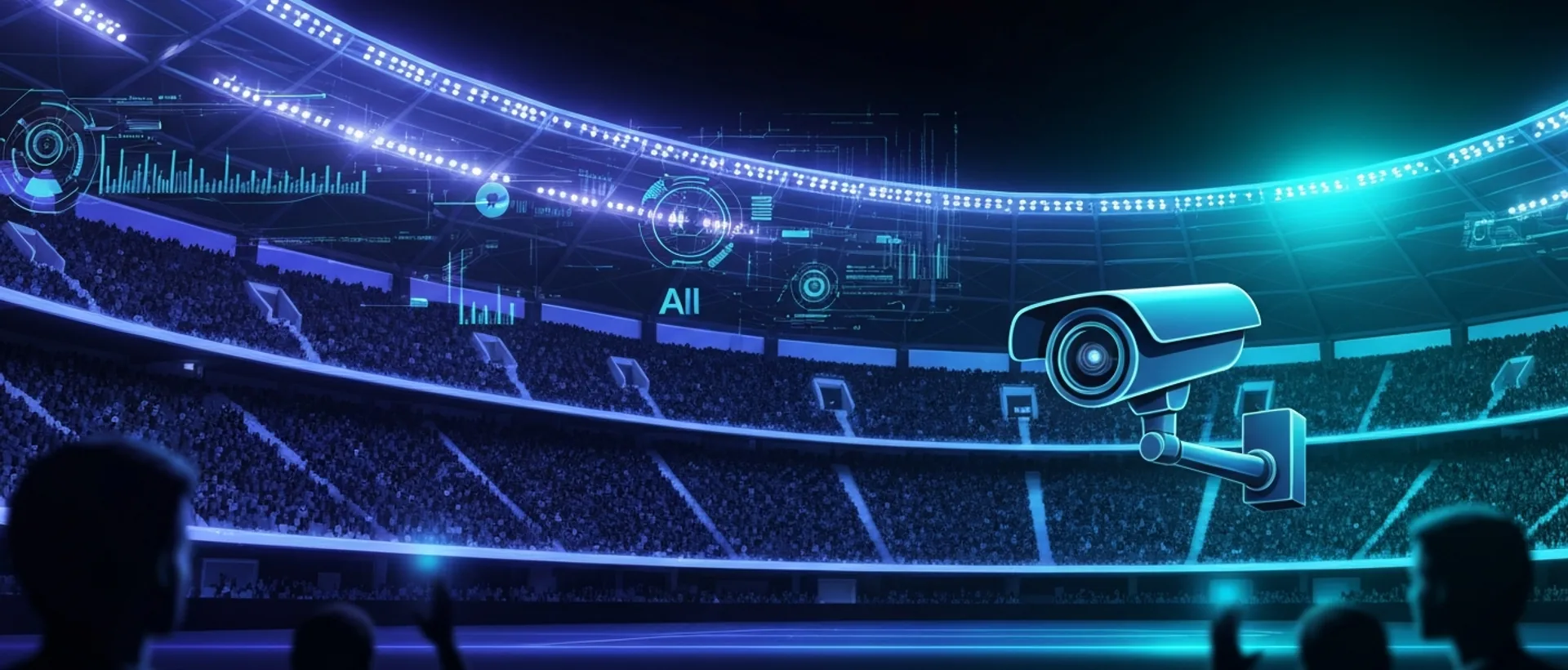
AI in Event Security 2026: An Illusion of Control
The word on the street is that Artificial Intelligence will solve all security headaches at major events by 2026, like the World Cup. The promise is that AI, with its ability to detect anomalies and model threats, will automate responses faster than any human [splashtop.com]. Honestly? This smells like an illusion of control to me, an overly optimistic narrative for a technology that, let’s face it, is still in its infancy in many aspects.
When people talk about AI in public security, we immediately think of super-cameras and magical algorithms. But the truth is, behind the buzz, there’s a tangled mess of data and algorithms that aren’t foolproof. Smart AI surveillance in stadiums, for example, looks great on paper, but human adaptability and the unpredictability of real events always tie the most “intelligent” algorithms in knots. My friend, Brazilians are too creative to fit into a code box.
The benefits are trumpeted, of course. But the challenges, like algorithmic biases and technological over-reliance, are conveniently swept aside. AI might alert us, but the final decision and the action itself still depend on us, mere mortals. And that’s where the “promised perfection” crumbles. I’ve seen so many tech projects that seemed like the future and just turned into another white elephant, that I’m always a bit skeptical.
Yeah, my friend, more than half of the companies using AI for security don’t trust it. Think about it: that’s not just a statistic, it’s proof that things are more “try it and see what happens” than “definitive solution.” If even those who invest heavily don’t trust it, why should we? It’s like buying a car that the salesperson says is great, but they themselves only take the bus. Something’s off there, right?
AI Technologies: More Hype than Concrete Solution for Crowds
We hear about AI technologies for crowd control, like sensors and flow analysis, as if they were infallible. But the complexity of mass human behavior, especially at an event with thousands of people, challenges any algorithm. Try to predict the reaction of a crowd on a decisive game day, or the people who gather to watch a free show on the street. It’s like trying to predict the weather in São Paulo: impossible!
AI’s predictive analysis tries to anticipate threats, but history shows that unforeseen events are the rule, not the exception. AI still miserably fails to predict the so-called “black swan.” One example that bothers me is the increase in incidents related to deepfakes and misuse of AI [broadcast.com.br]. The 2026 International AI Security Report already indicates that while AI’s capabilities improve rapidly, these abuses also grow [estadao.com.br]. In other words, the tool that should protect also becomes a weapon. It’s the famous double-edged sword, only sharper.
Facial recognition, however advanced, still stumbles on lighting conditions, angles, and most importantly, privacy issues. This creates more problems than solutions. And mind you, we’re talking about a country that has already discussed creating its own model to regulate AI, criticizing the excessive influence of European models that might not fit our reality [globo.com]. It’s like trying to wear a foreigner’s shoe that doesn’t fit our foot, you know?
AI solutions for mass security often generate “false positives,” diverting resources and attention from real threats. Information overload, often irrelevant, can be a greater risk than the benefit. I wonder: are we trading security for privacy, as people from UNESCO and IASEAI have already warned, speaking of “warning signs” from AI systems, including unwanted autonomy and psychological risks [hubdodesenvolvedor.com.br]? It’s a dilemma that keeps me up at night. And this discussion about data security and people’s image is something we’ve already covered in AI Facial Recognition 2026: Challenges and Future, it’s worth checking out.
The Raw Reality: AI Challenges and Failures in 2026
Cybersecurity at sports events with AI is an Achilles’ heel. While AI promises to protect, it also opens new doors for attacks, making events more vulnerable to hackers and sabotage. It’s a paradox, isn’t it? We want security, but the tool that offers it can also be our ruin. It’s like locking the front door and forgetting the window open.
Excessive reliance on AI can lead to human complacency. If we blindly trust the machine, our instinctive and critical response capacity in an emergency can diminish. Just imagine: a security guard who, instead of acting, waits for the green light from the AI system. In the real world, a second can make all the difference. And the worst part is that 52% of organizations don’t trust their own AI-based security controls to detect compromises [proofpoint.com]. It’s like buying a guard dog but not trusting it to bark. It’s infuriating.
The lack of regulation and the ethics of AI in security are urgent issues that are often ignored in the name of “efficiency.” This paves the way for abuses and catastrophic errors. It’s a good thing Brazil is moving. By 2026, we already had regulations for AI use, including rules for elections that prohibit deepfakes and require labeling of AI-generated content [r7.com]. The Chamber of Deputies even approved Bill 2,688/2025, which creates the Regulatory Framework for the Development and Use of Artificial Intelligence in Brazil, focusing on rights, duties, principles, and governance [camara.leg.br]. This is progress, but implementation and oversight are a whole different ball game.
And speaking of deepfakes, if you want to understand more about how to protect yourself, take a look at AI Voice Fraud 2026: Understanding Security Against Scams. It’s a serious topic that affects all of us.
Trust in AI is a paradox: we want its benefits, but we fear its failures. True security emerges from the collaboration between humans and machines, not from the replacement of one by the other.
Beyond the Hype: Where AI Really Matters (and Where It Fails)
Let’s be frank, AI in event security isn’t the silver bullet that will solve everything. Its true value lies in supporting decisions, not in making autonomous decisions in complex and chaotic scenarios. It’s a tool, not a superhero. It’s like having a GPS: it helps you get to your destination, but it doesn’t drive the car for you. If the GPS tells you to enter a dead-end street, you have to be smart enough to question it.
Instead of seeking “perfect surveillance,” we should focus on how AI can improve communication and coordination among human security teams. It’s humans who, ultimately, are the strongest link. The machine can analyze real-time data, but empathy, moral judgment, and the ability to improvise are ours. AI governance becomes crucial for companies, which need to establish clear policies for the safe and responsible use of artificial intelligence [migalhas.com.br], [masterfy.ai]. Without it, it’s a lawless land.
The challenges of AI in event security are many: from integrating different systems to ensuring that collected data is not misused. We need a more active stance from political leaders and companies, as discussed at the Unesco and IASEAI conference [hubdodesenvolvedor.com.br]. We can’t just stick to the discourse that AI is the future. The future is already here, and it demands responsibility.
If we’re not careful, AI, which has everything to be a powerful ally, can turn into an even bigger problem. That’s why it’s important to understand the “warning signs” and not get caught up in the hype without questioning. After all, event security is too serious to be left solely in the hands of algorithms. And if you’re still full of doubts about AI security, it might be good to read AI Security 2026: Urgent Challenges and Important Protection, which we’ve already broken down here.
Sources
- https://www.splashtop.com/pt/blog/top-cybersecurity-trends-and-predictions-for-2026 — Top Cybersecurity Trends and Predictions for 2026 ↩
- https://www.proofpoint.com/br/resources/threat-reports/ai-human-risk-landscape-report — AI Human Risk Landscape Report ↩
- https://www.broadcast.com.br/pr-newswire/relatorio-internacional-de-seguranca-da-ia-de-2026-aponta-mudancas-rapidas-e-riscos-emergentes/ — International AI Security Report 2026 points to rapid changes and emerging risks ↩
- https://bluestudio.estadao.com.br/agencia-de-comunicacao/prnewswire/relatorio-internacional-de-seguranca-da-ia-de-2026-aponta-mudancas-rapidas-e-riscos-emergentes/ — International AI Security Report 2026 points to rapid changes and emerging risks ↩
- https://blog.hubdodesenvolvedor.com.br/etica-e-inteligencia-artificial-desafios-para-2026/ — Ethics and Artificial Intelligence: Challenges for 2026 ↩
- https://g1.globo.com/rj/rio-de-janeiro/noticia/2026/06/10/web-summit-especialistas-defendem-que-brasil-crie-modelo-proprio-para-regular-ia-e-criticam-texto-em-discussao-no-congresso.ghtml — Web Summit: Experts advocate for Brazil to create its own model to regulate AI and criticize text under discussion in Congress ↩
- https://noticias.r7.com/prisma/inteligencia-cotidiana/brasil-avanca-na-criacao-de-regras-para-o-uso-de-inteligencia-artificial-04052026/ — Brazil advances in creating rules for the use of artificial intelligence ↩
- https://www2.camara.leg.br/atividade-legislativa/comissoes/comissoes-permanentes/ccom/noticias/comissao-aprova-criacao-do-marco-regulatorio-da-inteligencia-artificial-no-brasil — Committee approves creation of Regulatory Framework for Artificial Intelligence in Brazil ↩
- https://www.migalhas.com.br/depeso/460481/marco-legal-da-ia-empresas-devem-fortalecer-sua-governanca — AI Legal Framework: companies must strengthen their governance ↩
- https://masterfy.ai/artigo/governanca-e-seguranca-os-novos-pilares-da-ia-em-2026 — Governance and Security: The New Pillars of AI in 2026 ↩
Ready to scale this idea?
Narratron turns topics like this into retention-optimized YouTube scripts in under 2 minutes — magnetic hook, structure, complete SEO, timestamped description and thumbnail prompt ready to ship. 50 free credits, no card required.