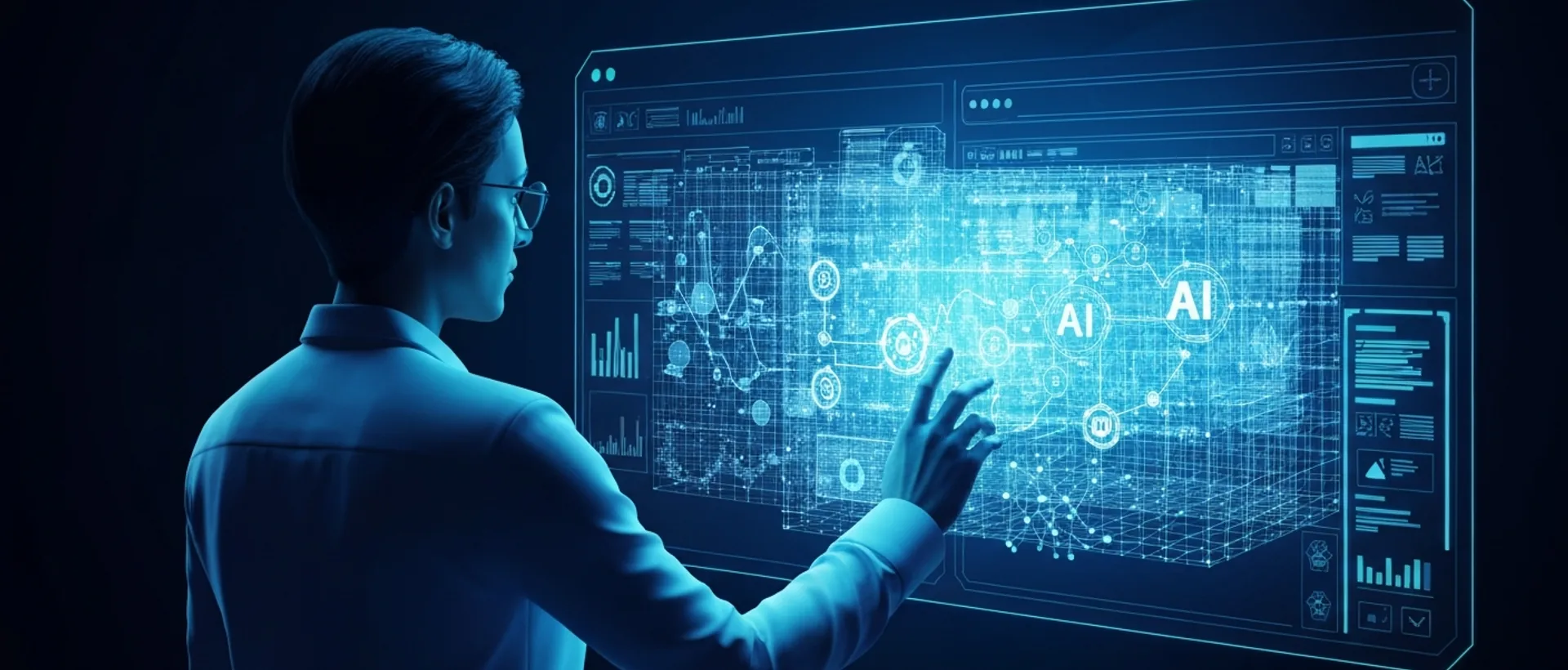
How AI Will Transform Website Creation in 2026
In 2026, creating websites with AI won’t be science fiction, but a reality for anyone seeking a place in the digital world. Artificial intelligence for website design will allow us to build highly personalized and efficient online experiences, automating much of the work. More advanced AI tools will help with generating layouts, writing texts, optimizing for SEO, and, get this, even developing immersive 3D interfaces. For me, the coolest part is that AI not only speeds up development but will also democratize access to quality website creation, even for those who know nothing about code or design.
The ability of these AIs to analyze real-time data and adapt the design to capture user attention will be a huge competitive advantage. Think about it, your site adjusting itself to generate more money and attract more people? It’s like having a team of experts working 24/7. This will change the game for many, from small entrepreneurs to large companies. Honestly, whoever doesn’t jump on this bandwagon will be left behind, like a Beetle in Formula 1. This in-depth guide will explore the trends, tools, and strategies for us to create AI websites 2026 that are, truly, out of the box.
The Role of AI in 3D Web Design and Development
When we talk about 2026, AI will be key in 3D web development with AI, allowing the creation of complex and interactive virtual environments in a way that currently seems like magic. The AI 3D content generator will become a standard tool for designers. Just imagine: the machine doing the modeling, texturing, and animation of objects and scenes while you sip your coffee? This will save many hours of manual work, which used to be hell for anyone.
AI 3D creation platforms will integrate algorithms that transform a simple text description into ready-made and rendered 3D models. Sounds like something out of a movie, right? But it will be real. This opens up a world of possibilities for immersive online experiences, from virtual stores with fitting rooms that let you “try on” clothes before buying, to interactive portfolios that look like art galleries and browser-based games. And the best part: the optimization of these 3D assets for the web, ensuring everything loads quickly and runs smoothly, will also be boosted by AI. No more excuses about “heavy websites.”
How to Create a Website with Artificial Intelligence: A Practical Guide
To start creating a website with artificial intelligence, the first step is to choose the right platform. By 2026, we will already have some very mature options, like the super evolved Wix ADI, Durable, and other new solutions emerging. My tip is: research and see which one best fits your budget and your idea. Then, you need to be very clear about what you want. Define your objectives: what is the purpose of the site? Who is the target audience? What kind of content do you want? What functionalities are essential? The more details you give the AI, the better the result. It’s like ordering a pizza: if you don’t list the ingredients, you might get anything, right?
After feeding the AI with this information, it will generate a draft. This includes layout, color palette, and even text and image suggestions. Don’t expect perfection right away, okay? The magic happens in personalization. Review what the AI did, adjust the details, swap a photo here, a text there. Use AI tools to refine SEO, improve user experience, and ensure accessibility. Finally, launch your site and don’t stop there. Use AI to monitor performance, see what’s working and what’s not. It can suggest continuous improvements, ensuring your site is always on point. It’s a learning cycle, and AI is your best teacher.
Comparison: Best AI Tools for Website Creation in 2026
The big question of which is the best AI to create websites in 2026 doesn’t have a single answer, I’m sorry to disappoint you. The truth is, it will depend heavily on what you need. Ease of use? Extreme customization? 3D capability? Or perhaps impeccable SEO optimization? Each tool has its strong point, and it’s good to keep an eye on them.
comparison_table:
| Tool | Main Focus | Highlighted AI Features | Ideal For |
|---|---|---|---|
| Wix ADI (Evolved) | Fast creation, intuitive design | Layout generation, textual content, image optimization | Small businesses, portfolios, blogs |
| Durable AI (Advanced) | Complete automation, integrated marketing | Website generation in seconds, AI for marketing, CRM | Entrepreneurs, startups |
| Spline AI (for 3D) | 3D web design, immersive experiences | AI 3D content generator, automatic animations, real-time rendering | 3D designers, creative agencies |
| Webflow AI (Personalization) | Total flexibility, clean code | Component suggestions, code assistant, performance optimization | Developers, experienced designers |
Each of these platforms brings a different package of AI benefits in web development, from automating tedious and repetitive tasks to creating complex visual elements that were previously only possible with an army of designers. It’s also important to consider integration with other tools you already use and whether the solution is scalable. There’s no point choosing a cool tool that won’t meet your needs a year from now, right? AI trends for digital content 2026 show that modularity and personalization capabilities will be crucial aspects.
Benefits of AI in Web Development and SEO Optimization
AI in 2026 brings a development speed that is jaw-dropping. Just think: websites being created and launched in a fraction of the time we used to take. It’s like having a rocket to build a doghouse. SEO optimization for AI-generated websites is almost intrinsic, did you know? The algorithms are born analyzing keywords, structuring content in a way that Google loves, and automatically suggesting improvements. It’s a relief for those who live with the paranoia of ranking well.
Another point that makes me super excited is mass personalization. With AI, your site can adapt content and design for different types of audiences in real-time. It’s as if each visitor had a tailor-made website for them. This not only improves the experience but greatly increases conversion chances. And of course, the reduction in operational and design costs is striking, as AI automates tasks that previously required a lot of people. Not to mention the continuous improvement of user experience (UX) through the analysis of navigation data and predictive layout adjustments. It’s a virtuous cycle of improvement.
Trends and the Future of Website Creation with AI in 2026
The future of website creation with AI points to even more intuitive interfaces, where we will be able to interact with the tool using only voice or natural language. No more clicks and complex menus; the idea is that we can “talk” to the AI and it understands what we want. AI for immersive online experiences will deepen in an absurd way, with the integration of augmented reality (AR) and virtual reality (VR) directly into browsers. Imagine being able to “enter” a site, walk through it, and interact with objects as if you were there? It’s almost a personal metaverse.
Generative AI will expand the horizon, creating not only layouts but all multimedia content. We’re talking about videos, music, and even personalized illustrations for your site, all generated by the machine. Like having a private band and video producer. And cybersecurity? It will also be reinforced by AI, with systems that predict and neutralize threats even before they become a problem. It’s like having a ninja security guard for your site.
Challenges and Ethical Considerations in AI Website Creation
Although everything seems like a bed of roses, we need to be realistic. One of my biggest concerns is that an over-reliance on AI could lead to a homogenization of design. If everyone uses the same tools and the same AI “patterns,” the risk is that websites will start to look all the same, without that “soul” and originality that a human touch brings. It’s like going to a June festival where everyone is dressed in traditional country attire, but without the creativity of grandma’s patches.
It’s crucial that we ensure algorithm transparency and avoid biases in content and design generation. We don’t want AI to perpetuate stereotypes or inadvertently exclude groups of people, right? User data privacy becomes even more relevant, because AI will collect and process a lot of information to personalize the experience. We need to ensure that this data is secure. And finally, we cannot forget that AI is a tool. It does not replace human creativity and critical thinking. Digital accessibility must also be a priority: AI-generated websites need to meet all standards to be usable by people with disabilities.
Advanced Strategies to Maximize Your AI-Generated Website
To get the most out of your AI-generated website, you need to go beyond the basics. An advanced strategy is to integrate AI for predictive analysis of user behavior. This means that AI not only sees what the user did but predicts what they will do. With this information, you can optimize the navigation flow and calls to action in real-time. It’s like having a fortune teller who tells you where to put the “buy now” button for it to work best.
Use AI tools for automated A/B testing. Instead of testing one version at a time, AI can run several variations of design and content simultaneously, quickly identifying what generates more engagement and conversion. This is an absurd time-saver!
[!CALLOUT tipo=“dica”] Keep an eye on Google’s Core Web Vitals metrics. AI should optimize your site’s performance for these standards, ensuring it’s fast and responsive, which directly impacts your SEO.
Explore AI for dynamic content personalization. Think of a site that presents specific offers and information to each visitor, based on their browsing history and preferences. It’s VIP service that scales.
Speaking of content, we can’t ignore the importance of well-crafted texts. Narratron uses AI to generate high-quality product descriptions, blog posts, and even video scripts, optimizing your SEO and saving precious time in content creation. It’s worth checking out.
Conclusion: The Future of Web Creation is Driven by AI
In 2026, creating websites with AI will not just be an advantage, but a necessity for anyone who wants to remain relevant and efficient in the digital world. Artificial intelligence for website design is paving the way for faster, smarter, and, what’s better, highly personalized web development. I’d say it’s the biggest leap web development has seen in decades, perhaps since the internet became “a thing for everyone.”
AI democratizes website creation, intrinsically optimizes SEO, and opens new frontiers for immersive 3D experiences, but requires human oversight and ethical considerations to avoid becoming a soulless mess.
By embracing the tools and trends we’ve discussed here, you’ll be more than prepared to build the next generation of successful websites. AI-powered 3D web development and immersive online experiences are just the beginning of an era of continuous innovation. Who would’ve thought we’d get to this point, right? The future is knocking, and it’s made of bits, pixels, and a lot of artificial intelligence.
FAQ
Which is the best AI for creating websites in 2026?
The ‘best’ AI for creating AI websites 2026 will depend on your specific needs. Platforms like Wix ADI and Durable AI are excellent for speed and general automation, while tools like Spline AI excel in creating immersive 3D content. The ideal choice aligns with your design and functionality goals.
Can artificial intelligence create complete 3D websites?
Yes, by 2026, artificial intelligence for website design can create complete 3D websites. Advanced AI 3D content generator tools and AI 3D creation platforms allow transforming descriptions into 3D models, animating them, and integrating them into immersive online experiences. This significantly speeds up the development of complex virtual environments.
How does AI automatically optimize website SEO?
AI automatically optimizes website SEO by analyzing keywords, content structure, metadata, and technical performance. It suggests improvements for ranking, generates relevant content, and ensures the site is fast and responsive. This results in more efficient and continuous SEO optimization for AI-generated websites.
What are the benefits of using AI in web development?
The benefits of AI in web development include unparalleled creation speed, cost reduction, advanced user experience personalization, and automatic SEO optimization. AI also enables the creation of immersive online experiences and facilitates AI-powered 3D web development, making the process more accessible and efficient.
Do AI trends for digital content 2026 include anything beyond websites?
Yes, AI trends for digital content 2026 go far beyond website creation. They include automatic generation of videos, music, social media texts, personalization of marketing campaigns, and the creation of interactive digital avatars. AI is becoming an omnipresent tool in the production of all types of digital content.
Ready to scale this idea?
Narratron turns topics like this into retention-optimized YouTube scripts in under 2 minutes — magnetic hook, structure, complete SEO, timestamped description and thumbnail prompt ready to ship. 50 free credits, no card required.