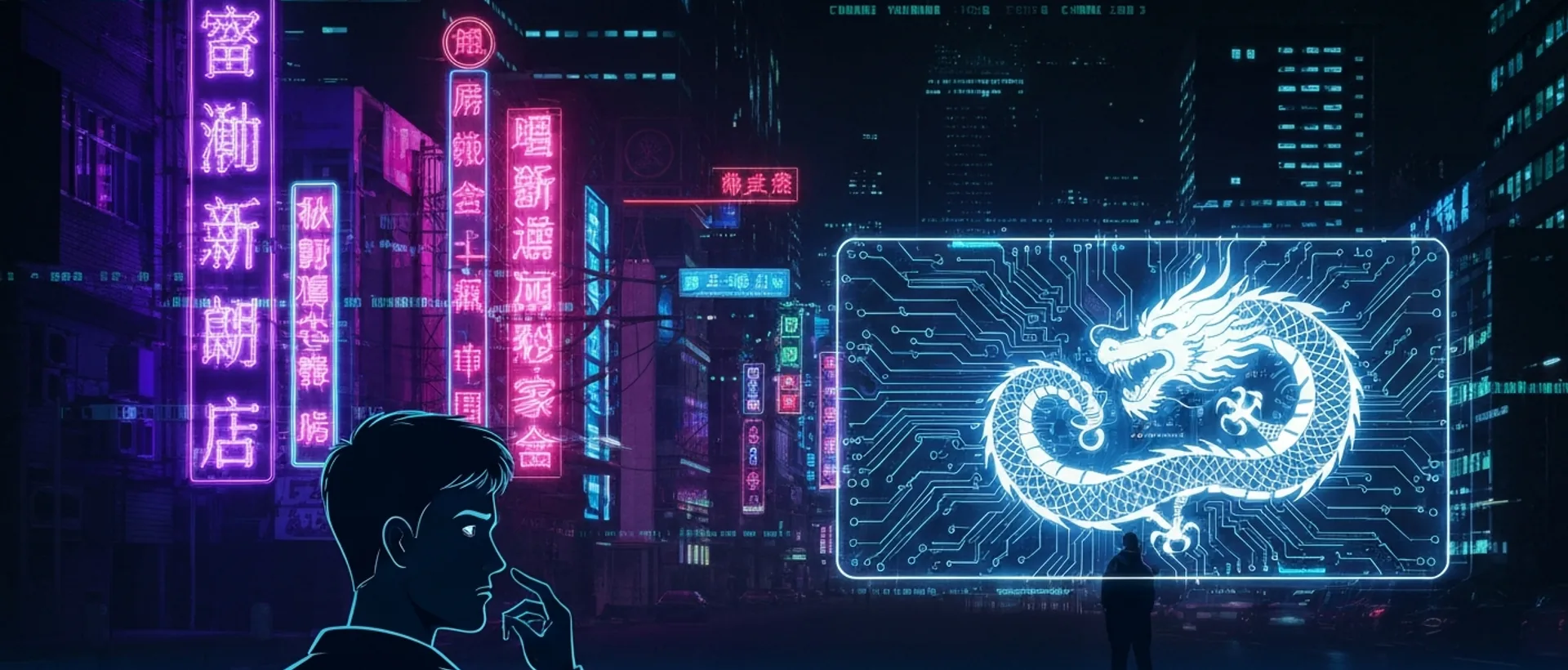
What Does Chinese AI Really Mean in 2026?
Let’s be honest, folks: we talk so much about Chinese AI that it seems like the dragon has already dominated the board, right? But the truth is, in 2026, the story is much more complex than a Hollywood apocalyptic movie script. It’s not just about having the fastest algorithm or the most powerful chip; it’s about a worldview, control, and, yes, a lot of money. While we in the West are still discussing whether AI will steal our jobs or if ChatGPT has a soul, China is in a relentless race, with an approach that mixes pragmatism and centralization that scares many people out there.
Since April 2026, the buzz about China’s AI industry has only grown, with a focus on open-source models, advancements in chips, and, of course, the government’s heavy-handed industrial policy educatronica.org. It’s no secret that Chinese AI models already have a global impact that cannot be ignored, especially in areas like surveillance and facial recognition. But, hey, this “total domination” narrative is a bit dangerous. It ignores fragilities, internal challenges, and even the famous competition with the US. It’s not a straight line to supremacy; there are some curves and potholes along the way.
The real question we should be asking ourselves is not whether China will have the “best” AI – which, by the way, is a very subjective concept – but rather how this AI, which is intrinsically linked to the State, will shape international relations and, most importantly, individual freedom globally. It’s a chess game on a planetary scale, and AI is the most powerful piece on the board. Ignoring AI development in China is, without a doubt, a colossal mistake. It’s like trying to cover the sun with a sieve. But, and here’s my two cents, overestimating it as invincible is also too naive, you know? This disregards the fierce competition that exists, the regulatory barriers, and even the technological limits they still face. Nobody’s a superhero, not even China.
Think about it: in June 2026, we saw Alibaba’s shares plummet due to concerns about China’s ambitious AI plans advfn.com. That’s a big deal. The idea that the Chinese government wants to expand computational capacity could lead to fierce competition among private cloud providers like Alibaba, Tencent, and Baidu, and that, my friend, could drive prices down across the entire tech sector advfn.com. Investors, who are no fools, reacted immediately, selling shares of these giants. The main concern? Oversupply in the cloud and AI market. So, who wins? Who loses? We need a deeper analysis than a simple “China will dominate everything.” To better understand this complexity, check out what we’ve already discussed about AI in China 2026: Advances Shaping the Global Future.
Security and Risks: The False Sense of Protection Against Chinese AI
Ah, the eternal question: “How do we protect ourselves from Chinese AI?”. To be very direct, this idea of protection is, for the most part, an illusion, a lie we tell ourselves to feel safer. China’s AI security in 2026 is not a firewall you install or an antivirus you download. It’s a challenge that mixes geopolitics, infrastructure, economics, and, frankly, a touch of Western naivety. You can’t just “turn off” China from the rest of the world, no matter how much some politicians out there dream of it.
The risks of Chinese AI go far beyond the old story of corporate espionage, which, by the way, still happens a lot. We’re talking about something that infiltrates critical infrastructure, manipulates mass data, and forms state-controlled information bubbles. Think about it: if their AI is behind energy systems, transportation, or even social networks you use, the influence goes far beyond stealing an electric car design. It’s about controlling narratives, influencing opinions, and, ultimately, destabilizing societies. And this is not a conspiracy theory; this is what 2026 looks like.
Chinese AI companies, like Baidu, Alibaba, and Tencent, are already so embedded in global supply chains that trying to separate them would incur a devastating economic cost. It’s like trying to remove an essential ingredient from an already baked cake; the cake simply crumbles. Their technology is in everything, from the cell phones you use to the servers that host your data. And who cares about open source in this fight? Many people, of course! But the reality is that Chinese open source has a different flavor. If you want to know more about this, we’ve already discussed China AI Open Source 2026: Ambition or Reality?
And AI regulation in China? It’s a double-edged sword, my friend. On the one hand, it imposes certain restrictions and directions that could, in theory, ensure a certain level of control. On the other hand, and here lies the danger, it consolidates the government’s power over the development and application of these emerging technologies. In other words, the State not only sets the rules of the game but is also the main player and the referee. This concentration of power is what should really make us wary. It’s not about whether the technology is good or bad, but about who holds the control and for what purpose. It’s like giving a Swiss army knife to a gardener or a surgeon: the tool is the same, but the intention and use change everything.
The ‘Best’ Chinese AIs 2026 and the Reality of Global Competition
When we talk about the ‘best’ Chinese AIs in 2026, the first thing that comes to mind is: “best for whom and for what?”. We need to be extremely cautious with these labels. Yes, China has made remarkable advancements in areas like natural language processing and computer vision. They have a gigantic database and heavy investment; that’s undeniable. But the originality of many of these innovations is sometimes questionable. A lot of it is an adaptation or optimization of what already exists, with a Chinese touch of large-scale application. Not that this is bad, but it’s not necessarily the same as inventing the wheel, you know?
The competition between US and Chinese AI, which we hear so much about, is not a pure technological race. Far from it. It’s more about different philosophies of development and application. The West, with the US leading, tends to focus on open innovation, fundamental research, and creating tools that can be adapted by many. China, with its more centralized model, focuses on large-scale application, massive data collection, and integrating these technologies to solve specific problems (and often state-controlled ones). It’s as if one side wants to build a toolbox and the other wants to build an entire factory using existing tools. Both are important, but with distinct purposes.
AI trends in China for 2026 point to an intensification in the use of AI to optimize manufacturing and logistics. That’s no surprise, right? They want to consolidate their position as the “factory of the world,” but now with “artificial brains” behind every step. It’s Industry 4.0 turbocharged, with algorithms deciding where, when, and how to produce. This can mean cheaper and more efficient products, but it also raises the question of global dependence on a single source for these intelligent systems. So, whoever controls the factory, controls the world?
Ethics in Chinese AI is a malleable concept, adapted to the needs of the State, which generates products and services that, in Western democracies, would be considered unacceptable, but are extremely efficient in their context. And no, I’m not talking about a casual data leak, but something much deeper.
And ethics in Chinese AI? Ah, that’s a ready-made joke, but a bad one. It’s a concept that bends and adapts to the needs of the State. What we see there are products and services that, in Western democracies, would be considered a brutal violation of privacy and individual rights. But there, in their context, they are efficient tools for social control and governance. It’s AI serving a specific political model, and that makes all the difference. We can’t judge it with our lenses, but we can understand the impact it has on the rest of the planet.
The Future of Chinese AI: Less Domination, More Interdependence (and Surveillance)
Look, if you’re expecting a future where Chinese AI simply “dominates” the world in a dramatic takeover, I hate to disappoint you. The reality of 2026 is much more boring and complex: it’s an interdependence where China becomes an indispensable supplier of technology, data, and infrastructure. But, as always, with a hidden cost. It’s not an invasion; it’s a strategic infiltration. They won’t force you to use their AI; they’ll make you need it. It’s the bread and butter strategy: basic, essential, and nobody lives without it.
The narrative that China is “stealing” AI leadership is overly simplistic, not to mention lazy. They are not stealing; they are building a parallel ecosystem. A giant, robust ecosystem that integrates into the global one in ways many prefer to ignore, whether for convenience or sheer lack of vision. It’s as if we were at a party, and China set up another party next door, with its own music, food, and guests, but which, in some way, influences ours. And the worst part: we keep buying their beer.
And the Chinese government? Oh, they’re not playing games. They have ambitious plans to expand computational capacity, a move that could intensify the competition among private cloud providers and put pressure on prices across the entire sector educatronica.org. This isn’t just about having more servers; it’s about having the infrastructure to run gigantic AI models, train new algorithms, and process data on a scale we can’t even imagine. And if prices fall, who benefits? Global consumers, of course. But what about the business sustainability for those developing it? It’s the old “free lunch” story that always has a price. To stay updated, it’s also worth checking out what we’ve already discussed about Discover: China AI Open Source 2026: Inevitable Domination?
The real threat, for me, is not that Chinese AI is inherently superior. It’s not that they are geniuses we can’t catch up to. The issue is their willingness to use this technology on a scale and for purposes that the West is still debating whether they are ethical, acceptable, or even desirable. While we discuss the moral dilemmas of a chatbot, they are using AI to monitor 1.4 billion people. It’s a difference in scale and values that we cannot underestimate. Interdependence is real, but it comes with a dark side of surveillance and control that we need to keep an eye on. It’s like that relative who helps you, but then wants to know your every move.
Ultimately, Chinese AI in 2026 is not a monster coming from the East to devour us. It’s a complex, multifaceted force that is redefining the technological and geopolitical game. And we, as Brazilian tech creators and entrepreneurs, need to truly understand this, without sensationalism and without naivety. Because, like it or not, the future of our technology and our market will be influenced by this dance of dragons and eagles. And we need to be ready to dance along, or at least not drop the ball.
Sources
- https://educatronica.org/2026/04/12/industria-inteligencia-artificial-china-2026/ — Artificial Intelligence Industry in China in 2026: Open Source Models, Chips, and Industrial Policy ↩
- https://br.advfn.com/jornal/2026/06/alibaba-baba-queda-acoes-investimento-ia-china — Alibaba (BABA) shares fall due to concerns about China’s AI plans ↩
Ready to scale this idea?
Narratron turns topics like this into retention-optimized YouTube scripts in under 2 minutes — magnetic hook, structure, complete SEO, timestamped description and thumbnail prompt ready to ship. 50 free credits, no card required.