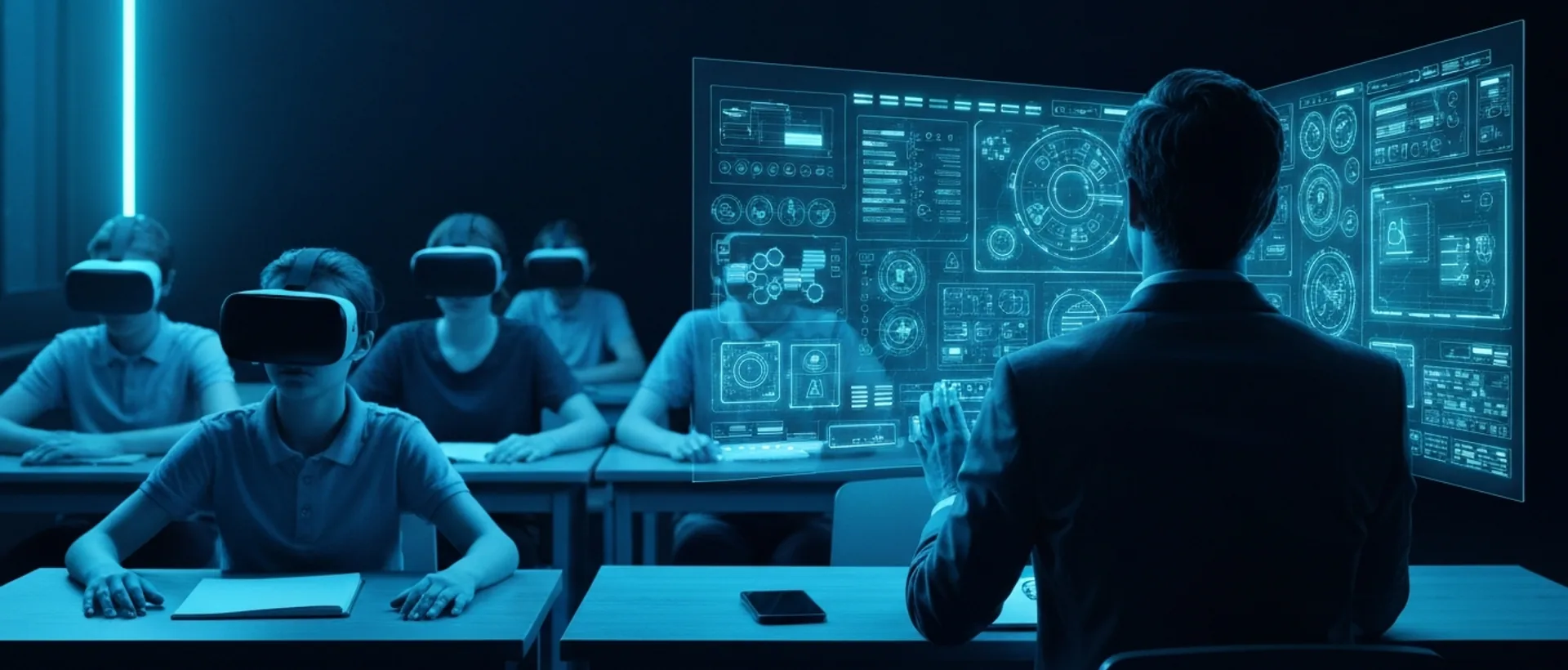
AI in Education 2026: The Raw, Ignored Reality
Everyone loves to say that AI in Education 2026 will be the salvation, right? That it will solve all school problems, personalize teaching, and turn our children into little geniuses. Utter nonsense. In 2026, artificial intelligence won’t be the panacea they promise, but a complex tool that will expose the structural flaws of our system. It focuses more on efficiency than on true pedagogy, and that’s a danger.
The impact of artificial intelligence in schools will be very different from what most people dream of. Get ready to see an even greater division: on one side, elite schools, with infrastructure and well-trained teachers; on the other, the vast majority who will be left behind, struggling with generic solutions. AI tools for teachers 2026 promise personalization, but the truth is that many of them will only automate repetitive tasks. Grading multiple-choice tests? A breeze for AI. Understanding why a student is unmotivated? That’s another story, and the machine doesn’t have that sensitivity.
The future of education with artificial intelligence is not a bed of roses, as they paint it to be. It’s a minefield of ethical and privacy issues that we are severely underestimating. Don’t expect a total revolution. Expect an incremental and, often, painful evolution, where the challenges of AI in the classroom may end up outweighing the initial benefits. It’s the kind of thing you only realize when push comes to shove.
The Teacher’s Role in the Age of AI: More Than a Machine Operator
So, what’s the role of the teacher in the age of AI? If you think it’s just going to be a “content curator,” you’re mistaken. That kind of talk comes from someone who doesn’t understand the complexity of the classroom. A true teacher will be a mentor, someone who guides critical thinking, stimulates creativity, and teaches how to question. That, my friend, the machine doesn’t do yet. It can give you a thousand pieces of information, but it doesn’t teach you how to think about them, how to have an “insight.”
Personalizing education with AI is a myth if there isn’t a teacher behind it, with a deep pedagogical understanding. The machine doesn’t replace human sensitivity, eye contact, the ability to perceive when a student needs a push or a hug. It’s like wanting a robot to cook feijão tropeiro just like your grandmother’s. It might follow the recipe, but it won’t have the same flavor.
Examples of applied AI in education often fail to highlight that the tool is just a means, not the end. Human interaction remains irreplaceable. I keep thinking about the teachers who, poor things, have already seen a thousand reforms. Now, they’ll have to learn to operate yet another technology without proper support. You can see the confusion from a mile away, right?
“AI in the classroom is a double-edged sword. Without adequate training and a human focus, it will only automate what we already do wrong.”
The Myths of AI in Education: Challenging the Optimistic Narrative
The narrative that AI “transforms learning” is simplistic and, to be honest, a bit lazy. It can even optimize some aspects, such as content delivery or exercise correction. But true transformation comes from innovative pedagogical methodologies, inspired teachers, and an environment that values error as part of the process. It’s not technology itself that works magic. It’s us.
The benefits of AI in education are frequently exaggerated, and that deeply annoys me. Nobody talks about the implementation cost, which is extremely high for most schools. Nobody talks about the need for continuous training for teachers, who are already overburdened. And nobody talks about the cultural resistance, from both educators and parents, which is natural in any drastic change. It’s like selling an electric car without mentioning the battery price or the lack of charging stations.
Artificial intelligence in elementary education raises serious ethical concerns about artificial intelligence in schools, especially regarding the collection of children’s data. Are we going to hand over our children’s childhoods to algorithms that, many times, we don’t even fully understand? And what about the development of social skills? Learning to negotiate, to share, to make friends isn’t learned with a chatbot. AI education trends 2026 point towards greater market segmentation, with solutions focused on specific niches, instead of that “universal solution” many expect. It’s a cold shower for those who dream of AI solving everything.
The Inconvenient Future: Ethics and Real Challenges of AI
The ethics of artificial intelligence in schools will be the main battleground in the coming years. Get ready for heated debates about algorithmic biases – yes, AI is as prejudiced as the data that feeds it. We will discuss student privacy, learning autonomy, and the risk of standardizing young minds. Do we really want AI to decide what’s best for each child, based on data, or for the teacher to continue having that role?
The challenges of AI in the classroom are much more mundane and urgent than we think. To start, technological infrastructure is inadequate in many regions of Brazil. How am I going to use AI if the internet keeps going down? And the lack of teacher training, which I’ve already mentioned, is a major problem. Finally, parental resistance, who fear the “dehumanization” of education, is real and needs to be heard. It’s not just fear of the new; it’s the legitimate concern of those who want the best for their children.
For AI in Education 2026 to have any chance of being good, we need to focus on the basics:
- Invest in infrastructure: Quality internet for everyone.
- Train teachers: Not just on how to press buttons, but on how to integrate AI into pedagogy.
- Ethical debate: Create clear rules about data, biases, and the role of AI.
- Keep humans at the center: AI is a tool, not a substitute for the teacher or social interaction.
If we don’t do this, the so-called AI in Education 2026 will be just another technological promise that didn’t deliver what it should have, and the fault won’t be the machine’s. It will be ours.