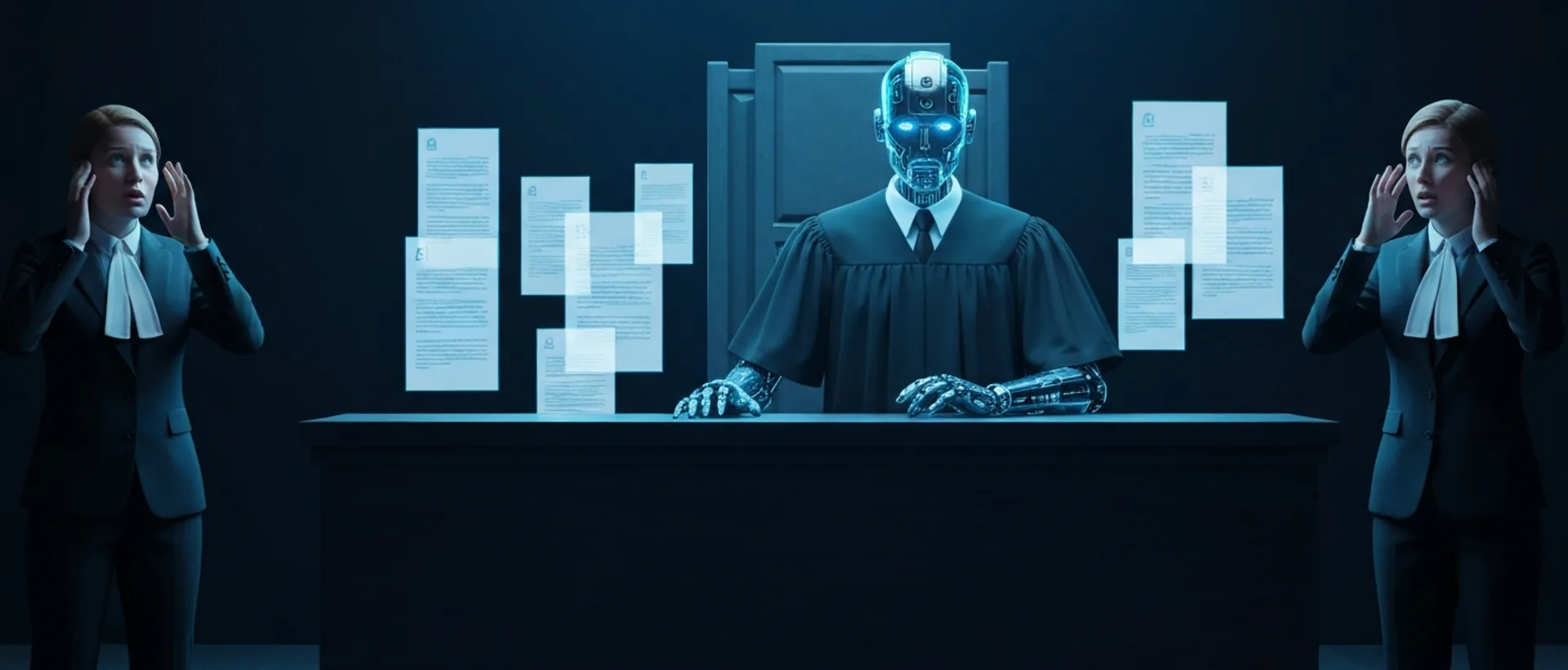
AI Has Already Surpassed Lawyers in 2026 – Wake Up!
Look, if you still believe that artificial intelligence won’t take the place of “human minds” in Law, I hate to break it to you, but you’re living in a bubble in 2026. This idea is a dangerous illusion. The truth is that AI in Law 2026 isn’t a distant promise; it’s already here, and smarter than many professionals I know.
A lot of people still think AI only “assists.” Pure nonsense. Serious studies, like the Stanford AI and Law study, have already shown that AI outperforms junior lawyers in accuracy and speed when analyzing documents. It doesn’t just help; it does the boring, repetitive work much better. While the legal crowd discusses ethics (which is important, of course), AI is redefining legal practice. And whoever insists on “paper and pen” will be left behind, sucking their thumb.
Think it’s an exaggeration? Ask anyone who has used a good AI tool for jurisprudential research. The difference is brutal.
Why AI is Better Than Law Professors (and Many Lawyers)
Here we’re treading on eggshells, but let’s be frank: artificial intelligence surpasses lawyers in many aspects because it doesn’t have human flaws. It has no prejudice, doesn’t get tired, doesn’t have an inflated ego that hinders judgment. Ever seen a Law professor who thinks they’re the best and won’t admit being wrong? Well, AI doesn’t have that problem.
Tools for AI for jurists 2026 access and process absurd amounts of jurisprudence and doctrine in seconds. Like, you blink, and it’s already read more than a human would read in a month. This is impossible for any person. It identifies patterns and precedents that even experienced lawyers might overlook, providing game-changing insights in complex litigation.
The impact of AI on the legal profession isn’t a future threat. It’s the present knocking on the door with a stick. And the question “can AI replace lawyers?” already has an answer: yes, if you’re stubborn enough not to learn how to use it.
Advogados que ignoram a IA em 2026 estão assinando sua própria irrelevância. Não é sobre substituir, é sobre dominar as ferramentas que já dominam o mercado. #DireitoIA #FuturoJuridico
— @JuristaTechFuturo no X
[!GIF] mind blown explosion
Challenges of AI for Brazilian Law: Ignorance and Resistance
The challenges of AI for Brazilian Law are less about the technology itself and more about our old habit of resisting the new. It’s impressive how much resistance there still is to adopting new tools. The excuse is always the same: “the human touch is irreplaceable.” Oh, please! Give me a break. What’s irreplaceable is the capacity to think, not to copy and paste.
While we’re busy complaining, firms abroad are already using AI to gain a competitive advantage, analyzing cases and predicting outcomes with frightening accuracy. The lack of investment in training and technological infrastructure here in Brazil is creating a huge gap in the national legal market. It’s like trying to win a Formula 1 race with a Beetle.
A IA não vai tirar seu emprego. Um advogado que usa IA vai. Simples assim. O futuro do Direito com inteligência artificial 2026 é para os adaptáveis. #LegalTech #AdvocaciaDoFuturo
— @FuturoJuridicoIA no Threads
The advantages of AI in the legal sector are obvious to those who want to see: efficiency, precision, and cost reduction. Whoever denies this, honestly, is asking to lose. And the worst part is they’ll drag their clients down with them.
The Inevitable Future: Adapt or Be Forgotten
The advances of AI in the legal field won’t stop. In AI in Law 2026, we’re just scratching the surface of what’s possible. Tools like predictive litigation analysis, contract automation, and virtual assistants are already the standard in firms that want to be ahead. It’s no longer a differentiator; it’s the minimum.
The discussion isn’t whether AI will change Law, but who will lead this change and who will be dragged along by it. Instead of fearing that artificial intelligence surpasses lawyers, it’s time to understand how AI affects lawyers and use it to your advantage. It’s an opportunity, not a curse.
AI is not a tool; it’s a new ecosystem. Whoever doesn’t learn to breathe in this ecosystem simply won’t survive in Law in 2026.
The Stanford AI and Law study was a warning. Ignorance will no longer be an excuse. If you don’t act now, the future of Law with artificial intelligence 2026 will run you over without mercy. Better start studying, right?
[!GIF] typing fast computer