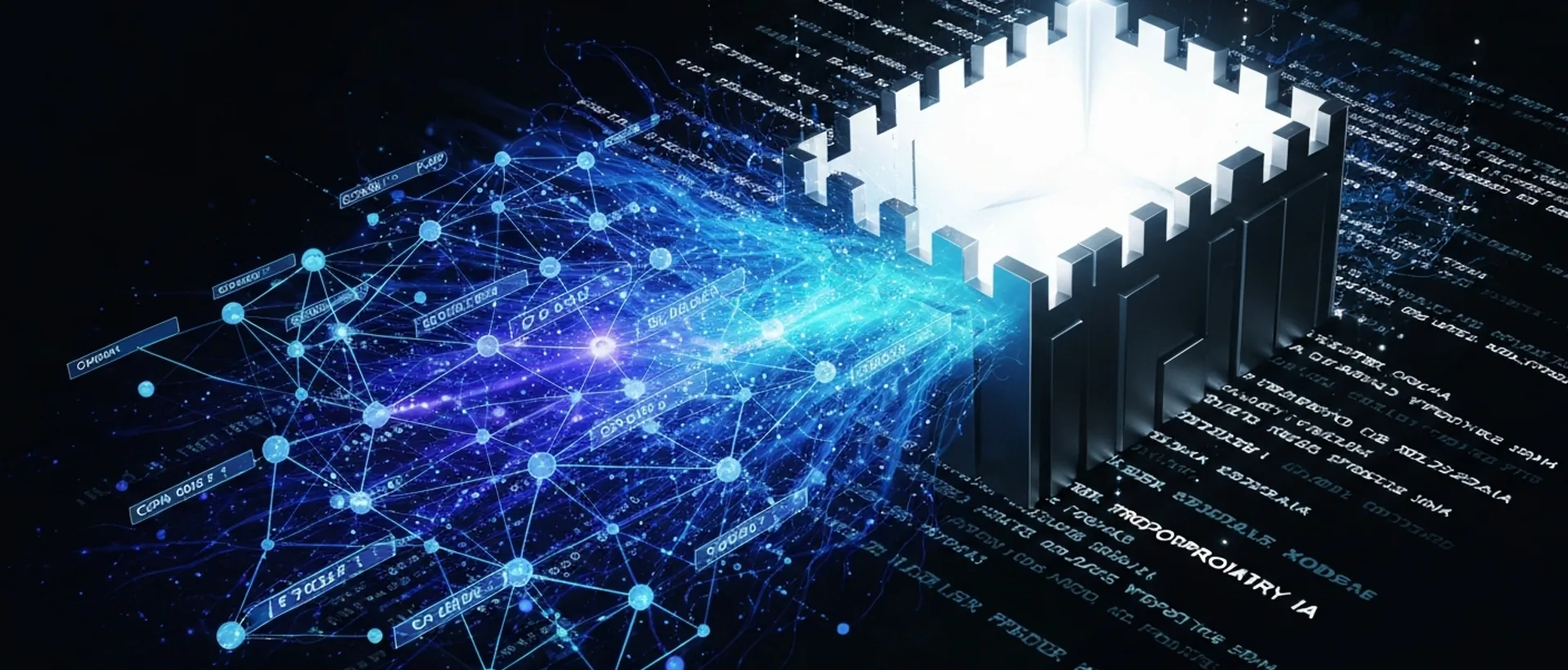
The main difference between open source and proprietary AI in 2026 lies in access to and control over the source code. Open source AI offers full transparency, allowing developers and companies to examine, alter, and share the code without restrictions. This fosters collaborative innovation that is very much in the Brazilian spirit, where we always find a way to improve what already exists. Proprietary AI, on the other hand, keeps its code secret, with its use and access controlled by very specific licenses from the company that developed it. This essential distinction affects a lot of things, such as price, customization possibilities, security, and even the ecosystem of developers and support providers.
The right choice for 2026 will heavily depend on what each organization prioritizes, the resources it has, and its concern for data privacy. For me, this “closed code” story is kind of asking to be left in the dark; we want to know what’s really going on, right? It’s like when we buy a car and can’t open the hood to see the engine. It creates a sense of insecurity, even if the salesperson says everything is fine.
This fundamental difference between open source and proprietary AI in 2026 directly impacts aspects such as cost, customization, security, and the available development and support ecosystem. The truth is, sometimes we feel a bit naive blindly trusting a solution that doesn’t show its face.
What Distinguishes Open Source from Proprietary AI in 2026?
In 2026, the main distinction between open source and proprietary AI lies in the accessibility and control over the underlying source code. Open source AI offers full transparency, allowing developers and companies to inspect, modify, and distribute the code freely, fostering collaborative innovation. It’s like a community potluck, where everyone brings an ingredient and the recipe gets better because many minds help season it. This openness creates an environment of continuous improvement, where bugs are quickly found and fixed by the community.
Proprietary AI, on the other hand, keeps its source code confidential, with access and use controlled by restrictive licenses from the developing company. Here, the recipe is a family secret, and you only eat what you’re given, without complaining. This fundamental difference directly impacts aspects such as cost, customization, security, and the available development and support ecosystem. In my experience, the folks involved with open source tend to be more engaged, more “good people” to solve problems together.
The ideal choice in 2026 will depend on each organization’s strategic priorities, resources, and specific data privacy requirements. I confess that, at the beginning of my career, I thought the “free” aspect of open source was always a trick. But, over time, I saw that the freedom and power to tinker with the code are a treasure, especially when it comes to something as complex as AI. Who doesn’t like to have control in their hands?
Detailed Analysis: Advantages and Disadvantages of Each Approach
Delving deeper, the choice between open source vs. closed source artificial intelligence in 2026 is quite a dilemma. The advantages of open source AI are quite attractive: the initial cost is almost zero, the flexibility for customization is enormous, and transparency greatly aids security, as the community reviews the code constantly. It’s like a programmers’ collective effort, everyone keeping an eye out, ensuring nothing is hidden. Additionally, there’s a giant ecosystem of tools and support; you can find help for everything.
However, it’s not all roses. The disadvantages of open source AI include the need for a knowledgeable technical team to implement and maintain the solution. The responsibility for security also falls on your lap, and the lack of centralized support can be a headache, especially if you’re used to a customer service that solves everything. It’s like building a house with friends: it’s cheaper and done your way, but if the wall falls, it’s your fault.
Proprietary AI, on the other hand, has its aces up its sleeve. Advantages include dedicated technical support, documentation that is usually very comprehensive and easy to understand, and ease of use, as most function as a service. They ensure everything is compliant with regulations, which is a relief for many people. But the disadvantages are steep: the cost is much higher, with licenses and subscriptions that hit the wallet hard. Customization is more limited, and you become dependent on a single vendor, without much room for maneuver. The opacity about how the algorithm works also bothers me; it’s like having a car where you can’t even know how the engine works. The decision between open source vs. closed source artificial intelligence in 2026 is a balance between freedom and convenience, with significant implications for long-term strategy.
The eternal balance between freedom and convenience.
What’s the Best AI for Businesses in 2026: An Analytical Perspective
So, what’s the best AI for businesses in 2026? The answer is: it depends. There’s no one-size-fits-all solution, and anyone who says otherwise is kidding. The choice heavily depends on the company’s sector, its size, and the objectives it aims to achieve. Companies with a strong R&D department that require extensive customization can benefit greatly from the advantages of open source AI, leveraging the freedom to innovate. It’s paradise for those who like to get their hands dirty and create something unique, without the constraints of vendors.
Organizations that prefer ready-made solutions, with robust support and little need for customization, may lean towards proprietary AI. After all, what is proprietary AI? It’s a “plug and play” solution, perfect for those who don’t have the time or expertise to develop something from scratch. Open source AI security has improved significantly, with the community conducting rigorous audits. But, in the end, the responsibility for keeping everything secure still rests with your team. It’s good to be clear about that.
It’s important to consider the cost of proprietary vs. open source AI not just for licenses, but also for operational expenses, maintenance, and the expertise each model requires. Once, I saw a company spend a fortune on proprietary licenses only to later discover they had no one to properly use the tool. It ended up being more expensive than buying a private jet to go to the bakery. So, cheap can be expensive, and expensive can be unnecessary.
When comparing open source and proprietary AI, don’t just look at the license price. Also consider implementation costs, maintenance, team training, and the need for internal specialists. The TCO can completely change your perception.
Detailed Comparison: Open Source vs. Proprietary AI (2026)
To make things easier, I’ve prepared a detailed comparison of open source vs. proprietary AI in 2026. We need to see things clearly, without the fluff that some salespeople love. Note how open source AI data privacy can be managed with much more internal control, whereas with proprietary, you’re at the mercy of the vendor. I, personally, don’t trust leaving my most intimate data in the hands of third parties without being able to snoop on what they’re doing with it.
| Feature | Open Source AI | Proprietary AI |
|---|---|---|
| Source Code | Accessible, Modifiable | Closed, Restricted |
| Initial Cost | Generally low/zero | Generally high (licenses) |
| Customization | High, Flexible | Low/Medium, Limited |
| Support | Community, Third-party | Direct from Vendor |
| Security | Community Audit | Vendor Guarantee |
| Innovation | Rapid, Collaborative | Controlled by Vendor |
| Privacy | Total Internal Control | Depends on Vendor |
| Examples | TensorFlow, PyTorch | OpenAI GPT, Google AI Platform |
The following pro_con_list offers a quick overview of the strengths and weaknesses, aiding in decision-making. It’s like a tie-breaker so you don’t get lost.
✓ Prós
- Cost-effective
- adaptability
- transparency
- active community.
✗ Contras
- Requires technical expertise
- security responsibility
- decentralized support.
✓ Prós
- Professional support
- ease of use
- guaranteed compliance
- optimized models.
✗ Contras
- High cost
- vendor dependence
- less flexibility
- black box.
It’s really cool to see how the open source community comes together to solve problems. There was a time I had an annoying bug in a project, and within hours, the folks on the forum had already given me the solution. That’s priceless; not all paid support is that efficient.
How to Choose the Ideal AI Solution for Your Strategy in 2026
To choose between open source and proprietary AI, the first thing is to look in your company’s mirror. What are your business requirements? What’s the available budget? Does your team have people with technical AI knowledge or will you need to hire? And, most importantly, what are your long-term goals? There’s no point in dreaming of becoming a unicorn if the foundation isn’t ready.
Consider the nature of the data your AI will process. If you deal with sensitive information, such as health or financial data, open source AI data privacy can be a decisive factor. Having total control over where your data is and how it’s processed is a relief. I, for example, feel safer when I know I can audit the code that handles my information.
Analyze open source AI examples, such as TensorFlow or PyTorch, and compare them with proprietary offerings. See which one best fits your functionality needs. Sometimes, the open source solution already does everything you need, and spending more would be throwing money away. Think about the future: AI trends for 2026 point to a mix of both approaches, where open source components can be used for customization and proprietary solutions for scale and support. This hybridization might be the smartest path.
To help you get a more complete picture, check out this video that explores the topic well:
It’s good to see what the folks on the front lines are saying. After all, you can never have too much knowledge, right?
Trends and the Future of Artificial Intelligence in 2026
AI trends for 2026 indicate that both the open source ecosystem and proprietary platforms will continue to grow, but with a new development: more collaboration and compatibility between them. The future of open source artificial intelligence looks very promising, driven by community innovation and the demand for greater transparency and control. It’s the community showing that you can do incredible things without needing a boss dictating everything.
Proprietary AI, on the other hand, will continue to dominate markets that require ready-to-use solutions and strong corporate support, especially in heavily regulated sectors. Think of banks or hospitals, where bureaucracy rules and compliance is everything. In these cases, the guarantee of a large vendor is a weight off your shoulders.
There will be a greater focus on AI ethics and understanding how models make decisions, the famous explainability. Both sides, open source and proprietary, will have to figure out how to address these issues in different ways. My bet is that hybridization, mixing the best of both worlds, will become the norm for many companies. They will use open source components for customization and proprietary solutions for scale and more robust support. And it’s in this scenario that open source and proprietary AI in 2026 will truly solidify, showing that you can have the best of both worlds.
FAQ
What is the main difference between open source and proprietary AI?
The main difference lies in access to the source code. Open source AI allows free access, modification, and distribution of the code, while proprietary AI keeps the code confidential and under the control of the developing company, with usage governed by licenses.
What are the advantages of using open source AI in 2026?
In 2026, the advantages of open source AI include reduced initial cost, high flexibility for customization, greater transparency and security through community review, and a vast ecosystem of collaborative tools and support.
When should a company choose proprietary AI instead of open source?
A company should choose proprietary AI when it prioritizes dedicated technical support, ease of use with ready-made solutions, comprehensive documentation, and compliance assurance. It’s ideal for those seeking less maintenance effort and limited internal AI expertise.
Is open source AI security reliable in 2026?
Yes, open source AI security has evolved significantly in 2026, with many communities conducting rigorous audits and quick fixes. However, the ultimate responsibility for secure implementation and maintenance rests with the security team of the company using it.
What are some popular examples of open source AI in 2026?
In 2026, some of the most popular examples of open source AI include TensorFlow and PyTorch for machine learning and deep learning, Hugging Face Transformers for natural language processing, and scikit-learn for more general machine learning tasks.