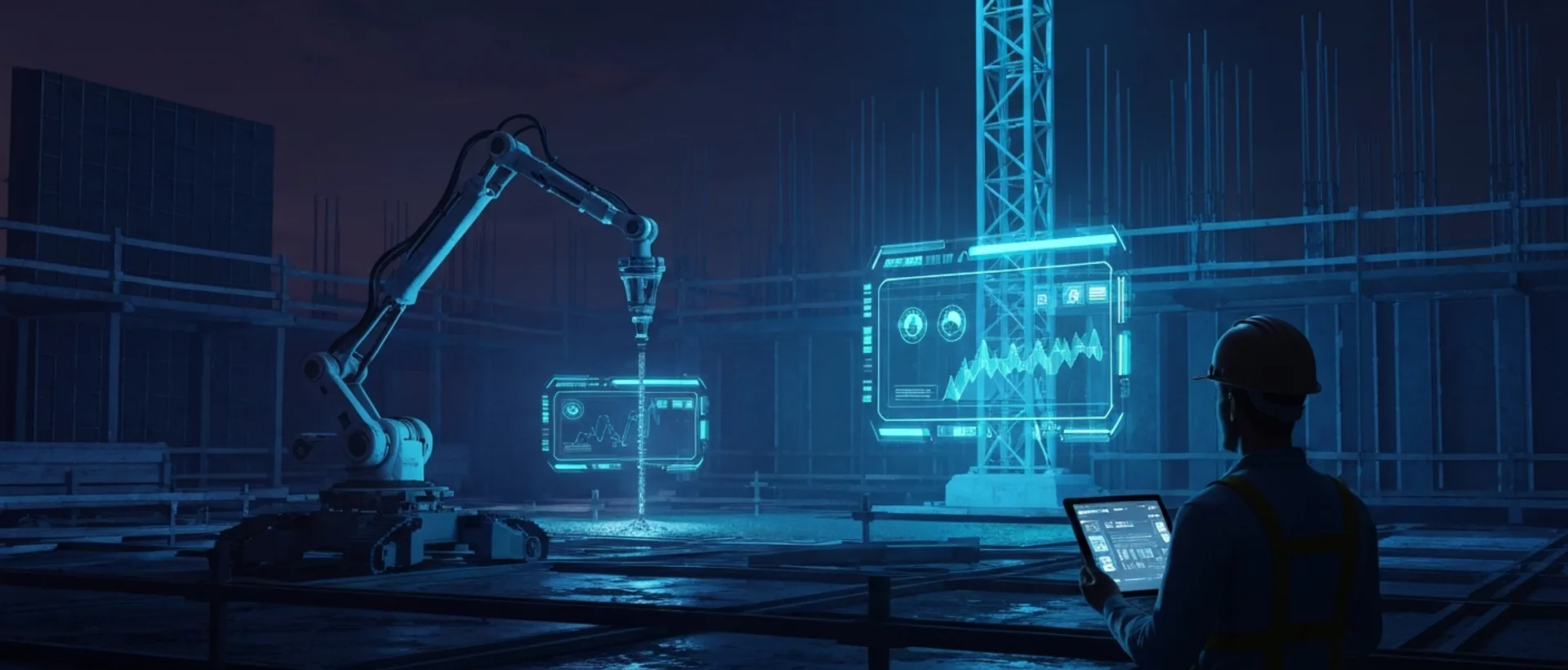
The Immediate Impact of AI on Concrete Contractors in 2026
AI for Concrete Contractors is no longer futuristic talk, folks. By 2026, it has become a game-changer, almost a matter of survival for those who want to remain relevant. Forget the idea that it’s just “another tool.” We’re talking about a leap in productivity and, even better, a waste reduction that makes the cash register smile.
Today’s AI systems analyze data in real-time to optimize concrete AI projects, from the exact dosage of cement, sand, and gravel to delivery logistics. Can you imagine being sure your concrete will arrive with the right consistency and quality, without delays or surprises on site? I, who have seen many construction sites stop due to poorly made concrete, find this a huge relief.
Safety is another point that AI is revolutionizing. AI in concrete construction safety is a priority, with algorithms monitoring the site and alerting about risks before we even notice them. It’s like having a digital guardian angel, only much more efficient than the building caretaker who only shows up to complain about the noise.
AI Tools for concrete 2026 allow for concrete demand forecasting AI with a precision we only dreamed of. Gone are the days of ordering too much concrete and having to throw it away, or ordering too little and delaying the entire project. This automation in civil construction AI, driven by smart algorithms, is redefining how we approach efficiency and agility in every stage of concrete work.
Construction worker surprised
How AI Transforms Construction Management and Concrete Use
AI improves concrete construction management in ways we’ve never seen. It uses predictive analytics to estimate deadlines and costs, pointing out where trouble will strike before the problem snowballs. It’s like having a treasure map that already shows you the pitfalls on the way, and even suggests how to avoid them.
Advanced algorithms can continuously monitor concrete curing. They adjust environmental variables to ensure maximum strength and durability. For those in the field, you know this is no small feat. That fear of concrete that doesn’t “set” properly, that keeps you up at night, is greatly reduced.
The integration of IoT sensors with AI platforms provides very detailed data on concrete performance, from mixing to the final structure. This ensures that everything is according to specifications, without deviations. I confess that, at first, I thought it was an exaggeration, but seeing the data in real-time is another story.
More savvy companies are already using AI to simulate construction scenarios. They test different concrete compositions and application methods to find the most efficient and cheapest solution. This technological advance is crucial for reducing construction costs with AI, minimizing rework and using materials more intelligently. It’s a chance to do more with less, without losing quality, like a good Sunday barbecue that lasts all week.
Tangible Benefits of AI for Concrete Contractors
Contractors who have already embraced AI are reaping the benefits. Many report up to a 20% reduction in operational costs. This comes mainly from logistical optimization and reduced material waste. Imagine the money left over at the end of the month, right?
The ability to monitor concrete quality in real-time with AI minimizes the chances of structural failures. This increases confidence in the integrity of the work. Nobody wants to deal with problems after the building is up.
Accelerating construction schedules is a direct benefit. AI optimizes planning and execution, delivering projects faster and within budget. Who doesn’t want a project that finishes on time, without breaking the client’s bank?
Safety also improves greatly. AI systems identify and mitigate risks on concrete construction sites, protecting both teams and equipment. For me, this is one of the biggest advantages.
AI not only optimizes processes but saves lives, raising safety standards in concrete construction.
The company’s reputation is strengthened with the consistent delivery of high-quality projects. All of this is driven by the precision and efficiency that Artificial Intelligence civil construction 2026 provides. It’s the difference between being “just another one” and being “the expert” in the market.
Thinking hard
Maximizing Efficiency and Overcoming Challenges with AI
To maximize efficiency with AI in concrete, there’s no secret: invest in training. It’s essential to train teams and integrate data from all systems. There’s no point having the best tool in the world if no one knows how to use it, right?
A challenge that always arises is data quality. AI is only as good as the data that feeds it. Therefore, collection and validation need to be rigorous. Garbage in, garbage out.
A qualidade dos dados é a espinha dorsal da IA na construção. Sem dados limpos e precisos, até o algoritmo mais avançado falha. #IAnaConstrucao #ConcretoInteligente
— @blogtechconcreto no X
The choice of AI tools for concrete 2026 must be strategic. Look for solutions that communicate well with what you already use and that can grow with your company. No buying the first thing you see and then having to redo everything.
Collaboration between AI developers and civil engineers is vital. Only then can we create solutions that truly meet the specific needs of the concrete sector. It’s like cooking beans: the chef has the recipe, but needs the homemaker to say if it’s just right.
A sinergia entre engenharia e IA é o futuro do concreto. Desenvolvedores precisam ouvir quem está no campo. #FuturoDaConstrucao #IAeConcreto
— @futuro_na_obra no Threads
Ultimately, AI’s success depends on a culture that values innovation. Your team needs to be open to new ways of working. Those who still live in the past will be left behind, watching the concrete slip through their fingers while the competition advances with AI for Concrete Contractors. Think it’s an exaggeration? Wait to see what 2027 has in store for us.