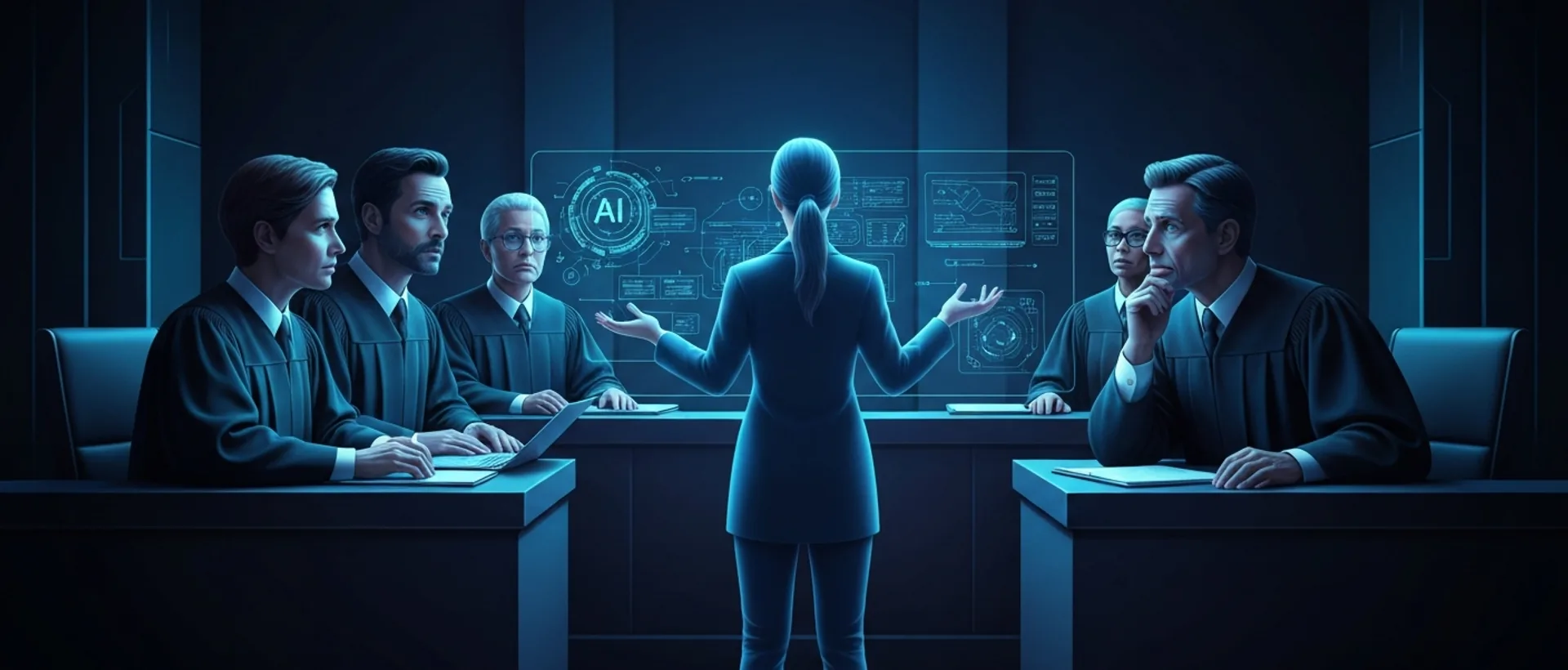
Will AI Surpass Law Professors in 2026? The Farce of Human Superiority
The question “Will AI surpass law professors in 2026?” isn’t if, but when – and the truth is, in certain things, it’s already surpassing them. That Stanford study on AI in law isn’t a warning for the future; it’s a testament to the present. Artificial intelligence law tools 2026 are already excellent at document review and hunting for precedents, with a pace and precision that no professor, no matter how brilliant, can match.
The idea that professors are irreplaceable on all fronts is a lie we tell ourselves to sleep soundly. AI isn’t coming to teach Philosophy of Law, but to swallow the heavy lifting of the law. This frees up time for us to focus on what matters: strategy, persuasion, empathy. No more memorizing codes.
The impact of AI on legal education will be brutally efficient, forcing everyone to rethink their courses. The future of law with AI isn’t a fight against machines, but rather using them to mercilessly crush the competition. I confess that, sometimes, I take a certain pleasure in seeing the dust AI kicks up in the path of the complacent.
After all, who needs a professor to explain a concept that AI can demonstrate with a thousand practical examples in seconds? All this resistance to change is just denial. And for those who still ask “Can AI replace lawyers?”, the question is wrong. The right question is: “Can AI make mediocre lawyers obsolete, and good ones, superhuman?”. Yes, my friend, and it’s already happening.
AI’s Shocking Performance in Legal Exams: The End of an Era?
AI’s performance in legal exams isn’t just good; it sends shivers down the spines of the old guard. Recent reports, including the infamous Stanford AI law study, show AI systems outperforming the average student and, surprisingly, even some tough-as-nails lawyers in pure knowledge tests. It’s like watching your favorite team lose to a kid playing a video game.
This isn’t a magic trick, get it? It’s the machine’s ability to digest and connect a massive amount of legal data on a scale our brain will never achieve. AI analyzes legal cases with an enviable coolness, without bias, without fatigue, without forgetting that annoying detail in the middle of the process.
What are the applications of AI in law today? A bit of everything. AI isn’t just a new toy; it’s already doing a lot of important things:
- Contract review in record time
- Predictive analysis of judicial decisions
- Generation of petitions and basic documents
- Identification of obscure precedents
The benefits of AI for law students are clear: access to a library of legal knowledge that can be analyzed instantly, and the chance to train with a “tutor” who never tells you to go to sleep. The challenge of AI in legal education isn’t technical; it’s more cultural. It’s about us accepting that the old way of doing things has to change.
AI is not a threat to human intelligence, but a mirror that reveals the limitations of our archaic teaching methods.
The ethics of AI in law 2026 is the only piece where we still have some wiggle room, but even here, AI can be programmed to follow ethical rules more strictly than many humans out there.
The Future of Law is Now: Adapt or Disappear?
The future of law with AI isn’t a distant mirage; it’s what we’re living today, man. The evolution of the legal system will be dictated by those who embrace artificial intelligence law 2026, not by those who run from it. The choice is simple: either you master the tool, or it crushes you. There’s no middle ground, no ‘Brazilian way’ out.
This idea that human ‘creativity’ or ‘intuition’ are insurmountable barriers for AI is just a lame excuse. AI may not have feelings, but it can simulate and even improve strategies based on patterns of success and failure that no human could ever process. It’s like the soccer star who studies the opponent for hours, but with an entire library of games in their head.
How does AI analyze legal cases? With algorithms that predict the best paths to win, something a lawyer would take decades to grasp in practice. This is a superpower, not a substitute. It’s the chance to be a “God-level” lawyer, you know?
The challenges of AI in legal education aren’t about code or hardware, but about mindset. The system needs to change to teach how to work TOGETHER with AI, not to compete. Those who still think about competing have already lost. The main challenges I see are:
- The conservative mindset: Many people still think that “law is different”.
- Lack of updated curricula: Universities still teach as if AI didn’t exist.
- Fear of the unknown: Professors and students afraid to learn something new.
After all, AI and the evolution of the legal system are an arranged marriage that worked out. Those who don’t adapt to this new reality where AI surpasses law professors 2026 will be in the dustbin of legal history. Prepare for a world where mediocrity has no place, no room.