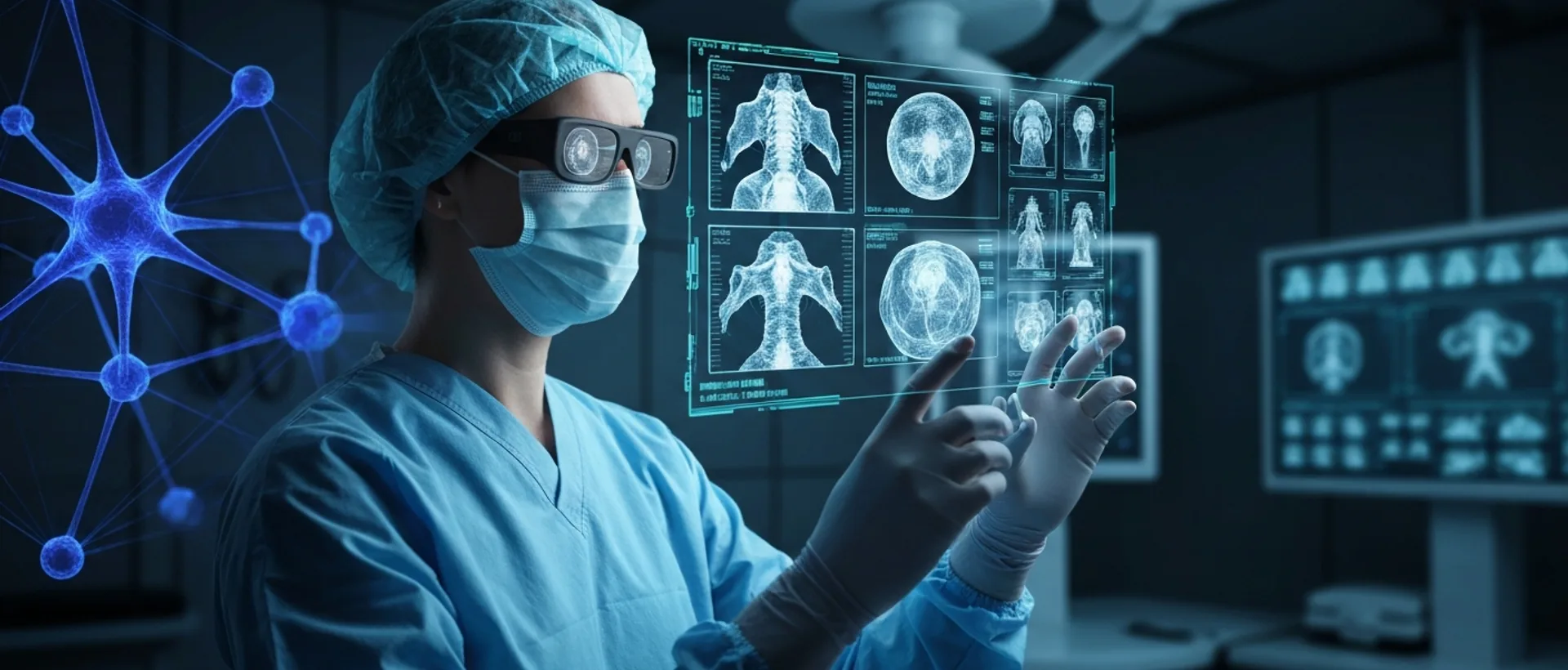
Hey there, DavitAI crew! Today’s topic is hot, and I’ll tell you right off the bat: if you came here expecting an ode to the AI revolution in medicine in 2026, you might want to sit down, because the reality is a bit more… raw. Midjourney, the folks who gave us some jaw-dropping AI images, decided to take a quantum leap into healthcare. They announced the “Midjourney Medical” and the “Midjourney Scanner,” a full-body ultrasound that promises to scan us in 60 seconds [hwupgrade.it]. Sounds like something out of a movie, right? But is it really all that? Or are we once again falling for a technological scam?
The truth is, as much as we love a good buzz, the reality of AI in healthcare in 2026 is still far from the future that sci-fi movies sold us. And mind you, Brazil has already taken an important step with the CFM’s regulation [cfm.org.br]. But, let’s face it, between a sensational announcement and the doctor’s office, there’s an ocean of bureaucracy, validation, and, most importantly, good old human distrust.
Midjourney Medical in 2026: The Raw Reality of AI in Healthcare
Don’t get me wrong, I’m a technology enthusiast, but with my feet on the ground. When Midjourney, on June 17, 2026, revealed that it was going to stick its nose into the healthcare sector with ultrasound hardware [portaltela.com], many people immediately started dreaming of instant diagnoses and personalized treatments. But, between us, Midjourney and other generative AIs like “AI in medical imaging” are not the panacea that many enthusiasts paint them to be. They are auxiliary tools, and, for now, their potential is still somewhat underexplored in clinical practice.
Despite all the fanfare, the integration of artificial intelligence into the routine of hospitals and clinics is still in its infancy, hampered by regulatory challenges and the inherent resistance of the medical sector. It’s like trying to teach your grandma to use TikTok: she might even have fun, but the process is slow and full of “but what if…” The “artificial intelligence medicine” is still crawling in practical applications beyond research, with Midjourney, for example, focusing more on visualization and simulation, and less on that autonomous diagnosis everyone expects.
Don’t expect robot doctors with the sensitivity and sagacity of a Dr. House; AI serves as a clever co-pilot, helping you read the map and avoid some potholes, but it’s not the pilot of the healthcare plane. The final decision, the responsibility, the “hassle”… that still belongs to the doctor. The real question isn’t “how does Midjourney help doctors,” but rather “how does the doctor adapt to an imperfect and constantly evolving tool.” If you’re an entrepreneur or creator thinking of entering this market, it’s good to keep in mind that the road is long and full of obstacles. Want to understand more about career possibilities in this new scenario? Read about the ChatGPT Operator 2026: Your Career in the Future of AI?.
“AI is a more powerful microscope. It shows us details that previously went unnoticed. But who decides what those details mean, and what to do with them, is still us. And that won’t change anytime soon.”
Where Hype Meets Reality: Genuine (and Limited) Applications
Okay, let’s be fair. The Midjourney Scanner promises to perform a complete human body scan in approximately 60 seconds, generating detailed data and high-resolution 3D maps [hwupgrade.it]. This is quite an advance! For those who work with visualization and modeling, it’s a goldmine. The “AI radiology benefits” with Midjourney reside mainly in creating complex 3D models from exams, assisting in surgical planning and medical education. It’s a visual advancement, a powerful “magic eye,” but not a diagnostic brain.
Midjourney’s “image analysis” for medical training purposes does offer realistic simulations that can be very useful. Imagine a medical student practicing a complex surgery on a hyper-realistic 3D model before operating on a patient. That’s awesome! But the final interpretation and responsibility remain 100% human. In November 2025, Midjourney had already closed an agreement with Butterfly Network, securing exclusive rights to the chip-based ultrasound technology [metodoviral.com]. This partnership could accelerate the arrival of these scanners on the market, with the promise of inaugurating “Midjourney Spas” in San Francisco in 2027 [tugatech.com.pt].
However, and there’s always a “however” when it comes to technology in healthcare, the “AI ethics health 2026” remains a Gordian knot. Who is responsible for an error generated by AI? The programmer? The doctor who used it? The hospital? This lack of clarity hinders mass adoption, and rightly so. The “future of medicine with AI” is collaborative, not substitutive. Generative AI in hospitals can optimize administrative and educational processes, but the human touch is irreducible. The question “what is the impact of AI on health” has an ambiguous answer: great potential, but still small generalized practical application in 2026. The cultural barrier, my friend, is much higher than the technological one. There’s no point in having the best AI in the world if no one trusts it.
Brazilian Challenges and the Illusion of Medical Singularity
Here in Brazil, things are even more complex. The “AI medical challenges Brazil” are amplified by precarious infrastructure and a lack of investment in “medical training with Midjourney” and other AI tools. There’s no point dreaming of “Midjourney Spas” if most public hospitals are still struggling with basic equipment and staff shortages. We need to put food on the table before thinking about caviar.
The belief that AI can replicate clinical intuition is a dangerous mistake. Midjourney doesn’t diagnose; it visualizes complex data in a more digestible way. It’s like having a super-detailed map but not knowing where to go. The navigation, the interpretation of that complex terrain, still belongs to the human. And the Federal Council of Medicine (CFM) is keeping an eye on this. On February 27, 2026, the CFM published Resolution No. 2.454/2026, regulating the use of artificial intelligence in medicine in Brazil [cfm.org.br]. This regulation, which came into force in March 2026, establishes ethical, technical, and governance guidelines, reinforcing that AI is a support tool and that the final decision is always the doctor’s [abril.com.br]. Patients, moreover, can refuse the use of AI in their treatment [globo.com]. That’s a relief, right? Because the ultimate responsibility lies with the professional [afya.com.br].
“AI didn’t come to steal medical jobs, but to expose those who refuse to evolve. The problem isn’t the machine, but the closed mind.”
“Generative AI in hospitals” is still struggling to prove its ROI (return on investment) in an environment where every penny counts, and data security is paramount. In Brazil, health data is too sensitive, and the LGPD is there to prove that you can’t mess around with it. The romanticization that AI will solve all healthcare problems is a fallacy. It is a tool, and like any tool, it depends on the skill and ethics of those who use it. If you’re thinking of using AI in your business, whether it’s e-commerce or a content project, it’s good to pay attention to privacy and security details. By the way, if you want to explore the power of AI without relying on the cloud, you might be interested in the discussion about Local AI on PC 2026: Unveiling the Decentralized Future.
Hype vs. Reality: Where Midjourney Shines (and Where It Fails)
So, after all this prose, where does Midjourney really shine? It shines in “AI in medical imaging” for 3D visualization of complex anatomies and simulation of procedures. This is a real breakthrough for “medical training with Midjourney.” Imagine a surgeon being able to “rehearse” a rare operation on a patient’s digital twin before making the actual incision? That’s a leap in safety and precision. The ability to generate high-resolution 3D maps [rdworldonline.com] from ultrasound data is something that can, indeed, improve understanding and planning.
However, it fails miserably when the expectation is that it will replace clinical reasoning or human diagnosis. The “image analysis” capability of AI is auxiliary, not decisive. It points out patterns, suggests possibilities, but the final verdict, the responsibility of saying “this is it” or “this isn’t it,” remains with the doctor. The machine has no intuition, no empathy, no ability to put together all the loose pieces of a patient’s life – their family history, their habits, their fears – to reach a conclusion.
Midjourney is an incredible digital artist, not a doctor. Misaligned expectations lead to frustration and underutilization of AI in healthcare. #AIMedicine #2026
— @DrTechSaude no X
The debate about Midjourney Medical in 2026 is more about the fear of the unknown than about the actual capability of the technology. AI is not a threat; it’s a mirror that reflects our capacity for adaptation. If we know how to use it as a powerful tool, without falling into the temptation of delegating what is intrinsically human to it, then we will truly be on the right path. But if we let the hype dominate and forget that medicine is, above all, a human art of caring, then we’ll have a big problem. Technology is a means, never an end. And in healthcare, this maxim is truer than ever.
The Midjourney Scanner promises a 60-second scan. Cool. But what about the doctor’s 60 years of experience? AI complements, it doesn’t compete. We need to stop treating technology like magic.
— @FutureOfMedicine no Threads
Sources
- https://www.portaltela.com/noticias/ciencia/2026/06/17/startup-de-ia-midjourney-muda-foco-para-saude-com-maquina-de-ultrassom/ — AI startup Midjourney shifts focus to health with ultrasound machine ↩
- https://metodoviral.com/noticias/midjourney-investe-em-saude-com-ultrassom-inovador/ — Midjourney invests in health with innovative ultrasound ↩
- https://www.hwupgrade.it/news/scienza-tecnologia/il-futuro-della-medicina-midjourney-vuole-scansionare-il-tuo-corpo-in-60-secondi_154999.html — The future of medicine: Midjourney wants to scan your body in 60 seconds ↩
- https://tugatech.com.pt/t85779-midjourney-quer-revolucionar-a-saude-com-scanner-corporal-de-60-segundos — Midjourney wants to revolutionize health with 60-second body scanner ↩
- https://www.rdworldonline.com/ai-image-firm-midjourney-spins-up-medical-division-unveils-ultrasonic-ct/ — AI Image Firm Midjourney Spins Up Medical Division, Unveils Ultrasonic CT ↩
- https://veja.abril.com.br/saude/advogados-explicam-o-que-muda-com-as-novas-regras-de-uso-da-inteligencia-artificial-na-medicina/ — Lawyers explain what changes with the new rules for using artificial intelligence in medicine ↩
- https://sistemas.cfm.org.br/normas/arquivos/resolucoes/BR/2026/2454_2026.pdf — CFM Resolution nº 2.454/2026 ↩
- https://portal.afya.com.br/saude/brasil-regulamenta-uso-de-ia-na-medicina-e-reforca-decisao-clinica-como-ato-humano — Brazil regulates the use of AI in medicine and reinforces clinical decision as a human act ↩
- https://g1.globo.com/saude/noticia/2026/02/27/brasil-cria-primeira-regra-para-ia-na-medicina-diagnostico-nao-pode-ser-automatico-e-paciente-podera-recusar-uso.ghtml — Brazil creates first rule for AI in medicine: diagnosis cannot be automatic and patient may refuse use ↩
Read next
Ready to scale this idea?
Narratron turns topics like this into retention-optimized YouTube scripts in under 2 minutes — magnetic hook, structure, complete SEO, timestamped description and thumbnail prompt ready to ship. 50 free credits, no card required.