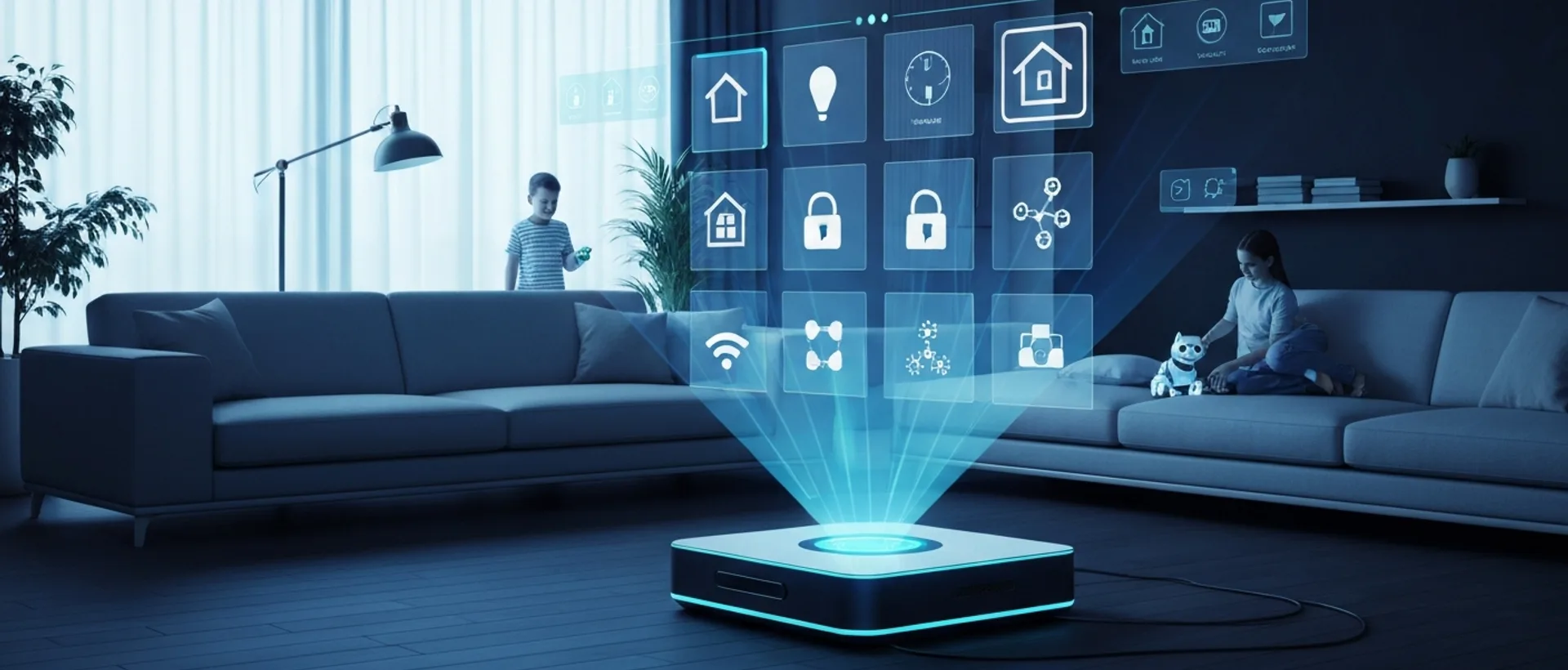
A smart home 2026 is no longer science fiction, but a reality knocking on our door, promising to transform the way we live. By 2026, your home will be an active partner, anticipating your desires, looking out for your wallet when it comes to energy, and ensuring security in ways we never imagined possible, all thanks to artificial intelligence and machine learning. Get ready for a home that not only obeys you but understands you.
What to Expect from a Smart Home in 2026?
Forget the idea of a smart home that just turns on the lights or the TV. In 2026, things will go far beyond simple automation. Your home will integrate so deeply into your daily life that it will feel like magic, with a level of personalization we used to only see in movies. Systems will be so smart that they anticipate what you need, optimize energy consumption without you lifting a finger, and ensure security almost on their own, all supercharged by AI and machine learning that truly work. For me, this proactivity is the big leap, what really changes the game.
One of the biggest headaches for anyone trying to set up a connected home today is the lack of communication between brands. For example, a light bulb from one brand doesn’t talk to a sensor from another. In 2026, this barrier will crumble. Interoperability between devices from different manufacturers will be a reality, eliminating complication and simplifying setup. Standards like Matter and Thread will consolidate more fluid ecosystems, and the question “which is the best smart home system” will be less about a specific brand and more about the experience you want to have. Finally, right? No more being stuck with a single manufacturer just to get everything working together. It’s like having a potluck where everyone brings a different dish, but they all go perfectly together.
Sustainability will also be a central pillar. Your home will not only be smart but also planet-friendly. We’ll see smart solutions for managing energy, water, and even waste. Devices will communicate to reduce waste, monitor resource usage, and even suggest more ecological habits for you. Can you imagine your fridge telling you not to take too long in the shower because the water bill is going up? Just kidding, but that’s the idea: helping you spend less and live more consciously. And, let’s be honest, who doesn’t want to save on the electricity bill?
And of course, smart home security and privacy will gain new layers of protection. Advanced biometric authentication, like facial or fingerprint recognition, and end-to-end encryption will be standard. There will be greater transparency about how your data is used, giving you total control over your information. I confess I’ve gotten a bit paranoid with the idea of my data flying around, but the promise is that by 2026 we’ll have more peace of mind. I hope it’s true, because I don’t want my virtual assistant selling my family secrets to anyone.
Best Smart Home Gadgets for 2026
When we talk about the best smart home gadgets in 2026, things are going to be much more “Star Trek” than we imagine. Virtual assistants, for example, won’t just respond to voice commands. In addition to that friendly voice, they’ll integrate facial recognition, gestures, and even emotion reading to interact in a super intuitive and contextualized way. For those wondering “which virtual assistant to choose for home,” in 2026 the choice will be more about who understands you best than who has the coolest voice. Just imagine: you come home tired, it sees you and immediately puts on a relaxing playlist and adjusts the lighting. My dream come true, you know?
Home security will also take a giant leap. Smart home security devices with AI will be the norm. Cameras with behavioral analysis, internal and external surveillance drones (yes, drones!), and smart home motion sensors that distinguish between your pet and an intruder will be standard. It’s not just about recording; it’s about understanding what’s happening. For me, a sensor’s ability to differentiate my cat from my mother-in-law (just kidding, mother-in-law!) is a huge advancement. No more false alarms because Fido decided to play treasure hunt in the middle of the night.
And what about plugs and lighting? The smart plug: what it is and how it works will evolve to manage your energy consumption predictively, learning your habits and cutting unnecessary expenses. As for smart lighting cost-benefit, it will automatically adjust the ambient light, based not only on the time but on your activity and even your mood. Reading a book? More focused light. Watching a movie? Cozy dim light. For me, lighting is one of the most impactful gadgets because it completely changes the home’s atmosphere. It’s almost like having a personal cinematographer.
Connected and autonomous appliances will also dominate. Refrigerators that manage inventory, suggest recipes with what you have, and even make shopping lists on their own. Ovens that cook food perfectly without you needing to watch. Cleaning robots with advanced AI that map the house and clean in a way we never could. Domestic life will become much smoother. I, who have lost count of how many times food has burned, am dying to have an oven that knows what it’s doing. And if the fridge suggests a salad, I might even try to make it, but I can’t promise anything.
Finally, we will have advanced environmental sensors. In addition to temperature and humidity, they will monitor air quality, CO2 levels, and detect gas or water leaks. This ensures a super healthy and safe indoor environment. It’s like having a doctor on call for your home, always attentive so that you and your family breathe well and stay away from trouble. I once had a tough situation with a gas leak, so I know the value of such a sensor.
How to Set Up a Cheap Smart Home: The Definitive Guide
Many people think that setting up a smart home 2026 is only for the rich or those who know a lot about technology. Not at all! You can start your connected home technology 2026 without spending a fortune. The key to how to set up a cheap smart home is to start with the essentials. Prioritize devices that solve real problems and offer clear home automation advantages. Think of something simple, like smart plugs to save energy or smart light bulbs for more comfort. The initial investment doesn’t have to be high, and the satisfaction of seeing your home respond to your commands is priceless. I, for example, started with a smart light bulb in my bedroom and already thought it was amazing to be able to turn off the light without getting out of bed. Pure laziness, I know, but it’s good!
Another golden tip is to choose an open ecosystem. Opt for brands and products compatible with open standards like Matter, Thread, or Zigbee. This is super important because it allows you to expand your smart home with products from different manufacturers without getting stuck on a single platform. It’s like having a soccer team where all the players, even from different teams, speak the same language. This way, you don’t run the risk of buying a bunch of things that don’t communicate. And there’s nothing more frustrating than spending money on something that doesn’t work well, right? I fell for that once and it was a huge headache.
Keep an eye out for promotions and starter kits. Often, the cost of a complete smart home can be spread out over time if you take advantage of offers and starter kits that already come with a hub and some basic devices. Black Friday, Cyber Monday, or even flash sales in online stores are great opportunities. It’s like getting a fast-food combo meal: it’s cheaper than buying everything separately.
The good news is that many of the best smart home gadgets are plug-and-play, meaning you can install them yourself, without needing a professional. This saves a good amount of money and allows you to configure your smart home at your own pace. You don’t need to be an electronics genius to install a smart plug or a light bulb. Just follow the manual, which is usually very well explained. My grandma, who barely knows how to use a cell phone, managed to set hers up, so you can too!
Finally, be creative and reuse old devices. Explore solutions to integrate “non-smart” things into your smart home. For example, use smart plugs to turn conventional appliances on/off by voice or schedule. You know that old lamp you love? With a smart plug, it becomes a smart lamp! It’s a smart way to give new life to your objects and save even more.
To help you get an idea of prices, check out this table comparing some basic items you can use to get started:
| Basic Smart Device | Average Price (R$) | Main Functions | Notes |
|---|---|---|---|
| Smart Light Bulb | 45 - 90 | Color/intensity control, scheduling, voice | Great for starting, visual impact. |
| Smart Plug | 50 - 120 | Turn appliances on/off, scheduling, monitor consumption | Turns common appliances smart. |
| Door/Window Sensor | 60 - 150 | Opening notifications, alarm integration | Essential for basic security. |
| Hub/Automation Center | 200 - 600 | Connects multiple devices, complex automations | Not always necessary to start, depends on ecosystem. |
| Virtual Assistant (Echo Dot/Nest Mini) | 250 - 400 | Voice control, music playback, information | Central piece for voice interaction. |
*Estimated prices in 2024, may vary.
Home Automation: Advantages and Benefits Beyond Convenience
When we talk about home automation advantages, the first thing that comes to mind is convenience, right? Turning on the light with your voice, controlling the temperature with your phone. But the truth is, the benefits go far beyond just making life easier. One of the biggest strengths of the smart home 2026 is energy saving and sustainability. With precise control of lighting and climate, your home will reduce waste in ways you can’t even imagine. Presence sensors and timers ensure that energy is only used when really needed. Can you imagine the air conditioning turning off by itself when you leave home? Your electricity bill thanks you, and so does the planet.
Enhanced security is another crucial point. Integrated systems of cameras, alarms, door and window sensors, and smart locking offer 24/7 monitoring. You receive real-time notifications on your phone if something strange happens. And the best part: you can simulate presence, turning lights on and off or turning on the TV, even when you’re traveling. This discourages anyone with bad intentions. For me, the peace of mind of knowing my home is protected, even when I’m away, is one of the biggest home automation advantages. It’s like having a private security guard who never takes a vacation.
And of course, comfort and quality of life. Adjusting the temperature before you get home, turning on the lights with your voice, or programming scenarios for movie night. The home adapts to your rhythm, providing a much more pleasant environment. Want a “cinema” scene with dimmed lights and the TV on? One command and it’s done. Waking up with the bedroom light gradually coming on to simulate the sunrise? That’s possible too. It’s one treat after another, and I confess that after having this, I can no longer live without it. My home knows I’m the type who likes to wake up calmly, so it helps me with that ritual.
Accessibility and inclusion are benefits that many people don’t think about, but they are super important. For people with reduced mobility or the elderly, automation offers an unprecedented degree of independence. Controlling various aspects of the home by voice or simple apps can make a huge difference in their quality of life. Opening blinds, turning on the TV, adjusting the thermostat — all without needing physical help. It’s a technology that truly embraces everyone.
Finally, property value appreciation. A home with connected home technology 2026 and modern automation systems is much more attractive in the real estate market. It adds value and modernity to your assets. If you ever plan to sell your home, having these systems can be a huge differentiator, as well as a great conversation starter to impress friends at a barbecue. Who doesn’t want a home that’s worth more and is also super cool?
Privacy in the Smart Home: Myths and Realities in 2026
When we talk about privacy in the smart home, it’s normal to feel a certain apprehension. After all, we’re putting microphones and cameras inside our homes, right? But in 2026, technology is evolving to give us more control and security. The importance of encryption, for example, is something that cannot be ignored. In 2026, end-to-end encryption will be essential to protect the data transmitted by your smart devices. Understanding how it works and why it’s crucial is the first step to feeling more secure. It ensures that only you and those you authorize can read your information, like a sealed envelope that only you have the key to. And listen, I’ve heard so many stories of people whose cameras were hacked, so for me, encryption is law!
Another fundamental point is data control and permissions. In 2026, users will have much greater control over what data is collected and how it’s used. It’s your responsibility to review the privacy policies of each device and app, granting only the permissions that are truly necessary. Don’t go clicking “accept” on everything without reading, okay? It’s like giving your house keys to anyone who shows up at the door. I confess I don’t always read everything, but with the smart home, I’m making myself be more particular about it.
Wi-Fi network security is also the first line of defense. A secure Wi-Fi network, with strong passwords and WPA3 encryption, is basic to prevent unauthorized access to your devices. Think of your network as the front door of your digital home. You wouldn’t leave the door open for anyone to enter, right? So why would you leave your Wi-Fi unprotected? Change your router’s default password and use a combination of letters, numbers, and symbols. No “123456” or “password.”
Keeping software updated is vital. Regular software updates, both for your devices’ firmware and for apps, are crucial to fix security vulnerabilities and ensure the protection of your smart home privacy. Companies release these updates precisely to patch loopholes that can be exploited. Ignoring this is like leaving a window open for digital thieves. I know it’s tedious to update sometimes, but it’s a little time that’s worth it.
Finally, choosing reliable manufacturers. Opt for brands with a proven track record in security and privacy. Research the company’s reputation and how they handle user data before investing in new gadgets. Well-known brands like Google, Amazon, Apple, Samsung, for example, generally invest heavily in security. Don’t go for the lowest price without first researching who’s behind the product. After all, we don’t buy a car without knowing if the brand is good, right? With your smart home, the care should be the same.
Which is the Best Smart Home System for You in 2026?
Deciding which is the best smart home system for you in 2026 might seem like a daunting task, but it’s simpler than it looks. The truth is, there isn’t a universal “best,” but rather the best for you. First, analyze the integrated ecosystems that already dominate the market: Apple HomeKit, Google Home, and Amazon Alexa. See which platform aligns best with the devices you already own (your cell phone, your smart TV) and your level of familiarity with each. These systems offer the widest range of compatibility with the best smart home gadgets, and they’re great for those who want simplicity and a vast library of devices. I, for example, started with Google Home because I already used Android, and the transition was very smooth.
For those who are more enthusiastic or seek more detailed control, dedicated hub systems, like SmartThings or Hubitat, might be the best option. They offer greater local control and allow for more complex automations, with less dependence on the cloud. This means that even if the internet goes down, your home still works. It’s for those who like to be in control and customize every detail. It’s like having a car you can customize your way, instead of a ready-made factory model. If you don’t mind getting your hands dirty (metaphorically, of course), this might be your thing.
A factor that will be increasingly important in 2026 is focusing on open standards like Matter and Thread. Prioritize devices that support these new standards. They ensure future interoperability and give you the freedom to choose products from various manufacturers without worrying about compatibility. It’s the end of the format wars, where everything communicates. If I could go back in time and give myself one piece of advice, it would be this: “invest in open standards, your future self will thank you!”
Also consider the cost-benefit. Evaluate the smart lighting cost-benefit or the cost of a complete smart home in relation to your needs and your budget. You don’t need to automate everything at once. Start small, with what really makes a difference for you, and expand as your experience and your wallet allow. Sometimes, a smart light bulb is enough to give you a taste of automation and motivate you to go further.
Finally, evaluate support and community. Good customer support and an active user community can be crucial for solving problems and getting tips on which is the best smart home system and its automations. Knowing there are people to help you when you encounter a problem is a relief. After all, nobody wants to get lost in the tech universe alone, right?
Cost of a Complete Smart Home in 2026: Investment and Return
The million-dollar question: what’s the cost of a complete smart home in 2026? The answer, like almost everything in life, is “it depends.” The initial investment can vary widely, you see? You can start with about R$ 1,500 for a very basic setup, like a virtual assistant and a few smart light bulbs or plugs. But if you dream of a fully automated residence, with advanced security, smart climate control, and all the best smart home gadgets, the bill can easily exceed R$ 30,000. It’s a very wide range, like going from a Beetle to a luxury car. I honestly had a mini heart attack when I saw the prices of some complete systems, but the good news is it doesn’t have to be that way.
The great advantage of the smart home 2026 is its modularity. You don’t have to buy everything at once. You can start with a small investment, focusing on how to set up a cheap smart home, and add devices over time. It’s like building a house brick by brick. Start with the foundation (an assistant and some lights), then add the roof (security), and so on. This allows you to test what really works for you and your lifestyle, without blowing your budget all at once.
And the return on investment (ROI)? Ah, this is a point many people forget. The savings on the energy bill, which I already mentioned, and the property value appreciation are tangible returns that you feel in your wallet. But it’s not just that. The increased security and comfort provide an ROI in quality of life that is priceless. Sleeping more peacefully, having the house always at the ideal temperature, not having to worry about turning off the lights… For me, these “invisible” benefits are the most valuable.
Of course, there are some hidden costs and maintenance that we need to consider. You’ll need a good internet connection, that’s basic. You might need subscriptions for premium services, like cloud storage for your security cameras. And, like any electronic device, devices may need replacement or updates over time. It’s important to factor this in, like car registration fees and maintenance, you know?
To create a personalized budget, make a list of your priorities. What’s most important to you: security, savings, comfort? Research the best smart home gadgets that meet these needs and put together a plan that fits your budget. Don’t rush. The smart home is a journey, not a race. And the important thing is that it brings you more practicality and joy, without becoming a financial headache.
FAQ
What is a smart home in 2026?
In 2026, a smart home is a residence where electronic devices and systems are interconnected, allowing for automation and centralized control of functions such as lighting, security, and climate control. It adapts to the needs of residents through artificial intelligence and machine learning, optimizing comfort and efficiency proactively.
How much does it cost to set up a complete smart home?
The cost of a complete smart home in 2026 can vary widely. A basic setup to start can cost from R$ 1,500, while advanced home automation, with multiple integrated systems and robust security solutions, can exceed R$ 30,000. The investment is modular and can be made gradually, according to your needs and budget.
What are the main advantages of home automation?
The main advantages of home automation include energy savings through intelligent control, enhanced security with integrated surveillance systems and alarms, and a significant increase in comfort and quality of life. Additionally, a smart home offers greater accessibility for people with special needs and can increase property value in the market.
Which virtual assistant is best for a smart home?
The choice of the best virtual assistant for a smart home in 2026 depends on your current ecosystem and personal preferences. Google Assistant, Amazon Alexa, and Apple HomeKit are market leaders, each with its strengths in compatibility, features, and integration. It’s recommended to test the interaction and the range of compatible devices with each to see which fits best into your daily life.
How to ensure privacy in a smart home?
To ensure privacy in a smart home, it’s crucial to use strong passwords on your Wi-Fi network, keep all device and app software updated, and review manufacturers’ privacy policies. Choose reliable brands with a good security history, use end-to-end encryption, and control data access permissions to protect your personal information.