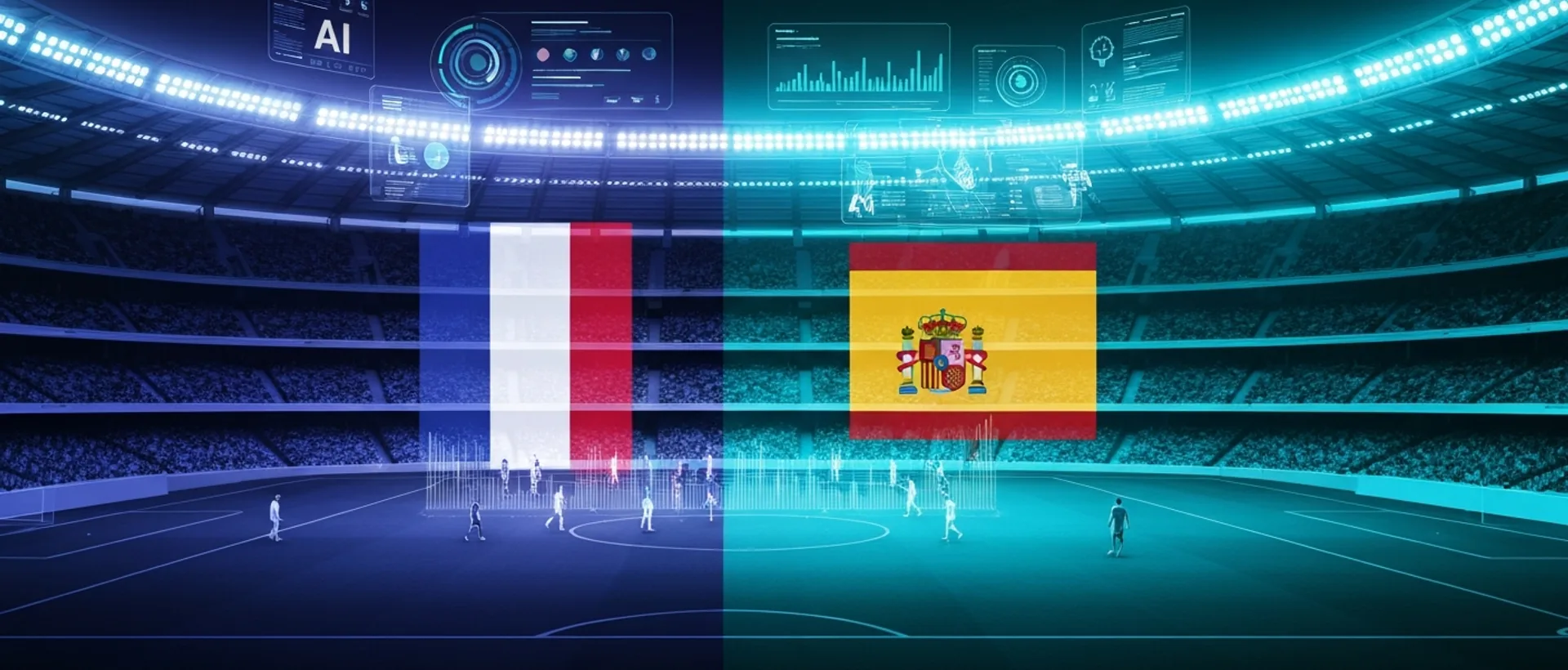
Technology in Football in 2026: France vs Spain
Hey there, tech and sports fans! The 2026 World Cup is here, and guess what, it’s not just about football. This edition, hosted by the United States, Canada, and Mexico, is proving to be a true global laboratory for artificial intelligence, data, and digital infrastructure, you know? 1 It’s the most complex World Cup ever organized, with 48 teams and 16 stadiums spread across three countries, and technology is at the heart of everything, from the fan experience to athlete analysis 2.
In this high-performance scenario with chips everywhere, the rivalry between France and Spain gains a special flavor. The ball isn’t just rolling on the field, but also behind the scenes, where the “AI war” is heating up to see who comes out on top. Supercomputers and market analyses differ on who’s the favorite, with Google’s AI slightly favoring Spain for the semi-final 4. But let’s face it, football is football, and the excitement of the pitch is still unbeatable. We know technology helps, but an upset can always happen, right?
To be honest, I think this 2026 World Cup is a game-changer. Lenovo, for example, an official FIFA partner, built an architecture to handle up to 180 million simultaneous accesses, combining AI servers and liquid cooling 1. That’s a lot! And the official ball, Adidas’ Trionda, comes with an AI chip and a 500 Hz sensor that sends real-time data to referees, even powering semi-automated offside calls 3. To me, this is proof that technology is no longer an “extra,” but the playing field itself.
Artificial Intelligence and Data Analysis: Distinct Approaches
When we talk about France and Spain, things get even more interesting, because both teams, despite being at the forefront of innovation, have their own ways with technology. The French national team in 2026, for example, uses AI primarily for tactical analysis before and during games. They use AI tools for pattern recognition in video and to identify opponents’ weaknesses, optimizing formations 3. It’s almost like they have a digital strategist on the bench, pretty cool, huh?
In Spain, the vibe is a bit different. Data analysis focuses more on individual player health and performance. They use big data to monitor training load, fatigue, and injury risk. This approach aims for longevity and peak performance, ensuring each player is always at their best. It’s like having a virtual doctor and physical trainer 24/7, taking care of each athlete.
Both nations use GPS tracking systems and wearables, of course, but France integrates this data more with AI algorithms to predict game scenarios and even optimize substitutions in real-time. Just imagine: AI suggesting who to substitute and who to bring in to turn the game around! The technology used by the French national team in 2026 includes AI platforms for play simulation, seeking a strategic advantage that goes beyond the field. On the other hand, Spain prioritizes the optimization of football training with technology, focusing on how technology can enhance each player’s physical and technical capabilities. The technological impact on football in France and Spain shows Spain as more oriented towards physiological data, and France more towards computational tactical intelligence. To me, France is more the “brain” and Spain more the “body” of the team, if you catch my drift.
Technological Trends and Innovations for 2026
The 2026 World Cup is not just a football spectacle, but a parade of innovations that will shape the future of the sport. We’re talking about drones that collect aerial data from training sessions and matches, offering a perspective that was previously unimaginable. And virtual reality (VR) is no longer just for video games! It’s being used for immersive training, allowing players to simulate game situations with incredible realism. Imagine training a penalty in the World Cup final without leaving the locker room? It’s almost like a Black Mirror episode, but for the good of sports.
Both France and Spain are testing advanced biometrics and even implantable sensors to continuously monitor athletes. Yes, you heard that right: implantable! This goes far beyond the wearables we know, providing even more precise data about players’ bodies. Big data in professional football expands to predictive analysis of fan behavior and logistics optimization, in addition to the main focus on on-field performance. Like, “how do we get people to the stadium without traffic and still make them want to buy more popcorn?”
Telemedicine and robotics will also lend a hand in injury recovery. Faster diagnoses, personalized treatments, all to get the star player back on the field as quickly as possible. It’s the standard of medical care in sports being raised to another level. And, of course, with so much data flying around, cybersecurity becomes a huge concern. Protecting sensitive athlete data and game strategies against cyber attacks is a challenge that cannot be taken lightly. After all, nobody wants the tactical plan to leak on the Deep Web before the final, right? For those who want to understand more about how AI is changing the game, I suggest checking out our article on AI in Football 2026: Win or Lose with Intelligence?.
Technological Implementation Comparison: France vs Spain
When we put France and Spain side-by-side on technology, you can see that, although both are powerhouses, they have very different ways of using this tool. France, as I said, invests heavily in AI-powered video analysis platforms and advanced tactical simulation systems. The goal is to prepare players for different game scenarios, almost rehearsing each play before it even happens.
Spain, in turn, prioritizes physiological and biometric data analysis tools. Their focus is on individualized training and long-term injury prevention. They want each player to be in their best physical shape, avoiding wear and tear and ensuring the star player is fully fit when it matters most. It’s like the famous Spanish “futebol arte” (artistic football), but with a scientific data basis that no one sees.
Here’s a clear idea of the differences:
| Aspecto Tecnológico | França (2026) | Espanha (2026) |
|---|---|---|
| Main Focus | Tactical AI and Simulation | Physiological Analysis and Personalized Training |
| Key Technologies | AI for Video Analysis, Tactical VR | Physiological Big Data, Advanced Wearables |
| Drone Usage | Tactical and Aerial Monitoring | Movement and Space Analysis |
| AI in Training | Game Simulation, Strategy Optimization | Injury Prevention, Load Optimization |
| Athlete Recovery | Assisted Robotic Systems | Predictive Fatigue Analysis, Telemedicine |
While France seeks a strategic advantage through an in-depth understanding of the game via AI, Spain focuses on physical excellence and the optimization of individual performance. The technology comparison between France and Spain in football reveals that both approaches are effective but reflect distinct footballing cultures. Who’s right? Who knows, right? What matters is that technology is there to help both sides. To understand more about the complexities of AI in sports, it’s worth reading about AI in Sports 2026: The Fallacy of Technological Perfection.
Challenges and Advantages of Technological Adoption
It’s not all sunshine and rainbows, though. Implementing so much technology in football also has its challenges. The acquisition and maintenance cost of these systems is very high, and not every club can afford it. Furthermore, you need highly specialized people to operate all of this, from data scientists to AI engineers. It’s not just pressing a button and boom, the team wins the World Cup.
The integration of different systems and ensuring the privacy of athlete data are constant concerns. Imagine if a player’s health data leaks? Or if the coach’s tactical plan falls into the hands of the opponent? It’s a recipe for headaches. But the advantages, oh, those are truly eye-opening!
✓ Prós
- Performance and Strategy Optimization
- Enhanced Injury Prevention and Recovery
- Real-time Game Analysis
- Personalized and Effective Training
- Data-Driven Decision Making
✗ Contras
- High Implementation Cost
- Need for Specialized Teams
- Cybersecurity Risks
- Data Privacy Issues
- Excessive Reliance on Technology
Decision-making becomes much more informed, right? Coaches and physical trainers have access to data that was once pure intuition. Optimized performance and reduced injury risk are undeniable gains, as we see in how AI changed Spanish football in risk analysis. Research by Bank of America (BofA) indicated France as the main title contender, with about [!STAT] 40% of analysts betting on a French victory 6. Meanwhile, Microsoft’s AI (Copilot) assigns equal probabilities to France and Spain 7. It’s the battle of algorithms, and we’re the winners, with more information and less guesswork.
The Future of Football: Trends Beyond 2026
Once the dust settles on the 2026 World Cup, we’ll see technology in football going even further. AI game simulation is expected to reach a level of realism that will allow players to “play” entire matches in virtual environments even before stepping onto the pitch. Imagine a striker practicing dribbling against an opponent’s defender a thousand times in VR? That’s another level!
The personalization of nutrition and supplementation, based on genetic and metabolic data, will become standard. Each athlete will have a tailor-made diet and supplement plan, further optimizing individual performance. It’s like having an exclusive chef and nutritionist, with the help of a supercomputer. The integration of wearable technologies directly into game uniforms, without compromising comfort, will provide even more precise and continuous real-time data. Goodbye, tight vests and external sensors!
Robotics can play a larger role in specific training and rehabilitation, offering real-time assistance and feedback for precise movements. And, to top it all off, the analysis of emotional and psychometric data, combined with AI, will help care for the mental well-being of athletes. Because, in the end, a player’s mind is as important as their legs. Who would have thought AI would become a star player’s psychologist, right? It’s a future where technology not only improves physical performance but also cares for the mind. And if you think AI is only for football, check out our article on World Cup 2026 AI Predictions: Why You’re Wrong to see how it’s everywhere!
Sources
- https://itforum.com.br/noticias/copa-do-mundo-2026-vira-laboratorio-global-para-ia-dados-e-infraestrutura-digital/ — World Cup 2026 becomes a global laboratory for AI, data, and digital infrastructure ↩
- https://www.computerweekly.com/br/reportagen/Copa-do-Mundo-2026-coloca-tecnologia-no-centro-da-operacoes — World Cup 2026 puts technology at the center of operations ↩
- https://www.administradores.com.br/noticias/aquarela-analytics-aponta-como-a-inteligencia-artificial-deve-transformar-a-copa-do-mundo-de-2026 — Aquarela Analytics points out how Artificial Intelligence should transform the 2026 World Cup ↩
- https://noataque.com.br/futebol/noticia/2026/07/14/ia-do-google-aponta-ligeiro-favoritismo-em-franca-x-espanha-e-crava-classificado-vai-sufocar/ — Google AI points to slight favoritism in France vs Spain and predicts qualifier: ‘Will suffocate’ ↩
- uol.com.br — Spain and France are World Cup favorites, Opta supercomputer points out ↩
- https://www.infomoney.com.br/esportes/franca-e-a-selecao-favorita-dos-analistas-para-vencer-a-copa-aponta-pesquisa-do-bofa/ — France is the favorite team of analysts to win the World Cup, BofA survey points out ↩
- https://pplware.sapo.pt/inteligencia-artificial/franca-e-favorita-mas-ia-da-microsoft-preve-outro-vencedor-para-o-mundial-2026/ — France is favorite, but Microsoft AI predicts another winner for World Cup 2026 ↩
Ready to scale this idea?
Narratron turns topics like this into retention-optimized YouTube scripts in under 2 minutes — magnetic hook, structure, complete SEO, timestamped description and thumbnail prompt ready to ship. 50 free credits, no card required.