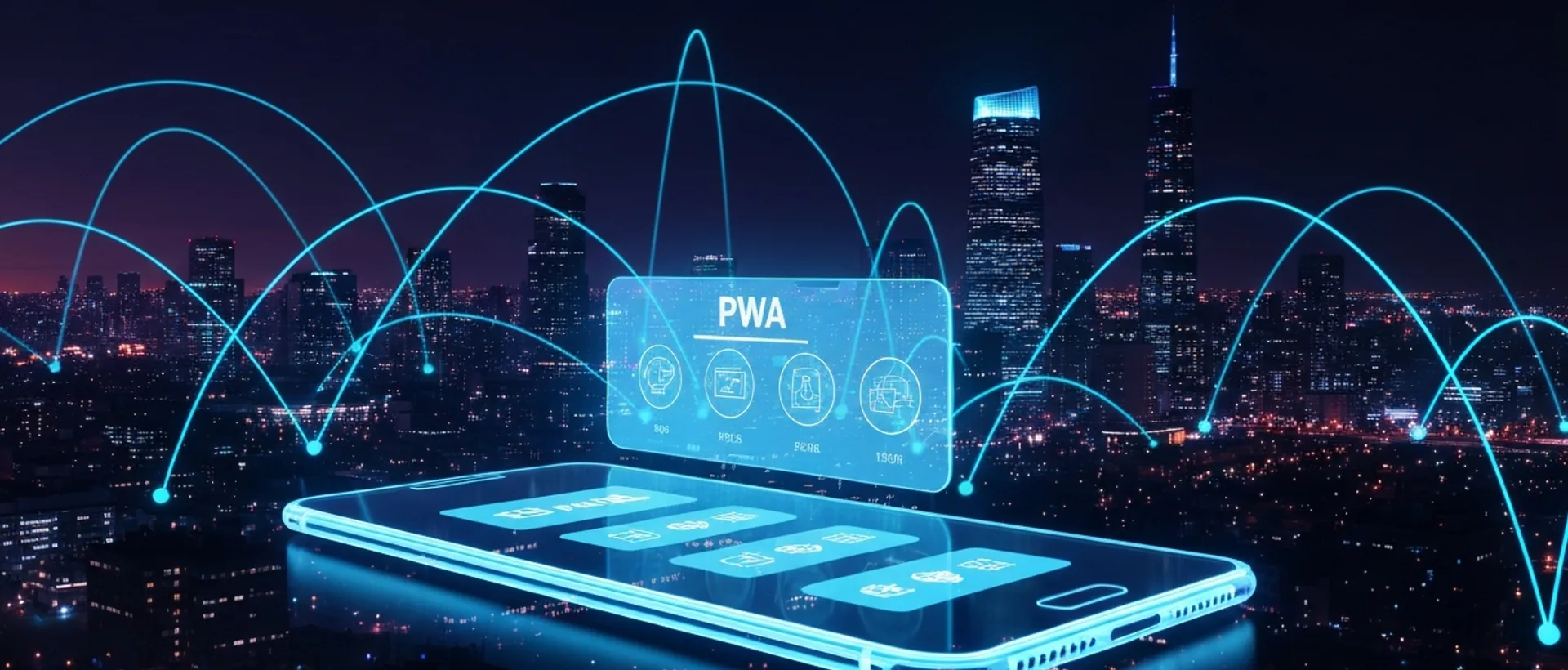
Progressive Web App (PWA) 2026: The Native App Hoax Revealed
Hey everyone! If you’re still stuck on “a native app is a native app, no discussion,” I’m sorry to inform you, but you’re living in 2016. In 2026, the PWA (Progressive Web App) is no longer a “trend” we chat about over coffee; it’s reality knocking at the door, kicking it open, and throwing a party in your living room. And many still refuse to accept it, you know? It’s like trying to use a floppy disk to save a movie nowadays. It just doesn’t work!
While development folks are burning rivers of money and brain cells on native apps that no one can stand downloading anymore (the famous “app fatigue,” get it?), PWA is here, chilling, delivering the same experience – or even better, honestly – with far less cost and headache. And without those app store fees that feel like an armed robbery.
But after all, what the heck is a PWA? Think of it this way: it’s the perfect union between the web, which you access in your browser, and an application, which you install on your phone. It’s fast, responsive, you can “install” (in quotes, I’ll explain) and best of all: it works offline. Forget that torture of going to the store, waiting for approval, downloading gigs and gigs. With PWA, you just open the browser, “add to home screen,” and voilà. Simple as that.
The truth is that the overwhelming majority of your users don’t need a native app. They want functionality, speed, and convenience. They want things to just work, no frills, no bureaucracy. And PWA delivers all that, and a little more, directly from the browser. No intermediaries, no friction. It’s almost as if your website turns into a superhero, gaining app powers.
So, get ready to hear “Does PWA replace an app?” The answer is a loud, resounding, no-blinking YES! Especially for most use cases where the complexity of a native app is unnecessary overkill. Why build a war tank to go to the bakery, right?
PWA vs. Native App 2026: The Battle That Already Has a Winner
Still unsure if PWA or native app is the way to go? In 2026, discussing this is like debating if the Earth is flat. The advantages of PWA are so glaring that insisting on native apps borders on stubbornness, or perhaps, a certain nostalgia for a business model whose days are numbered. I, personally, think it’s more stubbornness, or fear of changing what “always worked.”
PWA development is faster and, consequently, much more economical. Just think: you don’t need to maintain one team for iOS, another for Android, and yet another for your website. It’s just one codebase, my friend! This means fewer platforms to maintain, fewer bugs to hunt, and more time and money to truly innovate. Cost reduction can reach 40-60% compared to native apps [innov8world.com]. That’s no small thing! The PWA vs. native app cost overwhelmingly favors the web side, freeing up resources for you to focus on what truly matters: your product and your customer.
“Oh, but PWA doesn’t work offline!” Whoever told you that really fooled you. In 2026, with Service Workers smarter than ever, the ability to cache and access data without an internet connection is a practical reality [appstory.org]. The concept of “always available” has become real. No more excuses! You can be on the subway with no signal, and your PWA will continue to function, saving your data and giving you the experience you expect. This breaks one of the last “strongholds” of native apps, you know?
And PWA SEO optimization, huh? That’s a game-changer! Being indexable by Google means organic visibility, something native apps can only dream of without spending a fortune on advertising. Your PWA appears in search results, is easy to share, and installation is just one click. It’s the gateway for you to reach 100% of users, regardless of device or platform [innov8world.com]. Think of the freedom!
How to Create a PWA and Dominate the Market in 2026
Now, if you’re thinking “okay, I get it, but how do I create a PWA?”, relax. It’s not rocket science. Modern tools and frameworks have simplified the process in a way that even smaller teams can get into it. You don’t need to be a NASA genius to make your PWA. It’s more about having the vision and the will to think outside the box.
And there’s no shortage of successful PWA examples to prove it. Big companies like Twitter (now X), Starbucks, and Uber have already caught on and are reaping the benefits of a native-quality user experience, but without the friction of downloads and app store approvals [medium.com]. They saw that PWA performance is real and that the future is now.
For those working with e-commerce, PWA for e-commerce is a goldmine! Increased conversion rates, instant page loading, and the ability to engage your customers without that annoying nudge to install the app. It’s the end of friction in the purchase journey. How many times have you given up buying something because the website asked you to download the app? I’ve lost count!
PWAs offer the freedom of an app without the shackles of app stores, resulting in lower development costs, broader reach, and most importantly, more profit for your business.
And there’s more, the integration with artificial intelligence and edge computing is making PWAs even smarter. Push notifications in PWAs, for example, are no longer that generic thing that sends you spam. Now, they are intelligent and contextual, driven by AI to refine what is sent, when, and why [appstory.org]. This greatly improves user engagement and experience. If you want to know more about how AI is changing the game, check out our article on AI, Automation, and App Development in 2026. It’s a goldmine!
PWA development isn’t about “adapting,” but about “anticipating.” Those who don’t invest in it now will be left behind in 2026, stuck in closed and expensive ecosystems, watching the competition swim circles around them. That’s life, right? Either you innovate, or you become history.
Performance and the Future: Why Ignoring PWA Is a Huge Mistake
There are still people who doubt PWA performance. “Oh, but it’s not as fast as a native app!” My confession: I thought that too back in 2020. But the reality is that, with the right optimizations, a PWA can not only equal but surpass a native app in speed and fluidity, especially on mid-range devices [appstory.org]. Latency is minimized by integration with edge computing, causing apps to load instantly, even with a poor internet connection [appstory.org]. It’s the web turbocharged!
PWA SEO optimization is more than just using keywords. It’s ensuring that your application is discovered, indexed, and ranked in search engines. This is impossible for native apps without a complementary website. With PWA, your “app” is your website, and it’s born with this advantage. It’s like starting the game with a cheat code activated! Want to stay on top of the latest tech and AI news driving this? Check out our post Discover: AI Technology News 2026: Advances and Future.
And the supposed “security” of native apps? Another fallacy that needs to be debunked. PWAs, running on HTTPS, with secure Service Workers and controlled permissions, offer a robust and auditable level of protection. In 2026, they incorporate biometric and hardware security APIs, like WebAuthn and FIDO2, for fingerprint or facial recognition login with native-level encryption [appstory.org]. In other words, it’s super secure!
The PWA market is booming! In 2026, it is estimated at USD 3.14 billion, and the projection is that it will reach over USD 34.58 billion by 2035 [researchnester.com]. That’s not growth, it’s an explosion! And it’s driven by the need for online applications that are responsive, fast, and have offline capabilities. If you’re not on this wave, I’m sorry, but you’re missing a packed train.
Make no mistake: the future belongs to the open web, and PWA is its greatest exponent. In 2026, those who don’t embrace this technology will be fighting a losing battle against efficiency and user experience. It’s like trying to sell a cart in the middle of Formula 1. No way! The impact of AI and technology is shaping everything, and whoever doesn’t see that, my friend, is wrong! To better understand this “being wrong” vibe, take a look at AI Technology Impact 2026: Why You’re Wrong!.
In summary, if you’re a creator or entrepreneur and your head is in 2026, PWA isn’t an option, it’s a necessity. It’s the smartest, most economical, and most efficient way to reach your audience, offer a top-notch experience, and, as a bonus, wave “goodbye” to app store fees and bureaucracy. So, let’s turn the key, shall we? The future has arrived.
Sources
- https://www.appstory.org/blog/7-pwa-trends-that-will-define-mobile-and-web-development-in-2026/ ↩
- https://www.researchnester.com/reports/progressive-web-apps-market/6609 ↩
- https://appsthunder.com/best-pwa-progressive-web-apps-2026/ ↩
- https://www.innov8world.com/mobile-app-vs-pwa/ ↩
- https://medium.com/@mrhotfix/the-rise-of-pwas-and-the-quiet-decline-of-mobile-app-stores-4039bdc2aa0f ↩
- https://www.novasarc.com/pwavs-native-apps-choosing-right-approach-in-2026 ↩
- Techugo ↩
Ready to scale this idea?
Narratron turns topics like this into retention-optimized YouTube scripts in under 2 minutes — magnetic hook, structure, complete SEO, timestamped description and thumbnail prompt ready to ship. 50 free credits, no card required.