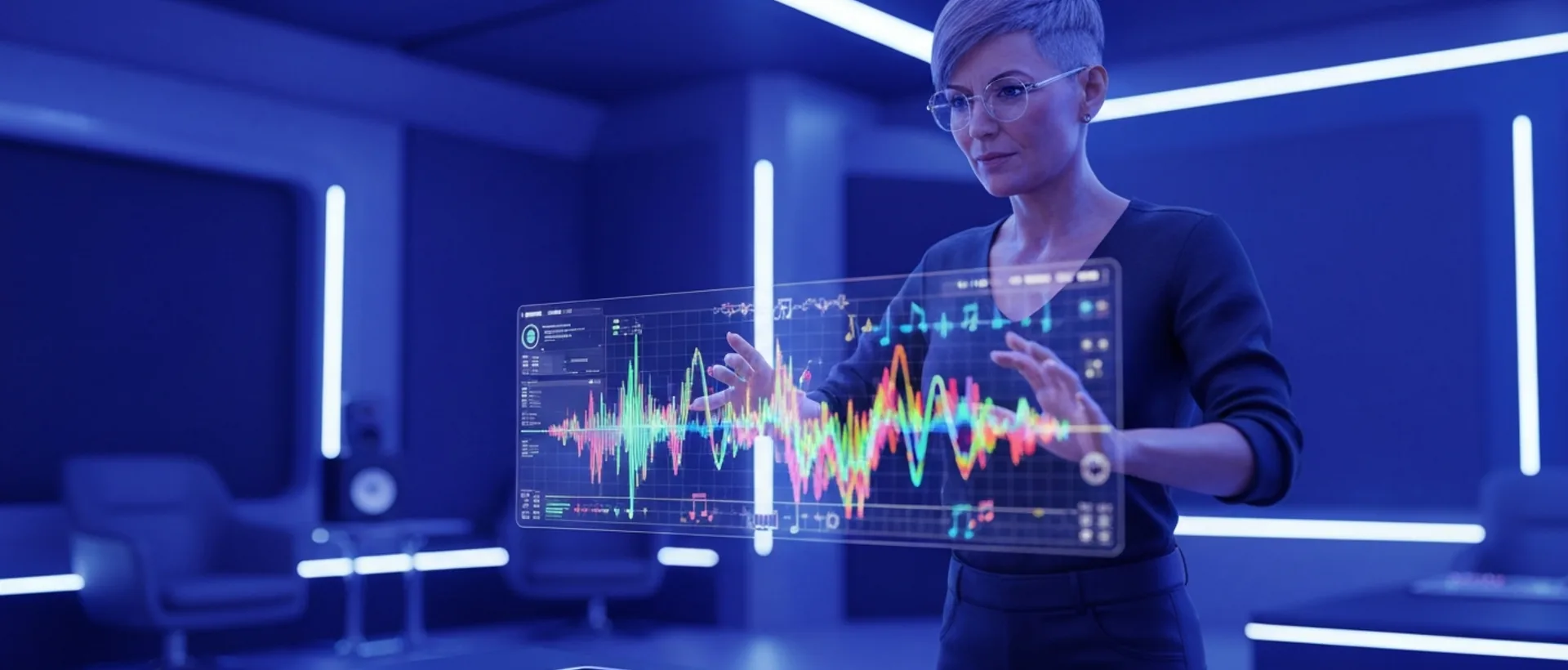
How AI Transforms Music in 2026: An Overview for Musicians
What’s up, music folks! If you still think artificial intelligence is something out of a sci-fi movie, I’m here to tell you: it’s already 2026, and AI is more ingrained in the music industry than that catchy earworm you can’t get out of your head. And no, it didn’t come to steal your job, but rather to be your new best friend in the studio – or, perhaps, a complex rival, depending on how you look at it.
Today, AI is like that Swiss army knife every musician should have. It offers powerful tools for composition, production, mixing, and mastering, democratizing access to resources that, until recently, were the privilege of large studios and artists with rockstar budgets musicdibs.com. Just think: you, an independent artist, can release studio-quality sound without having to sell a kidney to pay for an audio engineer’s time imusician.pro. That’s a game-changer, isn’t it?
Independent musicians, then, are thriving in this pool of possibilities. You can use AI to create vintage-sounding music, with that retro vibe, or to turbocharge your latest ideas. And if you have a band, you can personalize your sound with AI, giving it that polish that makes all the difference. Even reviving a band with AI, replicating styles or voices, has become a reality, although with some ethical questions we’ll discuss later.
The point is: AI isn’t here to replace you. It’s your co-pilot. Think of it as a creative partner that helps you generate crazy ideas, automate those repetitive tasks no one can stand anymore, and even gives you sonic perspectives you might never have considered. From melody generation to arrangement optimization, AI tools for music production are becoming a must-have for any artist looking to innovate and be more efficient.
In this guide, we’re going to dive headfirst into the main applications and show you how to integrate AI into your musical workflow so you can stand out in 2026. Get ready, because the way we make music will never be the same. And, honestly, thank goodness! It was about time for a shake-up, right?
Essential AI Tools for Music Production and Composition
Alright, now that you understand AI isn’t the T-1000 coming to get you, let’s talk about what matters: the tools! Because what’s the point of knowing AI is cool if you don’t know which one to use to compose that hit that’s going to play on the radio? (Or on Spotify, which is what counts these days).
There are several AI tools for music production that give you a hand in generating melodies, harmonies, and even lyrics. It’s like having a songwriting partner who never sleeps and has an infinite musical repertoire. Some of them are great for beginners who want to experiment without much commitment, you know?
And for those who like to give existing songs a new look, AI software for remixing music is a goldmine. They analyze your tracks, suggest new beats, arrangements, and open up a universe of creative possibilities. Have you ever thought about giving your old single a makeover with the help of AI? Just a thought!
[!CALLOUT tipo=“dica”] Experiment with different AI generators to find what best suits your musical style. Each tool has its “personality” and can surprise you with unexpected results. Don’t be afraid to test them out!
AI truly helps independent musicians overcome technical and financial barriers. With it, you have access to high-quality solutions for recording and editing, without having to invest a fortune in expensive equipment or professionals dittomusic.com. It’s the democratization of music production at its core!
And if nostalgia is your thing, there are platforms that use AI to create vintage music, replicating styles from past eras or specific artists. It’s ideal for projects that require that vintage touch or for those who want to pay homage without blatant copying. Just imagine recreating the sound of the 70s with algorithmic precision! That’s awesome, right?
For those in a band, AI can also be a great help in personalizing your sound. It analyzes your recordings and suggests timbre adjustments, equalization, and effects, helping you find a unique sound that truly represents your group. It’s like having a music producer you can consult 24 hours a day, without them complaining about their fee.
Still on the power of AI, Deezer, for example, in June 2026, launched a tool that allows users to identify 100% AI-generated tracks musicdibs.com. This shows how much the volume of AI-generated content is growing. By November 2025, the platform was already receiving over 50,000 fully AI-generated tracks daily, accounting for about a third of new deliveries musicdibs.com. In June 2026, that number was already seven times higher than in January 2025, representing almost half of the tracks submitted daily musicdibs.com. That’s a lot, folks!
And for those who want to delve a little deeper into how AI can help with content creation in general, not just music, check out our article on Discover: AI for Content Creators 2026: Complete Guide. It has some insights that apply well to the world of music too.
Step-by-Step Guide: Integrating AI into Audio Mastering
Mastering is like the cherry on top, or rather, the final pinch of salt that makes all the difference in your musical dish. It’s the stage where your music gains brilliance, volume, and that punch that makes it sound professional. In the past, this required an experienced mastering engineer and a studio with very expensive equipment. Today, AI is here to help us with that.
Learning which AI for audio mastering to use can save you a lot of money and give you results you’d only achieve with years of practice. Tools like LANDR and eMastered are examples that use intelligent algorithms to process your sound, applying compression, equalization, and limiting in an optimized way. It’s almost magic!
I’ll give you a step-by-step so you don’t get lost in this process:
- Choose an AI Tool: First, you need to decide which AI-powered mastering software you’re going to use. Popular ones include LANDR, eMastered, or even AI plugins that integrate with your DAW. Familiarize yourself with the interface of each to see which one you prefer.
- Upload the Track: After choosing, it’s time to upload your final mix. It’s crucial that this mix is balanced, without volume peaks that clip (distort) the sound. AI works wonders, but it can’t perform miracles, you know? A clean mix is half the battle.
- Define Parameters: Most AIs offer options for you to choose your track’s musical genre, intensity (whether you want something more “loud” and “aggressive” or more “smooth”), and perceived loudness level. Adjust these parameters according to your artistic vision and what the musical genre demands. Keep an eye on AI trends for music in 2026 to ensure your master is up-to-date with industry standards.
- Analysis and Processing: Now, AI springs into action! It will analyze your track, apply compression, equalization, limiting, and other processes to optimize the sound. All of this is done in a matter of minutes, which is a huge time-saver compared to the manual process.
- Review and Final Adjustments: Last but not least: listen carefully to the mastered version. Compare it with your original mix. Some platforms allow you to compare it with reference masters of famous songs. Make fine adjustments, if necessary. Remember that, despite the power of AI, your ear is still the most important tool for the final decision.
[!CALLOUT tipo=“aviso”] Important: Although AI is powerful, your ear is still the most important tool for the final decision. Don’t give up 100% control. The human touch still makes a difference!
I, personally, confess that I’ve used one of these tools to master some demos, and the result was surprising. Not that I’m an audio engineer, but for those who are starting out and don’t have the money to invest, it’s a huge help. It’s AI giving you a boost to put your sound out into the world with dignity!
AI and Music Copyright 2026: What You Need to Know
This is where things get a bit trickier, my friends. Advances in AI and music copyright in 2026 raise complex questions about who owns that awesome melody AI helped you create. Who holds the intellectual property of a work generated or co-created by algorithms? Is it yours, the AI’s, or no one’s? That’s the million-dollar question, and the answer, in Brazil, is very clear: Law 9.610/98 requires “human creation” for the protection of works iamusica.com.br. This means that, for now, music generated exclusively by AI is considered public domain ajeitosuamusica.com.br. That’s a tough one, right?
So, if you used AI software to remix songs or to personalize your band’s sound, the discussion is different. If AI was an auxiliary tool, and your human intervention was significant, then the situation changes. The complexity lies in defining what “significant human intervention” is.
To try and shed some light on this mess, ECAD (Central Office for Collection and Distribution), here in Brazil, has already taken action. In June 2025, they reformulated the music registration forms to include information about the use of AI sbacem.org.br. The idea is to differentiate human creations from AI-generated ones and protect authors’ rights. So, don’t try to be clever and say that AI did everything by itself and you just pressed a button, okay?
International music industry organizations, like IFPI and RIAA, are also catching up. In July 2026, they created a visual labeling system to inform consumers about the use of AI in music recordings on streaming services correiodamanhacanada.com. It’s an important step for transparency, but it also raises the question: does the average listener care about this? The truth is, according to studies, 97% of listeners cannot distinguish human music from AI rtp.pt. Can you believe it?
A UNESCO report from February 2026 estimates that music creators could see a global reduction of up to 24% in their earnings by 2028 due to the advancement of AI fenati.org.br. That’s a considerable slice of the pie, and we need to be smart not to lose out in this story.
[!CALLOUT tipo=“aviso”] Warning: Consult a copyright specialist for specific cases involving AI and your music. Legislation is constantly evolving, and each case has its peculiarities. Don’t be careless!
So, if you’re going to use AI to create vintage music or revive a band with AI, make sure you’re not infringing on the rights of pre-existing works. The complexity here is great, and the industry is still trying to adjust. My personal opinion? We need clearer and faster legislation, because technology moves like a jet, and the law, well, the law moves like a cart.
To better understand how AI is impacting the job market in general, and not just the music industry, check out our article AI in the Job Market 2026: It’s Not the End, It’s the Beginning!. It’s a read that can give you a broader perspective.
Music Marketing and Live Performances with AI in 2026
Now that we’ve discussed the boring (but necessary!) part of copyright, let’s talk about how AI can help you make your music and shows boom. Because there’s no point having an awesome sound if no one hears it, right? Music marketing with AI in 2026 is a powerful tool to optimize your campaigns, analyze audience data, and personalize the distribution of your sound to reach more fans.
Think with me: AI can analyze consumption patterns, identify who your ideal audience is, and where they are. With this, you can target your ads and promotions much more efficiently. No more wasting money on marketing that doesn’t reach anyone!
And it’s not just digital! AI can also make a difference in live shows. Have you ever imagined creating immersive experiences with real-time generated visuals, lighting that reacts to the music, and even interactive performance elements? AI for live shows allows all of this, transforming a concert into an unforgettable multi-sensory experience. The future is knocking on the stage door!
Keeping up with AI trends for music in 2026 is fundamental. AI can help you identify what’s trending, which genres are growing, and how to adapt your release and promotion strategy to maximize impact. It’s like having a crystal ball, only much more technological and precise.
Analyzing audience behavior and engagement metrics with AI tools for music marketing is another key point. You can find out which post performed best, what type of content generated the most interaction, and optimize your next publications and ads. It’s a continuous learning cycle that only AI can offer you with such agility.
And finally, AI can personalize fan interaction. From chatbots that answer frequent questions to individualized content recommendations. Have you ever thought about having a “virtual assistant” that chats with your fans on Instagram when you’re busy creating? AI does that. I, honestly, think AI can be a great ally in building a loyal community, as long as we don’t lose the human touch in communication, of course. No one wants to talk to a soulless robot.
Advanced Tips for Musicians: Maximizing AI’s Potential
We’ve reached the part where we simplify things for good and give you some insights to use AI in a way that goes beyond the basics. If you’ve made it this far, you’ve already understood that AI isn’t rocket science, but rather a powerful tool. Now, let’s turbocharge this!
First, experiment with AI to create vintage music, but with your own touch. It’s not just about replicating; it’s about combining elements from different eras and genres for an innovative and unique sound. Like, mixing a 70s funk with a 2026 trap. What if it turns into an unexpected hit? The sky’s the limit!
Use AI software to remix music not just to make covers, but to reinterpret your own tracks. Sometimes, an AI-generated remix can give you a new perspective on your own creation, opening up artistic paths you never imagined. It’s like looking at your music from another angle, and often, the result is surprising.
A golden tip: learn to “train” some AIs with your own musical style. There are tools that allow you to feed the algorithm with your compositions, riffs, and beats. This way, the AI learns your “signature” and helps you personalize your band’s sound in an even more authentic way. It’s like having your clone, but musical and without the flaws.
# Exemplo de prompt simplificado para geração de melodia em uma ferramenta de IA
# (Este é um exemplo conceitual, a sintaxe real varia por plataforma)

prompt = {
    "genero": "Funk Carioca",
    "bpm": 130,
    "instrumentacao": ["baixo", "bateria", "sintetizador"],
    "mood": "dançante e alegre",
    "melodia_base": "escala pentatônica maior em Dó",
    "inspiracao_artista": "Anitta (fase recente)",
    "variacao_ritmica": "síncopas acentuadas"
}

# Em uma ferramenta real, você passaria este dicionário ou um texto similar
# para o motor de IA gerar uma sugestão de melodia.
# exemplo_melodia = ia_musica.gerar_melodia(prompt)
# print(exemplo_melodia)
Stay updated on AI trends for music in 2026. Participate in online communities, follow specialized blogs, and, if possible, attend conferences. Technology advances rapidly, and what’s new today can be obsolete tomorrow. Staying informed gives you a huge competitive advantage. And if you want to know more about specific tools, our article AI for Creators 2026: Tools Guide can be a good starting point.
And the most important tip of all: consider AI as a member of your creative team. Collaborate with it, instead of just using it as a magic button. Talk to the AI (metaphorically, of course!), experiment, provoke. It’s in this interaction that the most unexpected and brilliant musical possibilities emerge. AI is a tool, but the creativity is still yours. Use it to elevate your art to another level. The future of music is collaborative, and AI is here to prove it.
Sources
- https://www.musicdibs.com/news/el-futuro-es-ahora-tendencias-industria-musical-ia-pt — The future is now: AI music industry trends ↩
- https://www.iamusica.com.br/blog/posso-registrar-musica-feita-por-ia-entenda-seus-direitos — Can I register AI-made music? Understand your rights ↩
- https://ajeitosuamusica.com.br/blog/registrar-musica-feita-por-ia/ — Registering AI-made music ↩
- https://sbacem.org.br/ecad-e-a-protecao-dos-direitos-autorais-na-era-da-inteligencia-artificial/ — ECAD and copyright protection in the age of artificial intelligence ↩
- https://imusician.pro/pt/recursos/blog/tendencias-da-industria-musical-para-2026 — Music Industry Trends for 2026 ↩
- https://www.correiodamanhacanada.com/industria-discografica-cria-rotulo-de-informacao-sobre-uso-de-ia-nas-musicas-em-streaming/ — Recording industry creates information label on AI use in streaming music ↩
- https://fenati.org.br/industria-musical-pode-perder-24-da-receita-com-avanco-da-ia/ — Music industry could lose 24% of revenue with AI advancement ↩
- https://dittomusic.com/pt/blog/ai-for-musicians-tools-to-help-you-make-music — AI for Musicians: Tools to Help You Make Music ↩
- https://www.rtp.pt/noticias/economia/industria-musical-procura-conter-efeitos-da-ia-no-setor_n1746631 — Music industry seeks to contain AI effects in the sector ↩
Ready to scale this idea?
Narratron turns topics like this into retention-optimized YouTube scripts in under 2 minutes — magnetic hook, structure, complete SEO, timestamped description and thumbnail prompt ready to ship. 50 free credits, no card required.