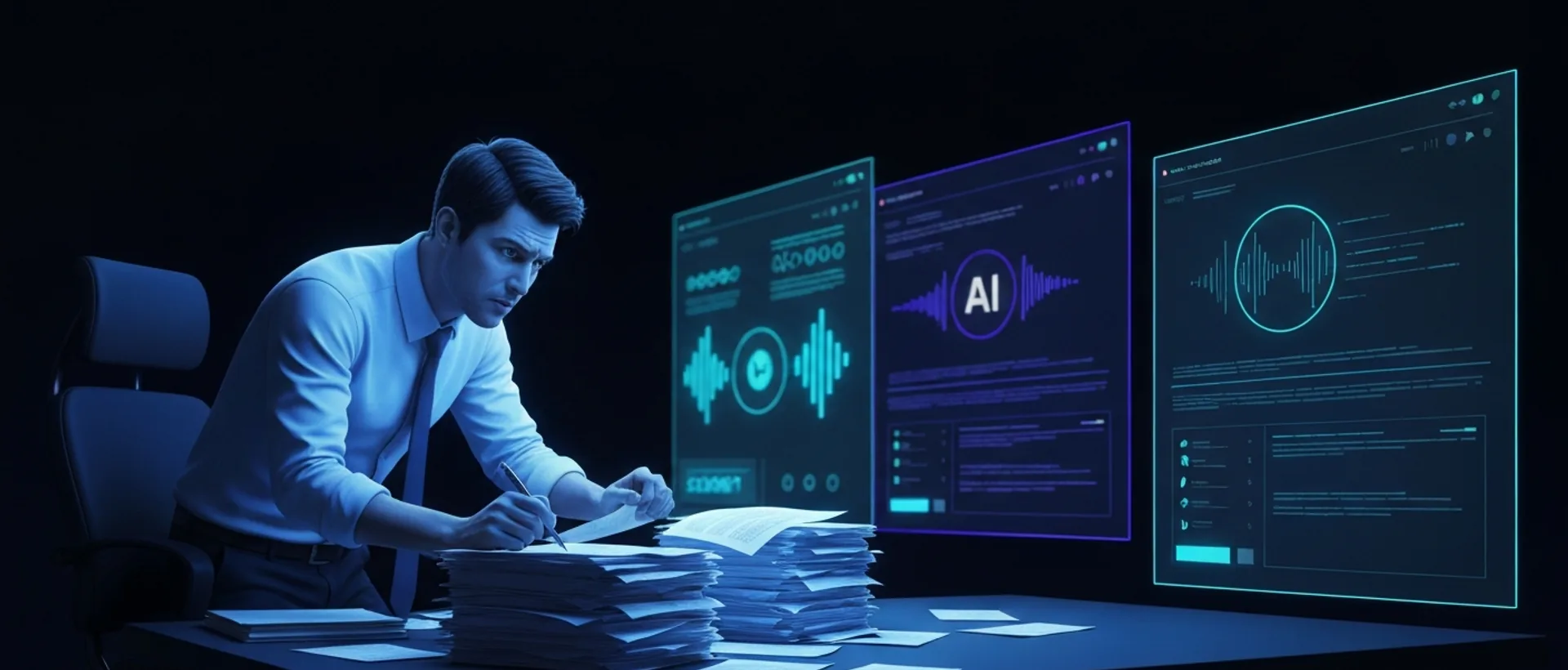
The Illusion of the ‘Best’ AI for Transcription in 2026: Stop Looking!
Hey there, tech and entrepreneurship folks who are always on the go! Have you ever stopped to think that, in 2026, the search for the “best AI transcription tool” is like looking for a unicorn in downtown São Paulo? It’s an illusion, a trap that makes you lose time and, worse, money. The truth is, the perfect tool doesn’t exist, right? What exists is the right tool for your specific need. And, seriously, most people make a big mistake by focusing only on price or popularity.
Many people still think that transcribing audio automatically with AI is a luxury, like having a self-driving car just to go to the bakery. But it’s not! It’s a misunderstood necessity. We’re not talking about replacing people, about sending the transcription team home. We’re talking about optimizing processes, about freeing up your team’s time for tasks that really matter. For example, in 2026, healthcare companies are using voice AI to provide better service, reducing bureaucracy and giving teams more time to focus on patients omnismart.com.br. Get the difference?
The “advantages of AI in transcription” are overestimated when you don’t know how to use the full potential of the thing. It’s not just about the speed of transforming speech into text, which is already a huge gain. It’s about contextual accuracy, identifying who’s speaking, summarizing conversations, and even translating in real-time future-trans.com. Think with me: if your company already uses AI in almost everything, from emails to qualtir.com reports, why would transcription be any different? By July 5, 2026, AI transcription will have already become a complete suite of tools that captures, organizes, and even reuses spoken content future-trans.com. It’s not just a robotic typist; it’s a digital Swiss Army knife.
And what’s the “best AI for free audio transcription”? My confession: None that are genuinely good for professional use. Sorry for the honesty, but it’s the truth. Those unrealistic expectations that you’ll get a top-tier service for free only lead to frustration and underutilization of technology. I mean, what’s free often ends up being expensive in the end, right? You lose out on quality, on review time, on features that could change the game.
AI for transcription isn’t magic; it’s mathematics. The ‘best’ tool is the one you understand how to feed and refine, not the one that promises miracles. Those who seek ‘free’ generally pay the price of low quality and wasted time.
So, before you go hunting for the “best,” understand what you need. Your search shouldn’t be for a product, but for a solution that fits your workflow. And if you’re focused only on price, I’m sorry to tell you, you’re already starting wrong.
Why Your AI Transcription Strategy Is Ineffective (and How to Change It)
Let’s face it, most of you who try to use AI for automatic captions or AI-powered meeting transcription fail miserably. And do you know why? Because you ignore the basics: the importance of audio pre-processing and contextual training. You can’t expect AI to work miracles with poor audio, full of noise, people talking over each other, and strange accents. It’s like trying to make a delicious cake with expired flour and rotten eggs. It’s not going to happen, my friend!
The “price of AI transcription software” isn’t the decisive factor either, no matter how tight the budget. Investing in cheap solutions that then force you to spend hours and hours manually correcting is foolish, excuse my language. In fact, it ends up being much more expensive! You need to understand the total cost of the whole thing, not just the sticker price. A 2025 global content automation report already showed that most companies that implemented AI for transcription without a clear protocol had an extremely high rework rate startse.com.
Your obsession with “AI for Brazilian Portuguese transcription” often makes you forget that Brazil is huge, right? There are accents from the Northeast, the South, the Central-West, slang from here and there. A good tool not only understands Portuguese but allows for personalization and adaptation. It adapts to your context, it doesn’t force you to use a generic language that foreign AI learned from a Brazilian soap opera. In 2026, AI is already reinventing the way we create and sell, with voice becoming a pillar of hyper-personalization startse.com. Your brand will have its own vocal identity, and that includes understanding your audience’s voice.
And your “AI transcription tool comparison” is probably focusing on the wrong metrics. Raw accuracy is important, of course. But the ability to integrate with your workflow, the ease of post-editing, and the tool’s flexibility for different scenarios are crucial. What good is 99% accurate AI if it doesn’t connect with your CRM or if the interface is a mess? We already have complete guides comparing these tools, considering accuracy, languages, features, and prices unite.ai. The problem isn’t a lack of information; it’s what you do with it.
To avoid falling into this trap again, my advice is: look beyond the obvious. Think of AI transcription as part of a larger ecosystem, not as an isolated solution. And if you’re curious about how AI can impact technology more broadly, check out our article on AI Technology Impact 2026: Why You’re Wrong!. I bet it will give you another perspective.
The True Potential of AI Transcription in 2026: Focus on Efficiency
To effectively ‘transcribe audio to text with AI,’ the first lesson is: start with source quality. It’s like getting the basics right, you know? Clean audio, with good diction and without much background noise, drastically reduces the AI’s error rate and, consequently, the time you spend reviewing. It’s simple math, but many people ignore it. AI can be super powerful, but it doesn’t work miracles if you provide audio that sounds like it was recorded inside a pressure cooker in the middle of a bustling market.
Don’t underestimate ‘AI video to text transcription.’ It’s not just for generating automatic captions. You can use it to index content, create automatic summaries, and even improve your videos’ SEO. Just think: your video can become a searchable asset, with specific segments found by keywords. This is gold for content creators and companies that produce a lot of video material. Voice AI, in 2026, is a pillar of hyper-personalization in marketing startse.com. If you’re not using this for transcription, you’re missing out on a huge opportunity.
‘Security and privacy in AI transcription’ is a blind spot for many, and it makes my hair stand on end. You simply cannot use just any service for sensitive data, like company strategic meetings or patient information. That’s asking for a headache! Opt for platforms that offer robust encryption, compliance certifications, and clear data retention policies. The rush for productivity with AI often overrides ethical controls, creating a free-for-all in data management and security fia.com.br. Stay sharp!
Everyone talks about AI for transcription, but few understand that the real advantage isn’t in automation, but in intelligent semi-automation. The machine does the heavy lifting, the human refines the essential. #AITranscription #2026
— @TechGuruBr no X
By the way, if you’re interested in other aspects of AI, we have some great content on AI Text to Speech 2026: Why Your Obsession Is Misguided. Sometimes we focus so much on one thing that we forget the big picture.
Tired of redoing AI transcriptions? The problem isn’t the AI; it’s your approach. Stop treating AI like a magic button. It’s a tool that requires strategy. Invest in audio quality and contextualization. #SmartTranscription #AI
— @DigitalInsights no Threads
AI for transcription in 2026 isn’t just a digital secretary; it’s an audio data analyst, a content indexer, and an accessibility assistant. But for it to truly work, you need to provide the right tools and, most importantly, use it intelligently. It’s not just about pressing a button and expecting magic to happen.
The Dark Side of AI in Transcription: Biases and the Digital “Truth”
Now, let’s talk about something serious that many people prefer to ignore: the dark side of AI in transcription. Because, like all technology, it’s not perfect and has its flaws. AI-powered automatic transcription, as common as it may be in 2026, presents systematic biases voicit.com. And that, my friend, is a huge problem.
These biases can affect accuracy across different voices, accents, or contexts. Have you ever considered that AI might have more difficulty transcribing a strong Northeastern Brazilian accent than a standard national news accent? Or that it might not understand specific technical terms from your market niche? This raises serious questions about the reliability of transcriptions as evidence in important decisions, such as in legal or HR processes voicit.com. We can’t blindly trust it. Just because the robot wrote it doesn’t make it the absolute truth, right?
The rush for productivity gains with AI often overrides concerns about ethical and regulatory controls. This creates huge gaps in data management, security, and transparency. By 2026, over 80% of companies will have AI solutions, and 80% of software providers will integrate generative functions into their products kron.digital. In other words, AI is everywhere. But that doesn’t mean it’s infallible.
It is truly fundamental that you keep the original audio and always review transcriptions with humans. Always! No matter how good the AI is, the human touch is still irreplaceable for ensuring information integrity. And to help, consider using speaker identification and timestamps that AI platforms already offer future-trans.com. This provides more context and helps validate what was said and by whom.
To whom does the ‘truth’ belong when AI transcribes? That’s the million-dollar question. If AI has biases, it can distort reality, and that has serious consequences. It’s not just a typo; it can be an interpretation error that costs you a business deal, a relationship, or even a lawsuit. Therefore, use AI intelligently, but with a massive dose of skepticism and human review. Technology is there to help, not to leave you tied up.
Sources
- https://www.unite.ai/pt/best-ai-transcription-software-services/ — The best AI transcription software ↩
- https://future-trans.com/pt/servi%C3%A7os-de-transcri%C3%A7%C3%A3o-de-IA/ — AI Transcription Services ↩
- https://voicit.com/pt/blog/recursos-humanos/evidencias-de-transcricao-de-vies/9002/ — Evidence of Transcription Bias ↩
- https://fia.com.br/blog/etica-na-inteligencia-artificial/ — Ethics in Artificial Intelligence ↩
- https://qualtir.com/pt/blog/future-of-ai-enterprise — The Future of AI in the Enterprise ↩
- https://www.startse.com/artigos/a-nova-era-da-voz-como-a-ia-esta-reinventando-a-forma-de-criar-atender-e-vender/ — The New Era of Voice: How AI is Reinventing How We Create, Serve, and Sell ↩
- https://omnismart.com.br/blog/blog-atendimento/7-tendencias-de-ia-de-voz-para-atendimento-em-2026-domine-o-futuro-do-sac/ — 7 Voice AI Trends for Customer Service in 2026: Master the Future of Customer Service ↩
- https://www.kron.digital/tendencias-de-ia-2026-5-previsoes-para-o-mercado-corporativo/ — AI Trends 2026: 5 Forecasts for the Corporate Market ↩
Read next
- IA Texto-Para-Fala Offline 2026: Por Que Você Está Errado
- IA Diagnóstico Médico 2026: Por Que Você Está Errado!
Ready to scale this idea?
Narratron turns topics like this into retention-optimized YouTube scripts in under 2 minutes — magnetic hook, structure, complete SEO, timestamped description and thumbnail prompt ready to ship. 50 free credits, no card required.