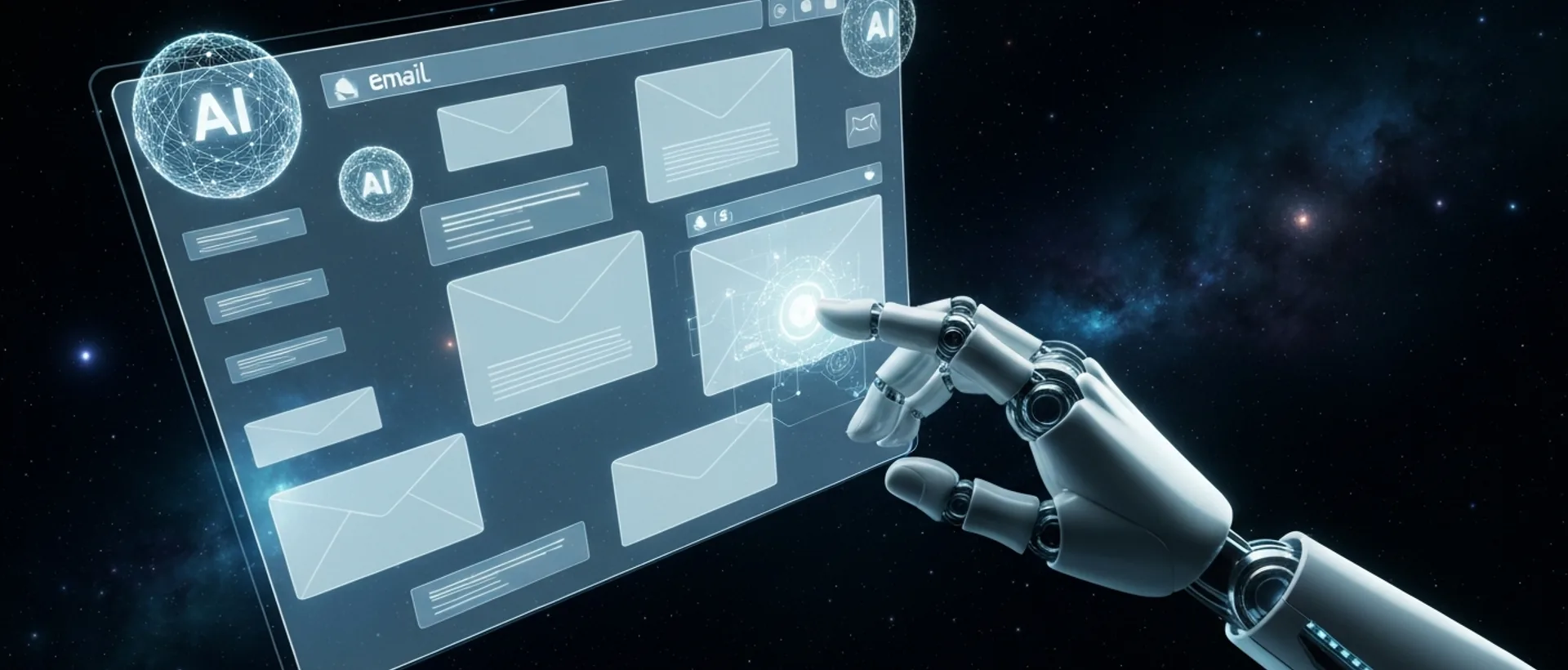
AI email automation in 2026 is no longer science fiction talk; it’s the reality defining the success of digital marketing campaigns. It uses smart algorithms to make your emails more accurate, personal, and, of course, automatic. Forget manual, repetitive work; artificial intelligence now handles content creation, chooses the best subject line, and even decides the optimal time to send a message to each person. For me, this is the biggest game-changer since email was invented!
AI can analyze a ton of customer data, predicting what they want and adapting communication so people truly engage and, as a bonus, buy more. In 2026, AI-powered automation tools are smarter, delivering actionable insights on the fly and executing everything in real-time. The results? Incredible efficiency, personalization that seems magical, and a return on investment that makes any marketer grin from ear to ear.
What is AI Email Automation in 2026?
AI email automation in 2026, honestly, is like having an army of marketing geniuses working 24/7 for you, but without complaining about the coffee. We’re talking about using artificial intelligence to supercharge, personalize, and automate your email marketing campaigns in a way that almost seems like magic. And the coolest part is that it does everything by itself!
This includes a bunch of things that used to be a real pain. For example, AI can create email copy, suggest irresistible subject lines, segment your audience with incredible precision, and even optimize send times for each person. Who would’ve thought machines would be so good at understanding people, right? It takes a gigantic volume of data, analyzes user behavior patterns, anticipates what they’ll want next, and adapts communication to make engagement and sales skyrocket. It’s like having a crystal ball, but one that actually works.
In 2026, AI email automation tools are much more integrated and can predict the future of customer behavior with frightening accuracy. They give you clear and direct information and execute actions immediately, without fuss. The benefits are clear: you gain more efficiency, can personalize your messages for many people at once, and your marketing ROI is much higher. For me, anyone not using this by now is losing money and time. It’s like trying to paddle a leaky boat with a spoon.
Essential Benefits of AI in Email Marketing Automation
When we talk about AI in email marketing automation, the first thing that comes to mind is personalization at scale. And for good reason! AI allows you to create emails that seem hand-crafted for each of your subscribers. It adapts the content, offers, and even the tone of voice, all based on behavioral data and individual characteristics. It’s like the baker who already knows your order before you even open your mouth.
Another point that leaves me amazed is the improvement of campaigns. AI tools analyze what worked (or didn’t) in past campaigns and provide immediate suggestions. From testing different subject lines to adjusting call-to-action buttons (the famous CTAs). It learns from successes and failures, which is a huge help for us.
Operational efficiency is a benefit that can’t be ignored. You know those tedious, repetitive tasks, like segmenting lists or scheduling sends? AI does all of that quickly, freeing up your marketing team’s time. This allows them to focus on what really matters: creating more elaborate strategies and truly attention-grabbing ideas. Nobody deserves to spend their day copying and pasting, right?
Behavior prediction is where AI truly shines. It can anticipate your customers’ next actions, allowing you to send highly relevant emails even before they realize they need something. It’s like having a sixth sense for sales. And finally, advanced analytics transforms a ton of complex data into simple, useful information. Something that would be impossible to do manually. This helps in making smarter, more planned decisions.
How to Use Artificial Intelligence in Email Marketing: A Practical Guide
To start using artificial intelligence in your email marketing and see the magic happen, the first step is quite basic, but many people skip it: define your objectives. What do you want AI to do for you? Increase open rates? Get more people to click? Sell more? Or perhaps prevent customers from churning? Being clear about this helps choose the right tools and guide your strategy. If you don’t know where you’re going, any AI will do, but the results might be frustrating.
Next, it’s time to choose the best AI for email marketing 2026 for your business. There are a ton of options on the market, and the choice will depend on your budget and what you need. Research thoroughly, see which tools integrate with what you already use, and ask for demos. My tip? Don’t go for the first one you see, unless it’s truly outstanding.
With the tool chosen, the next step is to integrate and collect data. Connect your email marketing platform with AI and ensure it has access to all important customer information. Purchase history, visited pages on the website, what they like to see… the more data, the smarter the AI becomes. It’s like feeding your pet: the better the food, the healthier it gets.
Then, set up intelligent email flows. Use AI to create email sequences that are sent automatically when something happens. A customer abandoned their cart? Send a reminder email. Visited a specific product? How about an email with more details? Had a birthday? A special discount! AI handles all of this for you. And to top it off, continuously monitor and improve. AI learns over time, so keep an eye on the results, make adjustments, and let artificial intelligence refine your strategies. It’s not a “set and forget,” but rather a “set and improve.”
Best AI Email Automation Tools in 2026
When it comes to the best AI for email marketing in 2026, the market is buzzing with options. But some stand out for their robustness and the intelligence they deliver. ActiveCampaign, for example, is famous for its strong automation and the machine learning resources it uses for segmentation and personalization. For me, it’s one of the favorites for those who want to go beyond the basics.
GetResponse also deserves a spot on the list, especially if you’re looking for AI to help with email copywriting. It suggests subject lines and optimizes send times, making it a great option for small businesses that need a little push for creativity.
Mailchimp, already a classic, hasn’t stood still. Now it integrates AI for predictive insights, product recommendations, and content improvement. It’s proof that even giants need to update to remain relevant.
HubSpot uses AI to personalize content, analyze campaign performance, and create email marketing workflows that are quite complex but deliver results. And if you work with e-commerce, Klaviyo is the one. It specializes in intelligent email flow automation based on detailed purchase behavior. It’s like having a super attentive salesperson who knows exactly what each customer wants.
Need impeccable and creative text for your emails? Narratron can help you create content that truly connects with your audience, saving your time and boosting your campaigns.
Choosing among these beauties can be a challenge, but the important thing is to understand what each offers best and how it fits into your strategy. There’s no point in using a cannon to kill a fly, right? Or, on the other hand, trying to take down an elephant with a slingshot.
Comparative Table: AI Email Automation Tools (2026)
Choosing the right tool is like choosing which team to root for in the national league: you have to see which one best fits your heart (and your budget, of course). To help you with this important decision, I’ve put together a table comparing the key features, cost, and differentiators of the tools that are booming in the AI email automation market in 2026.
This overview will shed some light for you to decide which tool is best for your type of business. After all, what works for a giant company might not be ideal for a small one, and vice-versa.
| Feature | ActiveCampaign | GetResponse | Mailchimp | HubSpot | Klaviyo |
|---|---|---|---|---|---|
| AI Personalization | High | Moderate | Moderate | High | High |
| AI Copywriting | Moderate | High | Moderate | Moderate | Low |
| Predictive Segmentation | High | Moderate | Moderate | High | High |
| Initial Cost | $$$ | $$ | $$ | $$$ | $$$ |
| Ideal For | Medium to Large Businesses | Small Businesses | Small to Medium Businesses | Large Businesses | E-commerce |
We used a few criteria for this comparison, such as the personalization capability offered by AI, whether it helps generate email content, the accuracy of predictive segmentation, cost-benefit, and, of course, ease of use. Because what’s the point of a super powerful tool if no one can use it, right?
Choosing the right tool is a crucial step for you to succeed with your AI email marketing strategy. Think carefully about your company’s specific needs, the size of your team, and the growth capacity of the solution you choose. It’s not just about pressing a button and expecting a miracle; there needs to be good planning behind it.
Examples of AI Email Marketing and Success Stories
Seeing how AI works in email marketing in practice really makes things click for us. Netflix, for example, is a master at this. It uses AI to recommend personalized movies and series, and its “New for You” emails have open and engagement rates that are enviable. It’s as if Netflix knows exactly what you’ll want to watch on the weekend.
Amazon does something similar, but with products. It implements AI to send “Products You Might Like” emails based on your browsing and purchase history. The result? Sales that keep growing. It’s one of those things where you think, “wow, how do they know?”
Spotify also does a great job. It generates weekly emails with “Discover Weekly” playlists that are fully personalized by AI. This keeps users glued to the platform, always listening to something new that matches their taste. For me, this is proof that AI isn’t just for selling; it’s for keeping people happy and engaged.
[!CALLOUT tipo=“dica”] Tip: Dive into your own customer data. It hides unique opportunities to personalize with AI in ways your competitors can’t even imagine. It’s your differentiator!
An online fashion retailer I know implemented AI to optimize the send time for promotional emails. Guess what? The click-through rate increased by 15% because they were reaching customers at the exact moment they were most likely to buy. It’s the perfect timing that AI provides. And a SaaS company used AI to segment users based on product usage and sent personalized tutorials and tips, reducing subscription cancellations by 10%. This shows that AI isn’t just for attracting, but also for retaining.
The Future of AI Email Automation: Trends for 2026
Looking at 2026 and beyond, the future of AI email automation seems like something out of a science fiction movie, but it’s the pure reality knocking at the door. One of the hottest trends is conversational AI. Imagine being able to interact with an AI chatbot directly within the email, asking questions or receiving personalized information instantly. That changes everything, right? We’ll be able to ask things and get instant answers, without even leaving the inbox.
Another thing that will come strongly is real-time dynamic content. Emails will no longer be static. They will adapt to the user’s context at the moment of opening: location, weather, time of day. Opened the email in the morning at the beach? Get a sunscreen offer. Opened it at night in the mountains? A promotion for warm clothing. That’s thinking ahead!
Predictive hyper-personalization is the next level. AI won’t just guess what the customer wants, but when they want it. It’s as if it knows more about you than you do yourself. This will allow brands to arrive with the right offer, at the most opportune moment for purchase, even before the customer feels the need. It’s a bit scary, I confess, but very efficient.
AI email automation in 2026 will be even smarter, more predictive, and integrated, transforming how brands connect with their customers in ways we can barely imagine today.
And get ready for autonomous campaign generation. AI will create complete email campaigns, from design to copy and segmentation, with very little human intervention. We’ll provide the idea, and it will do the rest. Finally, voice optimization and accessibility will also gain prominence. Emails optimized for voice assistants and with a greater focus on accessibility, all driven by AI. Those who don’t adapt to this will be left behind, like a car out of gas in the middle of the road.
FAQ
What is the best AI for email marketing in 2026?
The best AI for email marketing in 2026 is the one that fits your specific needs. Tools like ActiveCampaign and HubSpot are excellent for robust automation and personalization, while GetResponse excels in AI copywriting. For e-commerce, Klaviyo is a strong contender worth considering.
How can artificial intelligence optimize email campaigns?
Artificial intelligence improves email campaigns by analyzing data for predictive segmentation, personalizing content and subject lines, optimizing send times, and performing A/B tests automatically. This results in higher engagement and improved conversion rates, making every email count more.
Is it possible to use AI for email copywriting?
Yes, it is entirely possible to use AI for email copywriting in 2026. Many email automation tools, such as GetResponse and Mailchimp, already integrate AI functionalities that help generate text ideas, subject lines, and even complete email drafts, saving time and enhancing your team’s creativity.
What are the benefits of AI in email automation for small businesses in 2026?
For small businesses in 2026, the benefits of AI in email automation include the ability to compete with larger players through personalization at scale, optimizing campaigns with limited resources, and freeing up time to focus on business growth. More accessible tools offer these features, democratizing access to technology.
Is intelligent email flow automation with AI complex to set up?
While intelligent email flow automation with AI might seem complex, modern platforms are designed to be intuitive. They offer drag-and-drop interfaces and pre-defined templates that simplify the setup of email sequences triggered by user behavior, making it accessible even for beginners.