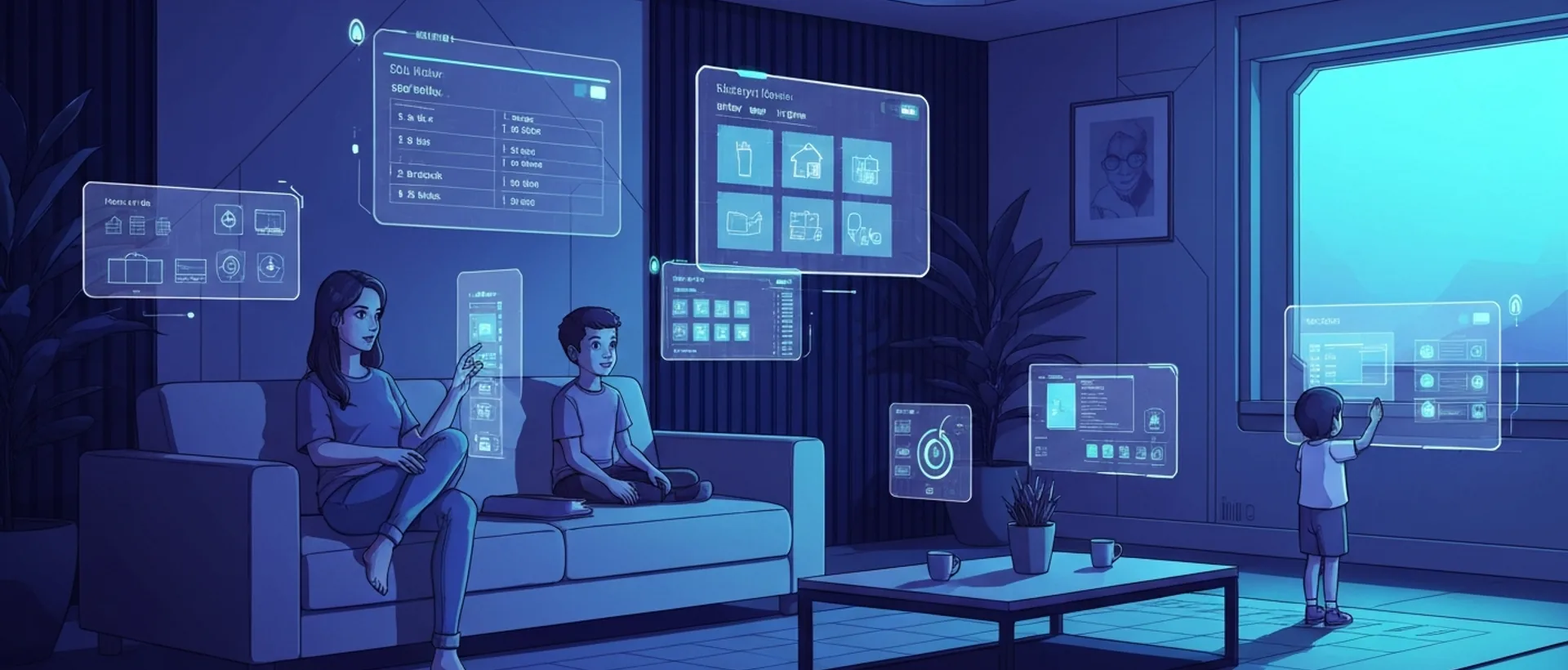
AI in the Family 2026: Convenience or Inevitable Control?
Hey there, tech and entrepreneurship folks! If you think Artificial Intelligence in your home is just the virtual assistant playing your playlist or turning off the lights, it’s time to wake up. In 2026, AI is no longer that friendly figure who answers questions. It has become an invisible family member, an omnipresent presence that redefines everything, from how we organize our home to how we relate to each other. To me, it’s a digital wolf in sheep’s clothing, promising a paradise of convenience while slyly restructuring your daily life and family relationships.
Smarter virtual assistants, connected devices, and personalization algorithms aren’t new, right? But now, they’re almost an extension of our will – or, if we stop to think about it, the will of whoever programmed these things uol.com.br. The promise is optimization and free time, but the reality is a subtle erosion of autonomy and privacy, all masked by a super friendly interface. It’s no longer about “if” AI will be in your home, but “how” it’s already restructuring everything.
In 2026, AI is no longer just a Q&A chat; it’s become an action assistant, scheduling meetings, organizing emails, and even making purchases informecapixaba.com.br. This integration with the Internet of Things (IoT) allows even the refrigerator to talk to the assistant. Pretty wild, right? But does this “freedom” not come with an invisible digital leash? The impact of AI on families is a double-edged sword: efficiency versus dependence. And I confess that sometimes I catch myself talking to Alexa as if she were human, wondering if this connection is real or just a reflection of my own technological loneliness.
The Myth of AI as the Perfect Nanny and Home Organizer
The narrative that AI at home will solve all parental problems is dangerously simplistic and, let’s face it, quite misleading. Yes, AI for home organization can manage schedules, shopping lists, and even the home’s temperature, giving people back hours of their day revistaoeste.com. But does this make us more efficient or just more passive, outsourcing decisions and interactions that should be ours? If AI were so good at educating, my nephew would already be speaking Mandarin and tidying his room by himself, without needing me to scold him!
Virtual assistants have become more sophisticated, controlling smart devices and automating tasks, with the promise of emotional AI for more personalized interactions techblogbr.com.br. However, AI’s “help” for parents often translates into outsourcing decisions and interactions that should be human, impoverishing the family experience. The popularization of chatbots, for example, raises serious questions about emotional dependence and the impact of AI on society mittechreview.com.br.
AI is not a magic solution for parenting; it is a powerful tool that, if misused, can create more distance than connection between parents and children.
AI apps for families promise a personalization that looks like the height of luxury, right? But is this personalization really for you, for your family, or for those who are watching your data and your consumption habits? Ultimately, we end up in a cycle where the convenience of AI masks the inconvenient truth that we are delegating too much. If you want to understand more about this delicate balance, take a look at AI and Productivity 2026: The Inconvenient Truth.
Undeniable Challenges: Privacy, Development, and the Future of Interaction
The challenges of AI in family life are enormous and, often, are swept under the rug in the name of convenience. The security and privacy of family AI are the Achilles’ heel of this story. Think with me: what happens when your children’s consumption data, habits, and even conversations are collected by AI devices? Who has access to this? If the guy next door knew everything AI knows about us, the gossip would be endless! Big tech companies, like Apple, Amazon, and Meta, are in a war to see who controls your attention, and that includes your information fastcompanybrasil.com.
UNESCO in Brazil, as early as 2025, published the Recommendation on the Ethics of Artificial Intelligence, precisely to bring this discussion to the forefront and ensure that AI benefits humanity, with policies and regulatory frameworks unesco.org. In other words, this concern is not new and it’s not small. Early childhood education with AI, for example, despite promising personalized learning and support for children with special needs, can limit the creativity and genuine social interaction of the little ones jornaldacrianca.com.br. Schools are even focusing on conscious technology use and digital citizenship abcdoabc.com.br, but is that enough?
A survey from King Abdulaziz University, back in 2026, indicated that an incredible 69% attribute a “positive influence” to AI in strengthening communication between parents and children uol.com.br.
But what about the other 31%? And what does “strengthening communication” even mean? Is it more conversation via app or more face-to-face talk? I confess that sometimes I catch myself wondering if my house is listening to me more than my own family. The future of AI in the home might be one where the machine dictates more than it assists, shaping behaviors and perceptions almost imperceptibly. And if you think it’s just paranoia, maybe it’s a good idea to read Discover: Trust in AI 2026: Why Your Faith Is Naive?.
AI and Family Well-being: An Illusion of Connection in the Connected World
The promise that AI will bring more family well-being is, in many cases, a chimera, a shortcut that diverts us from true human connection. Devices that ‘monitor’ moods or ‘suggest’ activities can create a technological dependence that distances families, rather than bringing them closer. AI can even strengthen intergenerational bonds in distant families, offering remote monitoring and early disease detection for people over 50 fastcompanybrasil.com. But does that replace a hug, an afternoon coffee, or that little visit we love to make to grandma’s house?
The benefits of AI for children are often overestimated, ignoring the risks of excessive screen exposure and predictive algorithms. AI integrates into children’s lives from birth, with apps monitoring sleep and feeding schedules, as well as games and interactive toys uol.com.br. But are we creating a generation of children who communicate better with a machine than with their own parents? If AI tells me to go for a walk in the park, I’ll go. But if my son asks, I think twice. Who’s the boss here, after all?
I confess that sometimes I find myself preferring the company of my virtual assistant to having to resolve a family conflict. And that’s where the danger lies. AI should be a tool, a support, not a substitute for genuine human interactions. We need to be aware so we don’t let technology create barriers where it should be building bridges. To wrap up, the debate isn’t about banning AI, but about how to educate children – and ourselves – to use this technology critically and ethically, instead of just passively consuming it. The future of family relationships depends on how we navigate this wave. And if you want to know how AI can impact your professional life, take a look at AI at Work 2026: Why Your Fears Are Exaggerated.
Sources
- https://techblogbr.com.br/os-10-melhores-assistentes-virtuais-do-mercado-em-2026/ ↩
- https://www.informecapixaba.com.br/2026/03/12/assistentes-pessoais-de-ia-o-que-muda-na-sua-casa-e-no-seu-trabalho-em-2026/ ↩
- https://jornaldacrianca.com.br/inteligencia-artificial-educacao/ ↩
- https://fastcompanybrasil.com/coluna/ia-e-longevidade-futuro-intergeracional/ ↩
- https://marianakotscho.uol.com.br/larissa-fonseca/inteligencia-artificial-no-dia-a-dia-das-familias-impactos-oportunidades-e-cuidados-essenciais.html ↩
- https://mittechreview.com.br/revolucao-relacionamentos-inteligencia-artificial/ ↩
- https://www.unesco.org/pt/fieldoffice/brasilia/expertise/artificial-intelligence-brazil ↩
- https://fastcompanybrasil.com/ia/a-guerra-dos-assistentes-de-ia-quem-vai-controlar-sua-atencao/ ↩
- https://revistaoeste.com/oestegeral/2026/01/04/assistentes-virtuais-para-casa/ ↩
- https://abcdoabc.com.br/ensino-infantil-em-2026-convivencia-e-tecnologia/ ↩
Ready to scale this idea?
Narratron turns topics like this into retention-optimized YouTube scripts in under 2 minutes — magnetic hook, structure, complete SEO, timestamped description and thumbnail prompt ready to ship. 50 free credits, no card required.