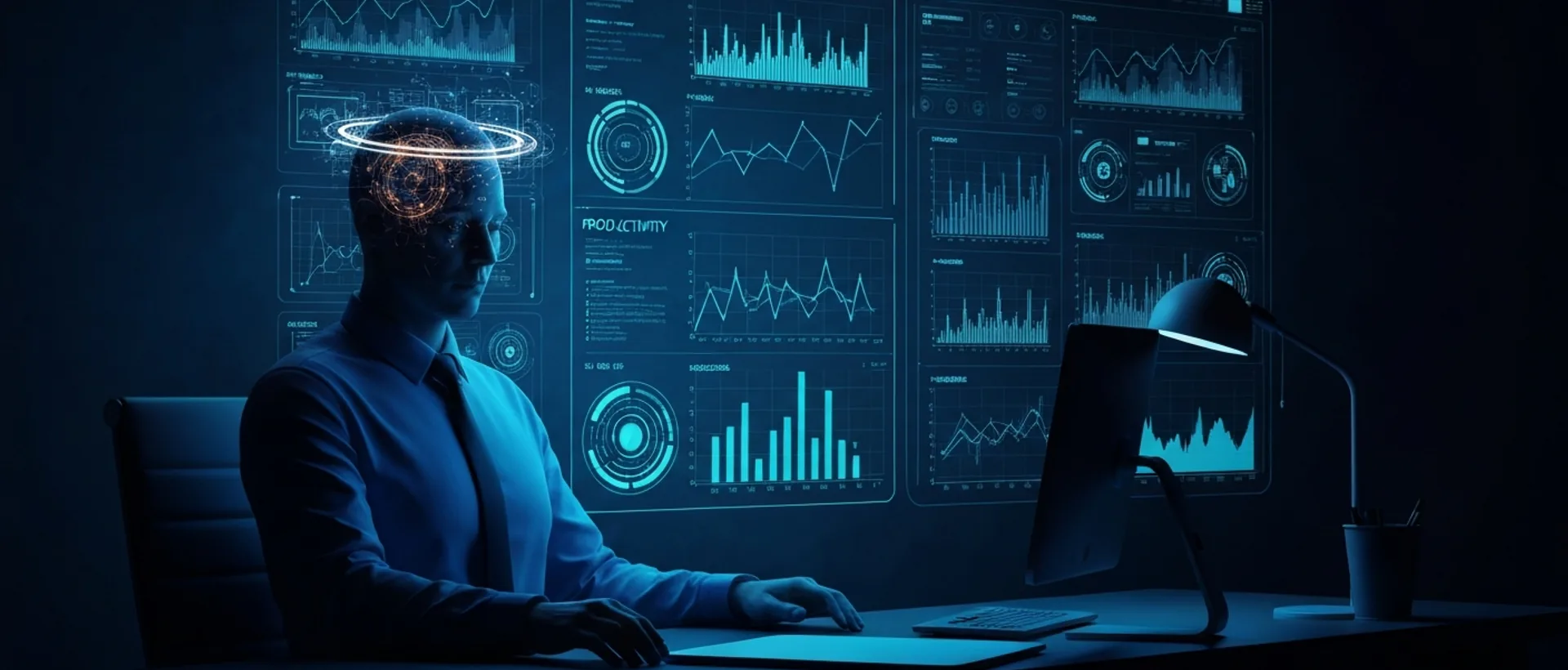
AI in Corporate Mental Health: More Surveillance Than Support?
Hey there, innovation and entrepreneurship folks! We live in a time where Artificial Intelligence, or AI for those already familiar, has become the spice of almost everything. At work, it promises the world, especially when the topic is “corporate AI well-being 2026.” But, between you and me, is the focus really on employee well-being or on the productivity that brings profit to the company? Because, honestly, sometimes I feel like we’re more like guinea pigs in an experiment than beneficiaries of a technology meant to help wellhub.com.
The official narrative is beautiful: AI will optimize boring tasks, reduce mental load, and even offer personalized support for mental health. How wonderful, right? Identifying stress patterns, suggesting breaks, maybe even an algorithmic “good morning, are you okay?” It sounds like a dream, but reality has some catches. Many of these “AI tools for workplace stress” end up monitoring our behavior, our communications, and this raises a giant red flag about privacy and our autonomy.
“Psychological support in the workplace” through AI can be very impersonal. Imagine confiding in a chatbot about the pressure of targets, and it responds with “I suggest you take a 15-minute break.” Like, seriously? The complexity of human emotions, the turmoil we feel, isn’t resolved with a generic algorithm. It’s almost a bad joke to expect a machine to understand the pain of burnout or the anxiety of an impending layoff.
Many of these AI solutions for mental health in companies are sold as panaceas, a cure for all HR ills. But what if they’re just masking structural problems in management, leadership, or culture? It’s easy to blame the employee and suggest a meditation app, when the real problem is an insane workload or a toxic environment. We need real change, not a digital band-aid.
Regulatory Standard No. 1 (NR-1) in Brazil, which came into effect on May 26, 2026, now requires companies to identify and manage psychosocial risks cnnbrasil.com.br. This is a significant step forward, placing mental health as a management responsibility. But then the question arises: will this AI be used to truly manage these risks, or to monitor and control the worker under the guise of “care”? For me, the true role of AI in burnout prevention in 2026 should be to lighten our load, not add another layer of digital scrutiny.
The Illusion of Personalization: Algorithms and Human Emotions
The idea that AI can offer “personalization of mental health support with AI” is seductive, I admit. Who wouldn’t want a tailor-made solution for their problems? But let’s be frank: can an algorithm truly capture the nuance of human anguish? Can it understand that weight in your chest that you can’t even explain? Sometimes, I think we look for shortcuts where none exist, especially when it comes to the complexity of the mind.
AI is excellent at identifying speech or text patterns. If you type “I’m exhausted” many times, it might signal a risk of stress. But is that a genuine reflection of your emotional state or just a superficial correlation? It’s like thinking a digital menu replaces the taste of your grandmother’s food, made with care and history. It’s a simplification that, in the end, can be dangerous. We need a deeper discussion about AI in Health 2026: Diagnosis and Future Reality, and not just about the “shine” of innovation.
To think that a chatbot replaces a human therapist is like believing a digital menu is the same as a meal made with care. It’s a dangerous simplification.
The Deloitte Human Capital Trends 2024 report already pointed to AI as one of the biggest HR trends for well-being and productivity deloitte.com (although I don’t have the specific URL for the report, the information comes from the research brief that references the Deloitte report). And yes, AI can reduce repetitive tasks and cognitive overload, which is great! But a study in the Scopus database, between September 2025 and January 2026, also indicates that it can generate technostress and anxiety, especially due to the fear of being replaced or the feeling of algorithmic surveillance recima21.com.br. Brazil, furthermore, leads the pressure for AI talent retention and records the greatest impact of mental health on corporate costs, with high rates of absenteeism and problems like anxiety and burnout consumidormoderno.com.br. This shows the scale of the problem.
“Technologies for employee well-being” often focus on metrics that are easy to quantify, like “meditation hours” or “self-reported stress levels.” But what about the subjectivity of mental health? And that day when you just want a friendly shoulder, not a bar chart? The “AI benefits for professional mental health” are often exaggerated, and this ends up hiding the need for real human interventions and organizational policies that go far beyond an app.
The truth is that AI can be a support, but never a substitute for human understanding and the clinical judgment of a mental health professional. Patients are already using AI alongside traditional therapy, and the main reason is emotional support globo.com. This shows that there is a gap, a real demand for support, but also a limit to what the machine can offer.
Ethical Challenges and the Obscure Future of AI at Work
The “challenges of AI in corporate mental health” are huge, folks. The first is the “ethics of AI in occupational mental health”: whose are the employee’s most intimate data? That rant you had with the company chatbot about work pressure, where does it go? Who has access? It’s swampy ground, and the illusion of privacy in conversations with AIs is a real risk, potentially even leading to situations like just cause for dismissal migalhas.com.br.
Collecting data on employees’ mental state can be a double-edged sword. On one hand, it can help identify who needs support. On the other, it can lead to subtle discrimination, you know? Like, “Oh, João’s stress level is high, better not give him that promotion now.” This affects careers, opportunities, and we might not even know why. It’s a type of algorithmic surveillance that can be very cruel.
The Science, Technology, and Innovation Commission of the Chamber of Deputies, on March 25, 2026, approved a proposal to amend the CLT (Consolidation of Labor Laws) and regulate the use of AI in the workplace, aiming to protect mental health and prevent algorithmic discrimination camara.leg.br. This is a sign that the matter is serious and that legislators are already paying attention. But can laws keep up with the speed of AI?
The “future of AI in corporate psychological support 2026” could be a scenario where AI “prescribes” solutions for the individual, like “you need to meditate more,” instead of the company correcting its own structural problems. It’s like giving pain relievers to someone with a broken leg and telling them to go to work. Can AI support employees’ mental health without becoming a micromanagement tool disguised as care? That’s the million-dollar question. If we’re not careful, the technology meant to be an ally becomes another source of concern, adding stress where it was supposed to reduce it. And we already have enough problems with the pressure of AI and Productivity 2026: The Inconvenient Truth.
What Really Works: Beyond Superficial AI
Enough with the nonsense about AI that “cares” for us. Let’s talk about what really works. Companies that genuinely care invest in culture, in leadership that understands people, in HR that is truly human. Not in a bunch of AI apps that “monitor mood” or a chatbot that tells you to do yoga. That’s superficial, it’s for show (or for the CEO who loves a colorful dashboard).
Instead of focusing solely on “AI tools for workplace stress,” companies should concentrate efforts on reducing workload, fostering a respectful environment, and offering fair wages. You know what reduces stress? Having time for life, for family, for hobbies. Being sure that your effort is valued, not just measured by an algorithmic metric.
“Corporate AI well-being 2026” should be a complement, a right hand, not a substitute for human interaction and truly effective HR policies. AI can, for example, automate the bureaucratic part of payroll, freeing up HR staff to talk to people, understand their concerns, and build a better environment. That’s using AI intelligently. And it’s an important topic to discuss when we talk about AI in the Job Market 2026: It’s Not the End, It’s the Beginning!.
A study by the Upwork Research Institute, published by Forbes in 2025, indicated that almost 80% of employees feel an increased workload and decreased productivity with the use of AI vixting.com.br. This is a screaming statistic! If AI is increasing the load instead of decreasing it, what are we doing wrong? True innovation is using AI to automate repetitive, boring tasks, and free up people’s time. This way, we humans can focus on more creative, more meaningful, and less stressful work. It’s that simple. Technology is a tool. We decide if it will be a chain or a wing. And please, let’s decide for wings.
Sources
- https://wellhub.com/pt-br/blog/beneficios-e-programas-de-bem-estar/impactos-ia-no-bem-estar/ — Impacts of AI on Employee Well-being ↩
- https://www.cnnbrasil.com.br/economia/negocios/nr-1-com-nova-regras-trabalhador-tera-protecao-a-saude-mental-no-trabalho/ — NR-1: with new rules, workers will have mental health protection at work ↩
- https://recima21.com.br/recima21/article/view/7426 — Artificial Intelligence as a Support Tool in Mental Health ↩
- https://consumidormoderno.com.br/saude-mental-ia-bem-estar-estrategias/ — Mental health and AI: strategies for employee well-being ↩
- https://g1.globo.com/bemestar/blog/longevidade-modo-de-usar/post/2026/07/12/pacientes-estao-usando-inteligencia-artificial-junto-com-a-terapia-tradicional.ghtml — Patients are using artificial intelligence alongside traditional therapy ↩
- https://www.migalhas.com.br/depeso/439069/ia-no-trabalho-a-ilusao-de-privacidade-como-caminho-para-justa-causa — AI at work: the illusion of privacy as a path to just cause for dismissal ↩
- https://www.camara.leg.br/noticias/1257744-comissao-aprova-regras-para-uso-de-ia-no-ambiente-de-trabalho/ — Commission approves rules for the use of AI in the workplace ↩
- https://www.vixting.com.br/blog/o-impacto-da-inteligencia-artificial-na-saude-mental-dos-colaboradores-risco-ou-aliado/ — The Impact of Artificial Intelligence on Employees’ Mental Health: Risk or Ally? ↩
Ready to scale this idea?
Narratron turns topics like this into retention-optimized YouTube scripts in under 2 minutes — magnetic hook, structure, complete SEO, timestamped description and thumbnail prompt ready to ship. 50 free credits, no card required.