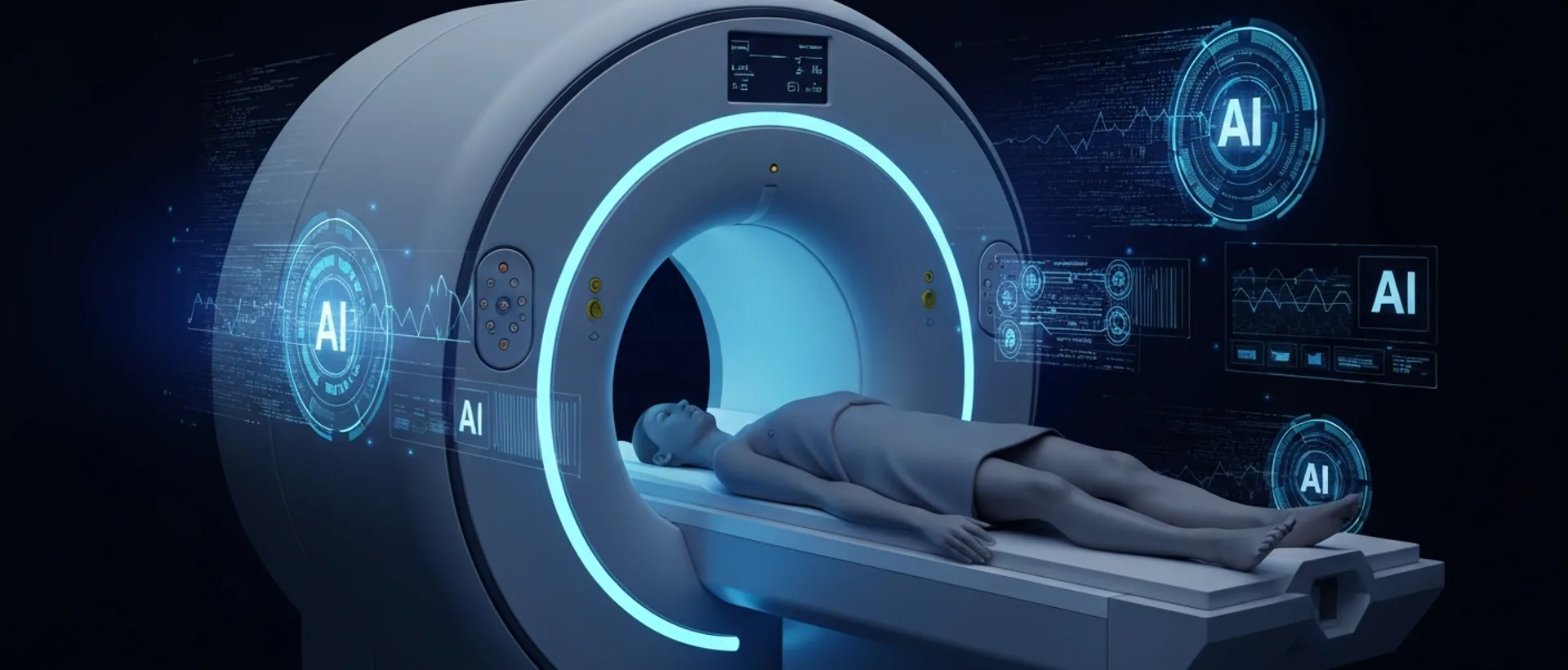
AI in MRI in 2026: Reality or Science Fiction?
Hey there, DavitAI folks! If you’re thinking that Artificial Intelligence in MRI in 2026 is like a sci-fi movie where robots diagnose everything by themselves, you can hold your horses. The truth is that AI is indeed out there, but full diagnostic autonomy, the kind that replaces the doctor, is still Hollywood talk. Deep down, we’re seeing AI more as a smart co-pilot than as a substitute for the human radiologist 1.
The benefits of AI in radiology are undeniable for optimizing workflow and for catching those more subtle patterns that, in the rush, we sometimes miss. In 2026, AI is transforming the diagnostic imaging sector in Brazil, promising faster exams, more precise images, and more assertive diagnoses 1. Grupo Fleury, for example, presented a study at the European Congress of Radiology (ECR 2026) that validated the use of AI to optimize MRI exams, improving image quality and, believe it or not, reducing exam times by 53% 2. That’s quite a number, right? But a “perfect diagnosis,” error-free, is nonsense that only those who don’t understand medicine or AI could sell. We are far, very far, from a scenario where AI gets it right 100% of the time, and excessive reliance can be a shot in the foot.
Exaggerated Benefits? The True Impact of AI in Medical Analysis
The narrative that AI will “revolutionize” healthcare ignores the intrinsic complexity of medicine. Honestly, it seems some people think AI is a magic wand. Yes, artificial intelligence in medical analysis speeds up triage, helps identify diseases in early stages, and that’s awesome. Researchers at Michigan Medicine, for example, developed an AI model capable of reading and diagnosing complete brain MRIs in seconds, with an accuracy of up to 97.5% 4. That’s cool! But solving the problem of doctor scarcity? That’s another story, my friend. AI doesn’t clone itself or work 24-hour shifts.
The so-called “diagnostic precision” of AI, which we hear so much about, is often a laboratory metric, from a controlled environment, that doesn’t directly translate to the messiness of the real world, where every patient is a universe and no two cases are ever alike. AI tools for radiologists are valuable, yes, for reducing exam reading time. Just think: more than 900 AI-powered medical devices and algorithms were approved by the FDA (USA) and over 200 by the EMA (Europe) in 2026, with radiology being the field of greatest clinical impact 5. This shows that things are moving, but contextual interpretation and clinical experience, the doctor’s intuition, continue to be the great human differential. Otherwise, you’d just press a button and be done with it.
The challenges of AI in healthcare include robust validation of models across different populations – because what works for one group doesn’t work for another, right? – and seamless integration into hospital systems, which, let’s be honest, are mostly legacy and resistant to change. It’s like trying to put a Ferrari engine in a ’70s Beetle. It’s hard work.
Silent Challenges: The B-Side of AI in Medical Imaging
While we celebrate the speed of AI, few stop to discuss the cost and complexity of maintaining and updating these systems. The future of AI in medicine in 2026 is not just about developing the next big tech, but about sustainability. Who pays the bill for servers, energy, and the specialists who will keep these algorithms running and learning? It’s not free.
Data security in healthcare AI is a gigantic Achilles’ heel. Leaks and misuse of sensitive information are real risks that far outweigh the convenience of a slightly faster diagnosis. Imagine the chaos if the medical data of millions of Brazilians fell into the wrong hands. It gives you chills. CFM Resolution No. 2.454/2026, published in February 2026, already regulates the use of AI in Brazilian medicine, making it clear that AI is a support tool and does not replace the doctor, who retains final responsibility 6. That’s a relief, right? Because we know that, in the end, the decision is always human. If you want to delve deeper into the implications of this resolution, check out our article on AI in Healthcare 2026: Diagnosis and Future Reality.
The role of AI in medical imaging today is more about support than sovereignty. Excessive reliance on algorithms can lead to a loss of critical diagnostic skills among professionals. If we let the machine do everything, eventually we’ll forget how to do it ourselves. It’s like using Waze to go to the corner bakery. The AI “black box,” where algorithms make decisions without transparency, is still an ethical and legal problem. How can we trust a diagnosis if we can’t understand its reasoning? It’s a question with no easy answer, and we cannot ignore it.
AI is a powerful tool, but not an oracle. Human expertise remains irreplaceable in the nuance of medical interpretation.
2026: AI in MRI, a Reversal of Expectation
Instead of a quantum leap, the kind you see in movies, AI in MRI in 2026 shows more incremental progress. The use cases for AI in MRI are more focused on workflow optimization, on making day-to-day work smoother, than on revolutionary diagnostic discoveries that change the game overnight. It’s progress, but without fireworks.
Disease detection by AI is enhanced in specific areas, such as oncology and neurology. For example, a new multiplexed MRI (MRx) technology, developed by researchers at the University of Illinois, allows simultaneous mapping of over 20 brain biomarkers at high resolution, without contrast 11. Furthermore, Midjourney Medical is developing an ultrasound-based device that promises to replace MRI, performing 3D body mapping in about 60 seconds, without contrast or radiation 12. This is quite an advancement, but zero error is a dangerous illusion that can lead to false assurances or, worse, missed diagnoses. There’s no way we can be 100% at ease leaving everything in the hands of an algorithm.
The true role of AI is to free up the radiologist to focus on the more complex cases, those thorny problems that only a trained eye and human experience can untangle. It’s not meant to replace them. Anyone selling the idea that AI “will solve all problems” is, at the very least, being naive or ill-intentioned. If you want to understand more about how technology can be a double-edged sword, I suggest reading AI Technology Impact 2026: Why You’re Wrong!.
The reality is that AI in radiology is a tool, and like any tool, its effectiveness depends on the skill of the user and the intelligence of its implementer. There are no shortcuts to an accurate diagnosis. We must use AI wisely, with our feet on the ground, and always with the human at the center of the decision. Because, in the end, someone’s life is at stake, and that’s no joke. To close, if you’re curious to know what else might be overestimated in the world of AI, check out AI and LLMs 2026: The Disappointment No One Sees.
Sources
- https://www.futuremed.com.br/blog/entenda-como-a-ia-esta-transformando-a-ressonancia-magnetica/ — Understand how AI is transforming magnetic resonance imaging ↩
- https://medicinasa.com.br/fleury-ia-ressonancia/ — Grupo Fleury and AI: optimizing MRI exams ↩
- https://www.nsctotal.com.br/noticias/inteligencia-artificial-transforma-diagnosticos-e-reduz-pela-metade-o-tempo-dos-exames — Artificial Intelligence transforms diagnoses and halves exam times ↩
- https://foiumaideia.com/ia-na-saude-como-o-diagnostico-instantaneo-esta-salvando-vidas-em-2026/ — AI in Healthcare: How instant diagnosis is saving lives in 2026 ↩
- What’s New — AI in medicine: artificial intelligence for diagnosis and treatment in 2026 ↩
- https://cbr.org.br/wp-content/uploads/2026/03/Normatizacao-do-Uso-da-Inteligencia-Artificial-na-Medicina.pdf — Regulation of the Use of Artificial Intelligence in Medicine ↩
- https://www.demarest.com.br/cfm-publica-resolucao-que-regulamenta-o-uso-de-inteligencia-artificial-na-medicina/ — CFM publishes resolution regulating the use of artificial intelligence in medicine ↩
- https://www.oncodata.com.br/primeira-regra-para-ia-na-medicina-brasileira/ — First rule for AI in Brazilian medicine ↩
- https://www.usebip.com/blogs/bip-insights/nova-resolucao-do-cfm-sobre-ia-na-medicina-2026-guia-pratico-para-medicos — New CFM resolution on AI in medicine (2026): practical guide for doctors ↩
- https://portal.cfm.org.br/noticias/cfm-normatiza-uso-da-ia-na-medicina/ — CFM regulates the use of AI in medicine ↩
- https://sciadvances.com.br/n/nova-tecnologia-ressonancia-magnetica-usa-ia-melhorar-imagens-cerebrais/ — New magnetic resonance technology uses AI to improve brain images ↩
- https://tmc.com.br/tecnologia/midjourney-aposta-em-ia-para-reinventar-os-exames-de-imagem/ — Midjourney bets on AI to reinvent imaging exams ↩
Ready to scale this idea?
Narratron turns topics like this into retention-optimized YouTube scripts in under 2 minutes — magnetic hook, structure, complete SEO, timestamped description and thumbnail prompt ready to ship. 50 free credits, no card required.