The Danger of AI in Music: Reviving Bands is an Artistic Crime
Hey there, DavitAI folks! Today we’re going to kick the door down and talk about a topic that’s buzzing in the tech and music scene in 2026: this whole Artificial Intelligence thing. To me, this idea of “reviving” bands with AI isn’t a celebration; it’s a profanation of original art. It’s like trying to resurrect a Jurassic Park dinosaur, but instead of a T-Rex, we get a generic band spitting out rehashed hits. Give me a break, seriously?
The obsession with how AI recreates old songs ignores the soul, the imperfection, and the historical context that made these works iconic. Think of Mamonas Assassinas, for example. Their charm wasn’t just the music; it was the irreverence, the chaotic energy, the way they fit into Brazil in the 90s. AI might be able to imitate the sound, but the charisma, the mischief, the soul… no algorithm can generate that, my friend. It’s a cold simulacrum, not a resurrection. And I’m not even talking about bands with a more serious legacy, like Queen. Imagine Freddie Mercury singing a “new” AI-generated hit? To me, it’s a disrespect to his talent and history.
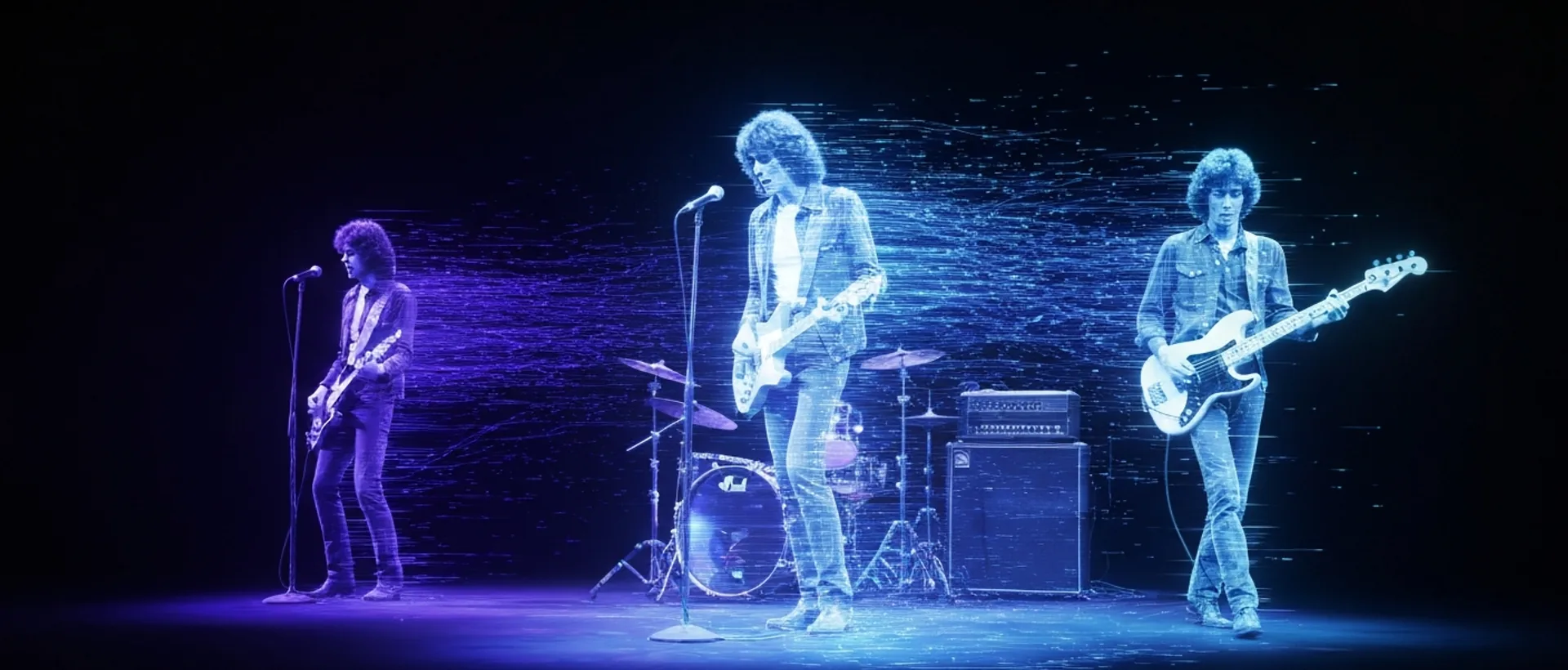
AI technology for music, when used to “resurrect” artists, transforms their legacy into an infinite consumer product, devaluing scarcity and genuine cultural impact. We’re already in an era where everything is disposable, and now they want to turn eternal art into an infinite commodity? For heaven’s sake! Classic bands with AI in 2026 will be nothing but digital ghosts, devoid of the passion and spontaneity that defined their live performances and original recordings. It’s like watching a hologram show: cool for about five minutes, then you realize something essential is missing. Life is missing.
AI Tools: Content Producers, Not Geniuses
While many wonder what the future of music with AI holds, the truth is that AI tools for music production are just that: tools. They optimize processes, yes, like Musicdibs, which assists in composition, mixing, and mastering 1. But creating genius? That’s another story entirely. The idea that it can generate a new “Beatles” is a dangerous illusion. AI can give you an “okay” melody or a “cool” beat, but the spark, the originality that makes us cry or dance, that comes from a human being.
The impact of AI on the music industry is more about efficiency and personalization than about creating new legends. We have tools like Suno and Udio, which are widely used to generate music with AI 3. Suno is praised for its ease of use for quick ideas, and Udio for its more refined audio quality 8. Alright, they’re great for those who want to explore or who need quick musical backgrounds. But do you really think the next “Girl from Ipanema” will come from a prompt? I highly doubt it.
Examples of AI-recreated songs often fail to capture the emotional nuance and artistic intent that only a human can infuse. It’s like asking a machine to paint the Mona Lisa. It can replicate every brushstroke, but where’s the mystery of the smile? Where’s the story behind it? We need to understand that, in 2026, AI is a superpower assistant, not the main artist.
While there are benefits of AI for older artists in terms of audio restoration or remixing, the attempt to “continue” their careers posthumously is an affront to their memory and body of work. And I’m not the only one who thinks so. Human authenticity is still an undeniable value for those who truly listen to music.
For those who want to venture into creation without losing the human touch, check out Discover: AI for Musicians 2026: Create and Boost Your Music. There, we discuss how to use AI to your advantage, without becoming its hostage. It’s about amplifying your voice, not silencing it.
The Digital Deluge and the Authorship Crisis
The meteoric rise of AI in music in 2026 is creating a minefield of ethical and creative dilemmas. The line between human art and algorithmic production becomes increasingly blurred. The problem is that we’re seeing a true digital deluge. In November 2025, Deezer was already receiving over 50,000 fully AI-generated tracks daily 4. This represents about a third of all new submissions on the platform! Imagine the sheer volume of that.
And it’s not just Deezer. In the same period, Spotify removed over 75 million tracks considered spam or low-quality in 12 months, and this included AI-generated content 4. That’s a lot! We’re talking about a market that could be flooded with a bunch of “music” that has neither soul nor quality. And worst of all: most listeners can’t even distinguish between human and algorithmic creation.
This proliferation of AI-generated music raises a serious question about the financial impact on artists. A UNESCO report estimates that music creators could see a global reduction of up to 24% in their earnings by 2028 due to the advancement of AI 2. Twenty-four percent! That’s no joke; it’s the livelihood of many people who live from art.
In Brazil, the Copyright Law (Law No. 9.610/98) defines the author as a “physical person” 5. This means that a work generated exclusively by AI, without human creative intervention, has no owner to be protected. So we enter a dilemma: who owns it? The programmer? The company that created the AI? Nobody? It’s a knot that needs to be untangled, and soon.
“AI can imitate the melody, but never the soul. True art lies in imperfection and human experience, not in algorithms.”
The discussion about “AI Technology Impact 2026: Why You’re Wrong!” ([/blog/ia/impacto-ia-tecnologia-2026]) gains a new dimension here. It’s not just about what AI can do, but what it should do and how it affects people’s real lives.
Regulation and the Fight for Transparency
Given this scenario of creative and financial chaos, the music industry isn’t standing still, you know? The main organizations in the sector announced the creation of an identification system to inform users when a song was created or used AI in the production process 6. Finally! This aims to increase transparency on streaming platforms, which is already a start. At least we’ll know if we’re listening to a flesh-and-blood artist or an algorithm.

In Brazil, things are heating up in Congress. Representatives from the music and cultural sectors sent a letter to the Special Commission on Artificial Intelligence of the Chamber of Deputies, advocating for the full preservation of copyright in Bill No. 2.338/2023 7. This mobilization is essential because, as we mentioned, current law does not support AI authorship 5. The idea is to ensure that human intervention in creation is valued and protected.
The recording industry is playing catch-up, but we know that legislation often moves at a snail’s pace compared to technology. It’s a complex debate, ranging from the protection of artists’ rights to fair remuneration. Nobody wants AI to become a vampire that sucks the creativity and money out of musicians.
The implementation of these labels for AI-generated music on streaming platforms is an initial step, but the effectiveness and long-term impact of these measures still need to be observed. Will the public care? Or will they continue to consume everything, regardless of its origin? We need more than just an “AI-made” stamp; we need a culture that values human creation.
And if you think LLMs are the solution to everything, maybe it’s time to rethink. We’ve already discussed this in AI and LLMs 2026: The Disappointment No One Sees. Technology is incredible, but it’s not magic, and it has its limits.
The True Future: AI as a Tool, Not a Creator
Instead of focusing on the farce of “reviving” bands, artificial intelligence for music should focus on assisting living artists, expanding their capabilities and not replacing their essence. Think of AI as a super producer, a maestro who gives you options, but the one who decides the path is you, the artist. It can be a shortcut for beginners, like Musicdibs, which I mentioned at the beginning, helping with composition, mixing, and mastering 1. Now that’s cool!
The future lies in using AI for trend analysis, intelligent mastering, or even as an innovative instrument, but always under the control and direction of a creative human being. Imagine AI giving you insights into which harmonies work best for your style, or mastering your track in seconds, leaving you free to focus on the true artistic part. That’s using the tool intelligently. It’s like having an autonomous car, but you still have the option to drive when you want to feel the road.
True innovation is not replicating the past, but allowing new voices and sounds to emerge, using AI as a catalyst for originality, not as a substitute. We don’t need another digital Elvis Presley; we need the next Chico Buarque, the next Marisa Monte, the next Racionais MC’s, using AI to expand their horizons, not to copy what has already been done.
The acceptance of finitude and the valuing of human art, with all its idiosyncrasies and imperfections, is what truly defines the value of music. AI should be an echo, not the main voice. To me, music has always been about connection, emotion, history. And that, my friend, only we, with all our flaws and qualities, can truly deliver. May AI help us create, but never steal our joy of being the source of creation.
Sources
- https://www.musicdibs.com/news/el-futuro-es-ahora-tendencias-industria-musical-ia-pt — The future is now: AI music industry trends, June 25, 2026 ↩
- https://fenati.org.br/industria-musical-pode-perder-24-da-receita-com-avanco-da-ia/ — Music industry could lose 24% of revenue with AI advancement ↩
- https://www.iamusica.com.br/seo/ia-musica-2026-para-criar-suas-melodias — AI in Music 2026: To Create Your Melodies ↩
- https://francesnews.com.br/post/2026/04/26/20018-ia-invade-o-mundo-da-musica-e-ameaca-o-futuro-dos-artistas-nas-plataformas-de-streaming — AI invades the music world and threatens the future of artists on streaming platforms, April 26, 2026 ↩
- https://blog.ruysam.adv.br/musica-feita-por-ia-direito-autoral/ — AI-made music: understand copyright law ↩
- https://sol.iol.pt/tecnologia/noticias/musicas-criadas-com-inteligencia-artificial-vao-passar-a-ter-identificacao-nos-servicos-de-streaming/20260710/6a51274a0cf2b42132dba0ab — Songs created with Artificial Intelligence will now have identification on streaming services, July 10, 2026 ↩
- https://rollingstone.com.br/musica/pl-da-inteligencia-artificial-setor-cultural-exige-protecao-a-direitos-autorais/ — AI Bill: Cultural sector demands copyright protection, May 19, 2026 ↩
- https://eco.sapo.pt/2026/07/10/industria-discografica-cria-rotulo-sobre-uso-de-ia-nas-musicas-em-streaming/ — Recording industry creates label on AI use in streaming music, July 10, 2026 ↩
Read next
- Impacto IA Tecnologia 2026: Por Que Você Está Errado!
- IA no Esporte 2026: A Falácia da Perfeição Tecnológica
Ready to scale this idea?
Narratron turns topics like this into retention-optimized YouTube scripts in under 2 minutes — magnetic hook, structure, complete SEO, timestamped description and thumbnail prompt ready to ship. 50 free credits, no card required.