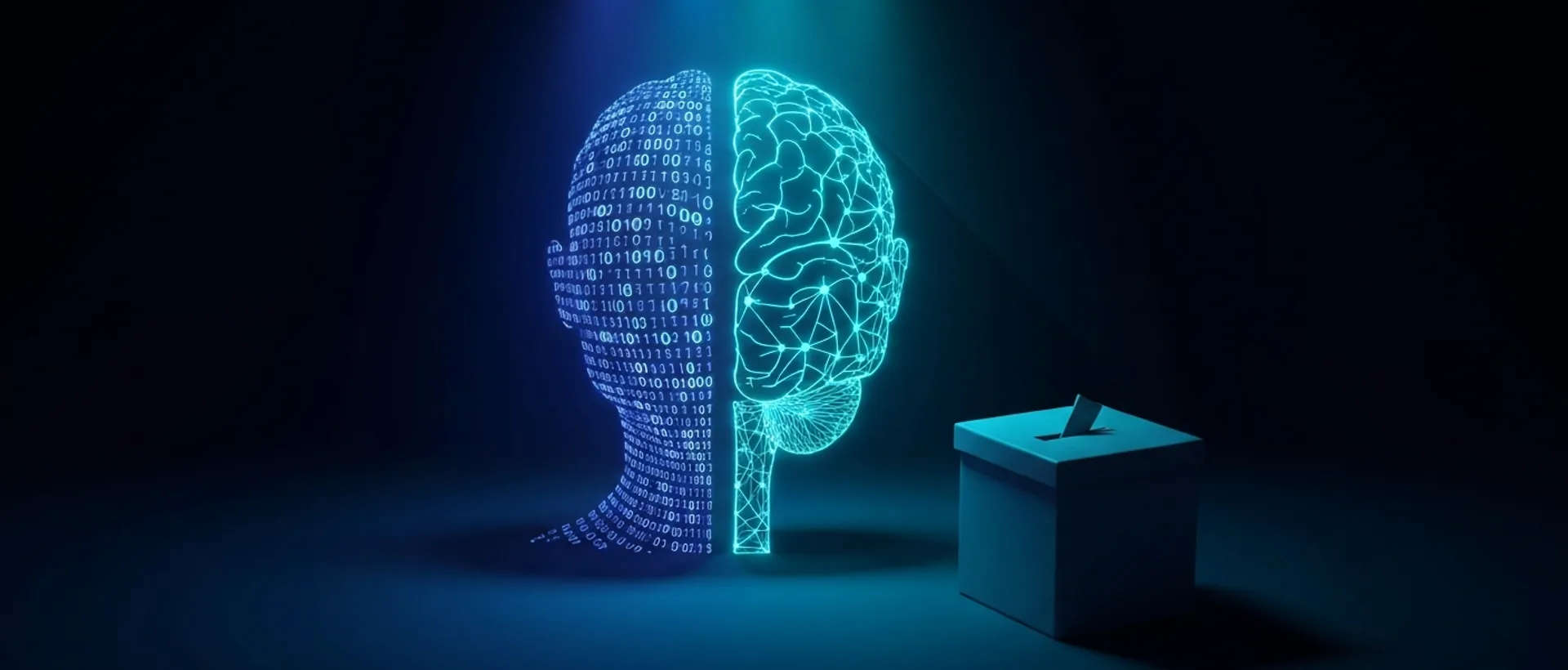
Political Bias in AI Is Inevitable (and You Think It Isn’t)
Folks, let’s be honest here: if you still believe that artificial intelligence is a neutral, impartial creature, a kind of digital robed judge who only spits out facts, I’m sorry to inform you, but you’re more out of touch than a winter coat on a hot day. This belief is a dangerous fallacy that, honestly, is going to blind us beautifully to the heavy manipulation coming our way in the 2026 elections. AI doesn’t “learn” in the human sense of the word; it “imitates” the prejudices we feed into it, and what’s worse: it amplifies all of it 1.
AI models, trained with mountains of data that come from our real world – a world full of often biased stories, texts, and opinions – end up reproducing patterns of political polarization. It’s like giving a megaphone to a parrot that’s only heard one side of the conversation. The result? A subtle, but constant, influence on public perception and, of course, on electoral decisions 2. It’s too naive to think that “mitigating bias in AI” is just pressing a button and it’s done. No, buddy. This is a problem that resides in the very DNA of the thing; it’s not some easy-to-fix little bug 3. The companies driving this have their own interests, and neutrality, let’s be real, isn’t at the top of their list.
Generative AI, the kind that creates text and images from scratch, and political disinformation are not a problem of the distant future. They are a reality that is already shaping narratives now, at this very moment. It creates convincing “news,” videos that look real, and undermines trust in traditional media. It’s the privatization of the ability to create political reality, as a June 2026 study rightly pointed out 9. The Superior Electoral Court (TSE) even approved new rules for the 2026 elections, prohibiting the circulation of AI-generated content in the 72 hours before the election and in the 24 hours after, in addition to barring AI systems from recommending candidates 6. But, between you and me, is it enough? I doubt it.
Algorithms: More Tools of Control Than Connection
You know that story about AI connecting you with what you like most? Nonsense. This “algorithmic personalization” is, in reality, a giant ideological echo chamber. It traps you in your bubble, radicalizes opinions, and deepens social divisions. Genuine political dialogue, that face-to-face kind, becomes a utopia. It’s the algorithm saying: “You’ll only see what I want you to see, and you’ll like it!”
Cases of political bias in AI are already popping up everywhere, from news recommendation systems that always lean towards one side of the political spectrum to chatbots that, unintentionally yet inevitably, end up reproducing hate speech. And mind you, this isn’t an accident along the way, no. It’s the reflection of the mirror that AI offers us, with all our imperfections and prejudices 4. Ethics in political AI? Oh, that’s beautiful on paper, a poem. But in practice, the race for profit and political influence overrides any moral concern, especially when AI companies and political positioning mix.
The 2026 elections, mark my words, will be a testing ground for AI manipulation tactics. The line between a legitimate campaign and misleading propaganda will become so thin that we won’t even know what’s what anymore. Politicians are already expanding the use of AI, and this is already generating concern 8. The TSE is trying to catch up, discussing rules and maintaining the prohibition of deepfakes, demanding transparency in the use of AI 8. But we know that oversight is quite a challenge.
“Restricted AIs, not general AI, are the real concern for democracy. General AI is a smokescreen.”
This quote from Andreas Jungherr, from January 14, 2026 7, is a slap in the face. He says that general AI is a “smokescreen,” and that the danger lies in restricted AIs. I agree wholeheartedly. It’s not the robot that will take over the world that scares us, it’s the algorithm that decides what we see in our feed.
The Dark Future of Digital Democracy in 2026
Let’s be brutally honest: the regulation of AI and biases, in Brazil and worldwide, is a joke in progress. Our legislators, with all due respect, barely understand how the internet works, let alone the complex and treacherous mechanisms of algorithmic bias. We are in a race against time, and AI, as usual, is winning by a landslide. Brazil, for example, is drawing inspiration from the European AI Act to create its general AI law, based on risks 10. Bill No. 2,338/2023 is in its final phase, but we know that bureaucracy here is slower than a turtle uphill.
“Artificial intelligence and politics” is an arranged marriage where AI dictates the rules, and politics, poor thing, adapts as best it can, losing its democratic essence in the name of a certain “efficiency” and, of course, control. If you want to understand more deeply how this efficiency can be a trap, take a look at this discussion about AI and Productivity 2026: The Inconvenient Truth. AI’s ability to create deepfakes and mass false narratives will make fact-checking a museum piece. The truth will drown in a sea of disinformation so convincing that we won’t even know where to turn. In April 2026, a survey by Agência Brasil already warned that AI accelerates disinformation and threatens democracies, with a staggering number: 81.2% of disinformation cases involving AI emerged in the last two years 11.
The European Union and parliamentarians even reached a provisional agreement on AI rules in May 2026, but there have already been some criticisms due to the flexibilization of some provisions, which could open a loophole for large technology companies 12. This is the difficulty of balancing innovation with democratic protection. It’s a challenge that seems like an endless tug-of-war. And if we don’t pay attention, the algorithm may have already decided the 2026 election before we even go to the polls 13.
Wake Up: There’s No Easy Solution for AI Bias
The idea that we can simply “train” AI to be impartial is a bad joke. This ignores the human nature from which it is fed. Our prejudices, our opinions, our mistakes… all of these are the data, and AI is just the megaphone, amplifying what already exists. That’s why discussing AI Technology Impact 2026: Why You’re Wrong! is so important. It’s not just about technology, it’s about us.
The question “what is AI’s impact on democracy” is no longer a matter of if it will impact, but of how deeply it will erode our democratic pillars. Elections can turn into mere spectacles of algorithmic manipulation, where the perception of reality is more controlled by algorithms than by facts 14. It’s a scenario of personalized “political realities” for each voter, reinforcing prejudices and isolating people in digital bubbles.
The true defense against AI’s political bias is not in more technology, in more complex algorithms, or in miraculous filters. The way out, my dear friends, lies in a more critical, more digitally educated, and, above all, more skeptical society. Something that, ironically, AI itself works incessantly to undermine. We need to discuss more about Open AI 2026: The Challenges of Digital Sovereignty and how we can have more control over these tools. If we don’t wake up to this, AI will continue playing its game, and we’ll just be the audience. And a very manipulated audience, at that.
Sources
- https://brevenlaw.com/vies-politico-na-inteligencia-artificial/ — Political Bias in Artificial Intelligence ↩
- https://www.datacamp.com/pt-br/blog/understanding-and-mitigating-bias-in-large-language-models-llms — Understanding and Mitigating Bias in Large Language Models (LLMs) ↩
- https://mailchimp.com/pt-br/resources/bias-in-machine-learning/ — Bias in Machine Learning ↩
- https://redem.tec.br/alem-das-deepfakes-como-a-ia-realmente-ameaca-e-desafia-as-democracias/ — Beyond Deepfakes: How AI Really Threatens and Challenges Democracies ↩
- https://www.tse.jus.br/comunicacao/noticias/2026/Abril/por-dentro-das-eleicoes-conheca-as-regras-sobre-uso-de-ia-na-campanha-eleitoral-de-2026 — Inside the Elections: Learn About the Rules for AI Use in the 2026 Electoral Campaign ↩
- https://g1.globo.com/politica/eleicoes/2026/noticia/2026/03/03/eleicoes-2026-regras-barram-ia-tres-dias-antes-da-votacao-e-proibem-plataformas-de-sugerir-candidatos.ghtml — 2026 Elections: Rules Bar AI Three Days Before Voting and Prohibit Platforms from Suggesting Candidates ↩
- https://www.gazetadopovo.com.br/opiniao/artigos/eleicoes-2026-inteligencia-artificial-democracia/ — 2026 Elections: Artificial Intelligence and Democracy ↩
- https://www1.folha.uol.com.br/poder/2026/01/politicos-ampliam-uso-de-ia-e-geram-preocupacao-enquanto-tse-discute-regras-para-2026.shtml — Politicians Expand AI Use and Generate Concern While TSE Discusses Rules for 2026 ↩
- https://www12.senado.leg.br/radio/1/noticia/2026/06/24/pesquisa-aponta-preocupacao-com-uso-da-inteligencia-artificial-nas-eleicoes — Research Points to Concern About the Use of Artificial Intelligence in Elections ↩
- https://www.congressoemfoco.com.br/artigo/116794/o-brasil-escolhe-como-regular-a-ia-e-define-limites-ao-poder — Brazil Chooses How to Regulate AI and Defines Limits to Power ↩
- https://agenciabrasil.ebc.com.br/geral/noticia/2026-04/ia-acelera-desinformacao-e-ameaca-democracias-alerta-pesquisa — AI Accelerates Disinformation and Threatens Democracies, Research Warns ↩
- cnnbrasil.com.br — EU and parliamentarians reach provisional agreement on AI rules ↩
- https://www.brasil247.com/blog/o-algoritmo-ja-decidiu-a-eleicao-de-2026-z3jmbg2t — The Algorithm Has Already Decided the 2026 Election ↩
- https://apublica.org/2026/01/inteligencia-artificial-e-desinformacao-nas-eleicoes-de-2026/ — Artificial Intelligence and Disinformation in the 2026 Elections ↩
Ready to scale this idea?
Narratron turns topics like this into retention-optimized YouTube scripts in under 2 minutes — magnetic hook, structure, complete SEO, timestamped description and thumbnail prompt ready to ship. 50 free credits, no card required.