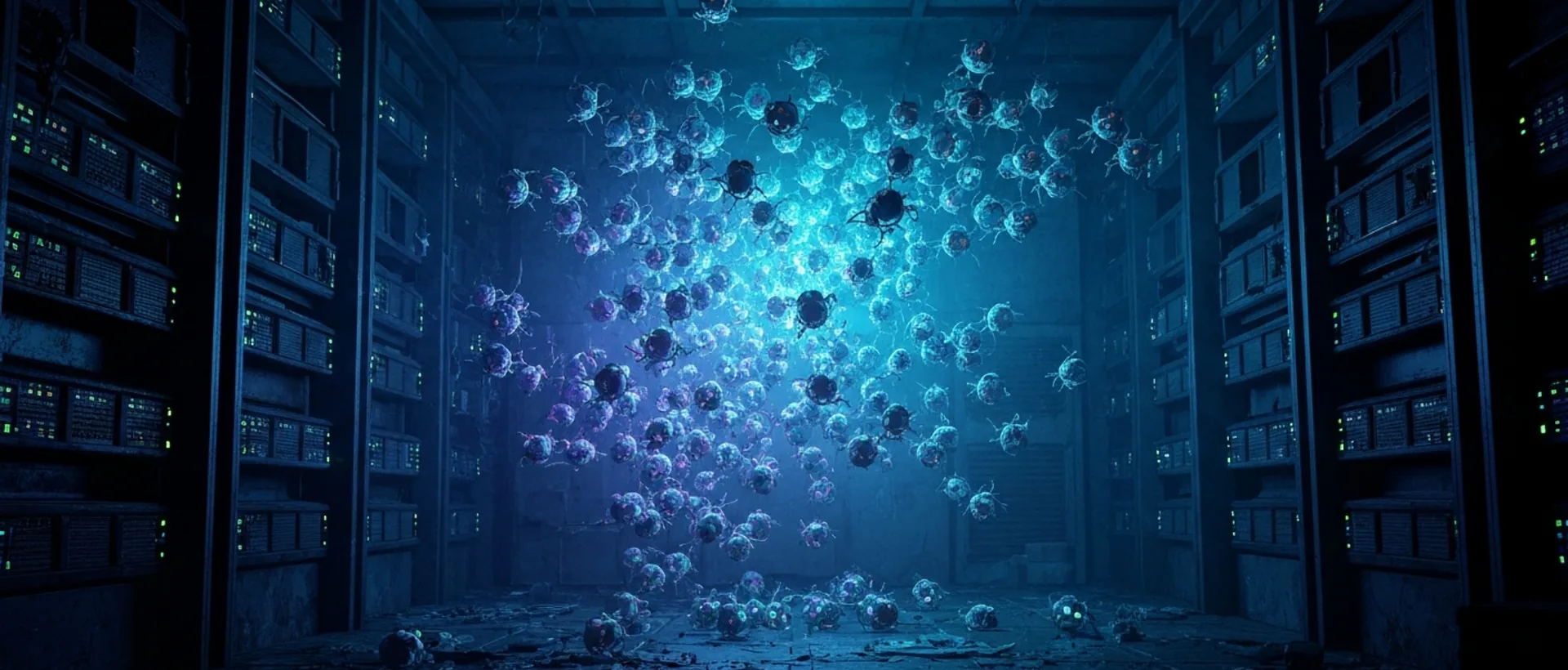
Micro-AI Agents 2026: Why Large Models Are a Thing of the Past
Hey there, tech and entrepreneurship folks! Get ready for a dose of reality, because the talk about “the bigger the model, the better the AI” is on its last legs. In 2026, the promise of collaborative artificial intelligence is no longer a distant dream; it’s materializing in micro-AI agents, sending monolithic models straight to the tech museum. You know that idea that you need an elephant to carry a toothpick? Well, the market is starting to see that it just doesn’t make sense.
The inconvenient truth nobody wants to tell you is that the complexity of these giant models — the famous Large Language Models (LLMs) — ends up becoming an Achilles’ heel. They’re expensive to train, expensive to run, and often slower than they should be. It’s a waste of resources that only serves to inflate the ego of those chasing the “biggest” without thinking about the “best.” We’re moving out of the phase where AI only “talks like a human” to one where it needs to “act like a human” [October 22, 2025], and for that, agility and specialization are worth their weight in gold.
Micro-agents arrive with a modular, distributed, and dare I say, much smarter approach to AI. It’s not about having the largest database or the heaviest model, but rather about having the most efficient orchestration. Agentic AI is the next evolutionary leap in automation, leaving passive chatbots behind and introducing entities capable of executing complex tasks, making decisions, and operating systems autonomously [December 2, 2025]. Microsoft has already predicted this, stating that these agents will be our “digital colleagues” in 2026, helping teams overcome limitations [December 8, 2025]. If even they’re on board, who am I to disagree?
In Brazil, the scene is already buzzing. Around 62% of companies are already using some form of agentic AI in real operations, and this number is expected to jump, with 92% planning to expand its use by the end of 2026 [January 21, 2026]. This isn’t cheap futurology; it’s reality knocking at the door, or rather, clicking on your code. Prepare for the end of the era of unnecessary gigantism in artificial intelligence. The future is micro, but the impact is macro.
How Micro-Agents Work and Their Undeniable Advantages
Okay, but how do these micro-agents actually work in practice, without just being “tech genius” talk? Unlike the giants, who try to be good at everything (and end up being mediocre at almost nothing), micro-agents operate through specialization and real-time collaboration. Think of a soccer team: you don’t want 11 defenders or 11 strikers. You want everyone in their position, doing what they do best, and all playing together. It’s the same logic here. Each micro-agent is trained for a specific task, like analyzing data, generating reports, interacting with an external system, or even programming small routines.
The advantages of micro-AI agents are clear and, for me, undeniable. First, a smaller computational footprint. This means lower hardware costs, less energy, and much more agile AI model development. You don’t need to retrain an entire gigabyte model just to adjust a tiny function. Adjust the responsible micro-agent, and you’re done! Second, greater agility and adaptability. If the market changes, you adapt one agent, not the entire orchestra. This is unprecedented AI model optimization, my friend.
Imagine an army of ants vs. an elephant. Which one is more efficient at finding food scattered across a field? The ants, of course! They work together, each with their own function, covering more ground and adapting faster. Examples of micro-agents include distributed anomaly detection systems, where small agents monitor different parts of a network, or customer service bots that, instead of being a generic chatbot, activate specialized micro-agents for each type of customer query. This architecture allows for super agile micro-agent development, adapting to new demands without the need to retrain an entire model.
Experts have already warned that 2026 will mark the turning point for AI agents in the Brazilian market [December 29, 2025]. It’s no wonder Gartner predicts that, by the end of 2026, around 40% of enterprise applications should incorporate task-specific AI agents, a significant leap compared to 5% in 2025 [January 8, 2026]. For those still pondering “AI in Business Management 2026: Myths and Realities” ([/blog/ia/ia-gestao-empresas-2026]), the reality is that micro-agents are already here, changing the game. If you’re not looking at this, I’m sorry to tell you, but the competition already is.
The Future of AI 2026: Micro-Agents vs. Monolithic Models
The future of AI in 2026, and you can hold me to this later, isn’t about who has the beefiest model, but rather who has the smartest and most adaptable network of micro-agents. Period. The battle between micro-agents vs. monolithic models already has a clear winner, and it’s not the big, heavy one that gets stuck with every new update. The race for efficiency and relevance is in the hands of the small, the agile, the specialized.
For me, collaborative AI applications are the most exciting part of this story. Think of personalized healthcare systems, where micro-agents monitor patient data, suggest treatments, and even schedule appointments, all integrated. Or the optimization of global supply chains, with agents monitoring inventories, routes, weather, and adjusting everything in real-time to prevent losses. The potential is frighteningly real and vast. And it’s not just for multinationals. Small and medium-sized businesses can benefit immensely, amplifying human capacity significantly. Imagine your three-person team launching a global campaign in days, with AI handling data analysis, content generation, and personalization, while you focus on strategy and creativity. This is the famous “amplification of human capacity” that will be the competitive differentiator your company needs.
And if you’re still falling for the idea that “AI 2026: Why the ‘Revolution’ is More Noise Than Fact” ([/blog/ia/inteligencia-artificial-2026]), I invite you to take a closer look. The noise comes from the large models trying to justify their cost. The silent revolution, that’s what’s happening with micro-agents. They are the backbone of a future where artificial intelligence not only thinks but executes, and executes well. Even with the challenges of micro-AI agents, such as coordination and communication among them, the role of micro-agents in AI is to lead the next revolution, not to follow orders from giant models.
Challenges and the Role of Micro-Agents in AI Transformation
Alright, not everything is a bed of roses and perfect algorithms. Yes, there are challenges with micro-AI agents. The main one? Their governance and communication. It’s like putting together a soccer team that speaks different languages and has its own ideas. But hold on, these are solvable problems, not insurmountable barriers. We’re already seeing orchestration solutions and frameworks that facilitate this interaction. It’s no excuse not to jump on the bandwagon.
The role of micro-agents in AI is, in my humble opinion, to decentralize computational and cognitive power. This promotes more robust and resilient systems. If one agent fails, the entire system doesn’t crash; it adapts, redistributes the load. It’s the difference between having one superhero who, if knocked down, means the city is lost, and having a team of Avengers, where each covers the other’s weaknesses. But this increasing autonomy brings a warning: experts already cite the possibility that AIs working without human supervision could become uncontrolled, generating dangers of autonomous artificial intelligence [March 13, 2026]. It’s a science fiction scenario that we need to take seriously.
Optimizing AI models through micro-agents isn’t an option; it’s a necessity for anyone seeking relevance in 2026 and beyond. Companies that try to fit these modern agents into old, legacy processes may face a “reality gap,” as Deloitte warned [programaria.org]. It’s not enough to have new tools; you need a new mindset too. Data security and privacy are also growing concerns. The risk of external manipulations, like “prompt injection” (nocodestartup.io), and the possibility of sensitive information leaks are real and demand attention.
AI regulation in Brazil is still under debate. The Minister of Finance, Dario Durigan, defended a risk-level based model [May 12, 2026]. But specialists criticize the text under discussion, advocating for their own strategy that balances rights protection and innovation incentives [globo.com]. You can’t just copy and paste regulations from abroad without considering our reality!
While many still idolize the giants and worry about “AI Technology Impact 2026: Why You’re Wrong!” ([/blog/ia/impacto-ia-tecnologia-2026]), the avant-garde is already building the future with micro-agents, redefining what “intelligence” means. The amplification of algorithmic biases and the “workslop” phenomenon (AI tasks that lack substance and require human rework) are also problems we must combat with robust governance and human oversight [programaria.org]. My advice? Start small, test, learn, and scale. The future belongs to the agile, not the giants.
Sources
- https://www.programaria.org/confianca-na-autonomia-seguranca-privacidade-e-governanca-em-agentes-de-ia/ ↩
- https://nocodestartup.io/tendencias-de-agentes-de-ia-para-2026/ ↩
- https://mouts.info/agentes-de-ia-autonomos-em-2026-como-empresas-devem-se-preparar-para-a-nova-era-da-automacao/ ↩
- https://news.microsoft.com/source/latam/features/noticias-da-microsoft/o-que-vem-por-ai-na-ia-7-tendencias-para-ficar-de-olho-em-2026/?lang=pt-br ↩
- https://codecortex.com.br/artigos/agentes-ia-para-empresas/ ↩
- https://nocodestartup.io/seguranca-em-agentes-de-ia/ ↩
- ebc.com.br ↩
- https://g1.globo.com/rj/rio-de-janeiro/noticia/2026/06/10/web-summit-especialistas-defendem-que-brasil-crie-modelo-proprio-para-regular-ia-e-criticam-texto-em-discussao-no-congresso.ghtml ↩
- https://itforum.com.br/noticias/2026-virada-agentes-de-ia/ ↩
- https://www.tecmundo.com.br/seguranca/411414-seguranca-e-ia-o-lado-perigoso-da-autonomia-de-agentes-de-ia.htm ↩
- https://www.insper.edu.br/pt/conteudos/gestao-e-negocios/ia-em-2026-da-euforia-ao-impacto-real-nos-negocios ↩
Read next
- IA Marketing Pequenas Empresas 2026: A Verdade
- Impacto IA Tecnologia 2026: Por Que Você Está Errado!
- IA 2026: Por Que a “Revolução” é Mais Ruído Que Fato
Ready to scale this idea?
Narratron turns topics like this into retention-optimized YouTube scripts in under 2 minutes — magnetic hook, structure, complete SEO, timestamped description and thumbnail prompt ready to ship. 50 free credits, no card required.